I run a club in a converted warehouse on the south side of Milwaukee, and there are six tables on that floor. I have leveled every one of them, replaced four folding mechanisms, and scrapped two tables that warped badly enough that the ball broke sideways off the bounce. So when a parent emails me asking what to buy for a basement, I do not start with brand names. I start with the bounce. This indoor ping pong table comparison covers the two JOOLA tables I get asked about most, plus the net set and the paddle bundle that decide whether either table is playable on day one.
I have not run my nine-point drop test on these two tables at home, and I am not going to pretend otherwise. What I can tell you is what the build descriptions promise, what my club's tables have taught me about those promises, and where each option actually fits.
Related: Table Thickness and Bounce: What Actually Matters
Short answer: if the table stays in one room and gets played hard, the JOOLA Rally TL is the one to buy. If it has to fold into a corner between sessions, the 15mm JOOLA indoor table is the honest choice. In both cases, plan on replacing the accessories eventually, and buy the Avanti net when the stock one starts to sag.
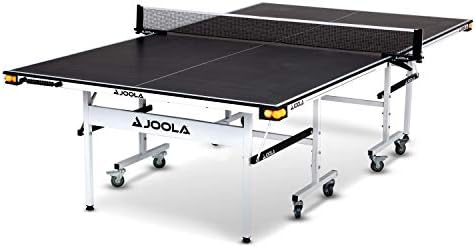
JOOLA Rally TL Professional MDF Indoor Ping Pong Table
The heavier build of the pair, playback mode for solo drills, corner ball holders, and a quick clamp net in the box
It is a commitment: it wants a permanent wall and two people to move it
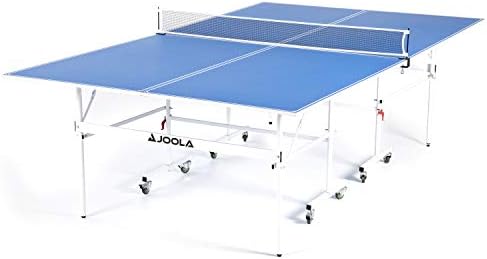
JOOLA Indoor 15mm Ping Pong Table with Quick Clamp Net Set
Folds away, regulation size, single player playback, and a net included
15mm is a garage compromise, not a club table, and the core construction is the open question
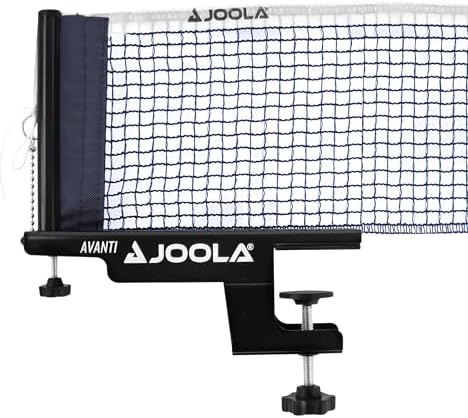
JOOLA Premium Avanti Table Tennis Net and Post Set
Screw on clamp that actually holds tension, packs flat, fits any regulation table
It is a replacement part, not something you need on day one if the stock net is fine

STIGA Ping Pong Paddles, 2mm Tournament-Approved Sponge
Flared handle and 2mm sponge, available in several performance levels for family play
A family set is still a family set, and I do not review paddles, so treat it as a starting point
Prices and availability were captured from Amazon Creators API and may change.
What each table is actually promising
The Rally TL is the one making the bigger claims. JOOLA calls it professional MDF and tournament quality, with ten minute assembly, corner ball holders, playback mode, and a quick clamp net and post set in the box. That last part matters more than the marketing language, because it means you can play the day it arrives instead of waiting on a separate order.
The 15mm table promises less and says more. It puts its top thickness right in the name, which I respect, and it lists regulation size, single player playback, compact storage, and a quick clamp net set. It is the folding table of the pair, and it does not pretend otherwise.
Notice what neither listing tells you: bounce consistency. That is the spec that decides whether a table is worth owning, and it is the one nobody prints on the box.
Bounce test first, spec sheet second
I drop a ball from 30cm at nine points on a table, three along each end and three down the middle, and I watch how high it comes back. A table that returns the ball within a centimeter or two across all nine points is a table you can practice on. A table that returns it lively in the middle and dead in the corners is a table that will teach your kid to compensate for the table instead of the opponent. That is exactly how bad habits start, and it is why I care more about the nine point pattern than about any badge on the apron.
Thickness is the number everyone argues about, and it is the least useful one on its own. An 18mm or 19mm top is the club standard for a reason, and I would take a solid 15mm core over a hollow 18mm every single time. The 15mm JOOLA is honest about being a home table. The Rally TL does not publish its thickness in the product name, so either ask before you buy or accept that you are buying the build and the features rather than a number.
The other thing a thickness number does not tell you is what happens after two winters in a garage. A table in a damp, unheated space will move. The apron and the frame are what keep it from moving, and that is where cheap tables fail quietly, long after the return window closes.
The JOOLA Rally TL, for a table that never moves
If you have a basement wall that belongs to the table, this is the one. Playback mode means one half folds up so you can drill serves alone, which is the single most underrated feature on any home table. Corner ball holders sound like a gimmick until you are the one crawling under the furnace chasing balls between rallies.
The trade-off is weight and footprint. Tables in this class are heavy, heavy tables are a two person job to move, and a table you cannot move is a table you have to plan a room around. Measure the room, decide the wall, then assemble. Do not assemble first and negotiate later, which is a mistake I have watched three families make in a single season.
The 15mm JOOLA, for the table that has to disappear
This is the table I recommend to families who need the room back. It folds, it stores compact, it plays regulation size, and it has playback mode for solo practice. For a garage or a spare bedroom, 15mm with a solid core is genuinely fine. I have played on worse at clubs that should have known better, and I mean that as a criticism of the clubs.
Where it loses is the same place every folding table loses: the mechanism. Folding hardware is where tables die. Check the locks, check that they do not pinch fingers, and check that the table sits flat when it is open. If it rocks on your floor, adjust the feet before you blame the table. Garage slabs are never level, and legs that will not adjust are a table that will never play right no matter how good the top is.
The net is not a footnote
Both tables ship with a quick clamp net, and both of those nets will eventually sag, because every net does. The JOOLA Premium Avanti is the replacement I keep in the club's parts bin. It screws onto the table edge, it holds tension, and it packs flat enough to live in a gear bag. Screw on clamps beat spring clamps for one reason: you can actually tighten them. A net hanging loose turns every rally into a guessing game about whether the ball clipped the tape.
If you are buying a table secondhand and the net is missing or stretched out, this is the first thing to order. If your stock net is still holding tension, you do not need it yet. That is the whole honest review, and it is shorter than most.
Paddles, and where I stop talking
I do not review paddles. I send people to coaches and to specialists, because rubber selection is personal and I have watched too many beginners buy spin heavy setups they cannot control. What I will say about the STIGA set is narrow: it is a 2mm sponge paddle with a flared handle, it comes in several performance levels, and for family play around a brand new table it is a reasonable starting point.
If a junior in your house starts training seriously, that becomes a different conversation. Buy one decent paddle on a coach's recommendation rather than a four pack, and let the family set become the guest set. That is what happens in my club anyway, and the guest set gets plenty of use.
Where each one lets you down
Every table has a failure point, and it is worth knowing which one you are signing up for before the boxes arrive. The Rally TL's weakness is weight: you will assemble it once and then resent moving it for the next five years. The 15mm table's weakness is the folding hardware, because that is where every folding table eventually gives out. The Avanti net's weakness is not much of anything, which is why it is the one accessory here I would buy without hesitating. The paddle set's weakness is the same as every bundled paddle: it is a starting point, not a destination.
What I would do with my own money
Permanent space, hard daily use, a kid who practices: the Rally TL, a net replacement when the stock one goes soft, and one good paddle later.
Shared room, tight space, weekend play: the 15mm table, and I would put the difference into a spare net and a level.
Neither of these is a club table, and I want to be clear about that. A club table lives on a concrete floor under controlled humidity and takes six hours a day. A home table lives in a basement with a furnace and a dog. Buy for the room you actually have, not the room you wish you had.
What I am watching next
The 19mm solid core table keeps getting cheaper as the mid tier brands eat the tournament brands' lunch, and that is good news for anyone shopping in the next year. Watch the folding mechanism patents, because that is where the next round of failures and fixes will come from. Watch the outdoor segment too, which is growing faster than indoor as people rebuild patios, though I still will not review an outdoor table. Different material science, different failure modes, and a different set of bad habits.
My dated list says the home table market gets a little more honest every year. Ask for bounce consistency, ask about core construction, and stop paying for the word tournament. That is the whole guide, and it is the same advice I give on the phone to parents every September.