I run a community table tennis club in a converted warehouse in Milwaukee: six tables on a concrete floor, a repair bench in the corner, and a folding mechanism I have taken apart more times than I want to count. I played competitively in the Czech Republic as a teenager, on tables older than I was, and I have been setting up, leveling, and fixing them ever since. This indoor ping pong table comparison is the conversation I have with parents at the club door every Saturday, minus the coffee.
The short answer: for a basement or garage where people actually want to learn the game, a full-size indoor table is the only purchase that makes sense, and in this group that means one of the two JOOLA Rally TL listings. If you have no room for a full-size table and you want something for the kids on a rainy afternoon, the GoSports mid-size set is honest about what it is. The Killerspin racket is a different purchase entirely, and I do not review paddles.
That is the summary. The reasoning is below, and it is mostly about category, because category is where people get this wrong.
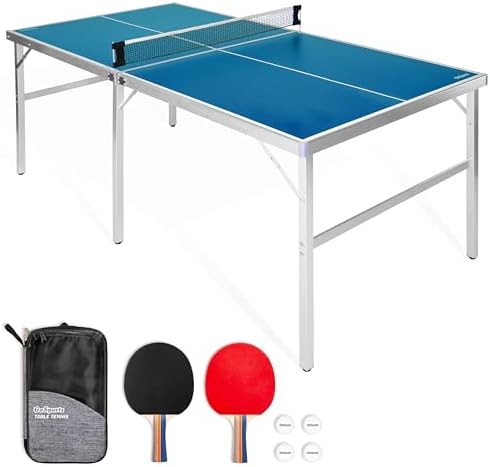
GoSports Mid-Size Table Tennis Game Set
Everything you need in one box, stores in a closet, fine for kids and small rooms
It is not a regulation surface, so strokes and ball travel are different from the real game

Killerspin Jet 600 Spin N2 Ping Pong Racket
Five-layer wood blade, Nitrx-4Z rubbers, flared handle, built for players past the beginner stage
It is a racket, not a table, and buying it does not solve a table problem
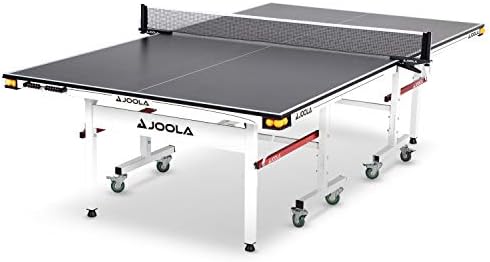
JOOLA Rally TL Professional MDF Indoor Ping Pong Table
Full-size indoor table with clamp net, corner ball holders, and playback mode for solo practice
The product name is identical to the other JOOLA listing here, so the name tells you nothing about which one you are buying
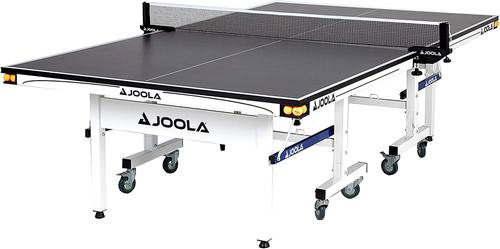
JOOLA Rally TL Professional MDF Indoor Ping Pong Table
Same table, same feature list, and the second page to open when you compare the two
Same problem in reverse: identical name, so any difference in what you pay has to be explained somewhere else on the page
Prices and availability were captured from Amazon Creators API and may change.
What these four products actually are
Three categories, four listings, and only one of them is really a decision between near-equals.
The two JOOLA Rally TL entries are full-size indoor tables. The GoSports set is a portable mid-size game. The Killerspin is a racket. If you read those three sentences and already know which category you are shopping in, you can skip the rest of this section, but most people who email me cannot, because the listings all live under the same search and the photos all look like ping pong.
The mistake I see most often is a family buying the portable set for a kid who has started playing seriously at a club or a school program, then wondering why the kid's game stalls at home. The second most common mistake is the opposite: buying a full-size table for an apartment where the only open floor is between the couch and the television.
Why I start with bounce, not with brand
Every table that comes through my club gets the same treatment before it earns floor space. I drop a ball from 30 cm at nine points across the surface, corners and center included, and I watch two things: whether the ball returns to a consistent height at all nine points, and whether the center sounds hollow when it lands. A table that fails the consistency check is a table that will teach you bad timing, because your hand learns a bounce that does not repeat.
I have not had these four listings on my floor, so I am not going to hand you a bounce number for any of them. What I can tell you is what the numbers mean in general. The club standard is 18 to 19mm, and that is the thickness where a table starts behaving like a table. A 12 to 15mm top can be perfectly fine for a garage if the core underneath is solid, and a thick top over a hollow core bounces worse than a thin one over a solid core. That last sentence is the one piece of table wisdom I would tattoo on my forearm if I had room.
Thickness is not quality. Thickness is one input into quality, and the core is the other one, and the core is the spec that sellers leave off the page because it is expensive to do properly. If a listing does not tell you the thickness, ask the seller. If the seller will not answer, that is your answer.
The two JOOLA Rally TL listings, and the identical-name problem
Here is the thing you need to know before you click either one: both JOOLA entries in this comparison carry exactly the same product name. Not similar. Identical. That means the name is not a buying signal, and it also means you cannot assume the more expensive listing is the better table. If the names match, then whatever you pay has to be justified by something else on the page.
So open both pages and compare what actually differs. Look at the variant details, the seller, the delivery window, and what the price shows at checkout. Look at whether one listing gives you a clear color or model selection and the other does not. Look at who is shipping it and who handles a return if the table arrives with a dented apron. That is boring advice, and it is the difference between a good purchase and a two-week argument with a seller.
What the JOOLA Rally TL brings as a product is the feature list a home table should have. The quick clamp net and post set means you are not fighting with a screwdriver every time you want to play. The corner ball holders are a small thing that turns out to matter, because otherwise your floor is covered in balls. Playback mode is the feature I care about most, because it lets you fold one half up and hit against it alone, and solo practice is how a junior gets better without a partner.
Visit on Amazon → for the first listing, and Visit on Amazon → for the second, then compare them side by side in two browser tabs. That is the honest way to shop this pair.
Assembly, folding, and the parts that actually break
Folding mechanisms are where tables die. I have repaired around 40 of them, and the failures cluster in the same three places: the hinge, the lock, and the casters.
Start with the casters. Locking casters are non-negotiable on any table that folds and rolls. I have watched a table roll across a garage and into a car door, and I have watched a kid try to stop it. If the wheels do not lock, the table does not belong on a sloped floor.
Then check the folding lock. A lock that holds the halves upright when the table is stored is the difference between a table that lasts ten years and a table that gets dropped on a foot. Ask yourself whether the lock looks like it could pinch a finger, because it probably can, and the person most likely to find out is the smallest person in the house.
The "10 minute easy assembly" line in the listing name is marketing, and I say that as someone who has assembled a lot of tables. First assembly of any full-size table is a two-person job on a cleared floor, with the hardware sorted into cups before you start. Budget an evening, not ten minutes, and you will be in a better mood when it is done.
One more thing for basements specifically: MDF and moisture are enemies. If your basement sweats or has ever taken on water, a swollen core is not repairable, and no amount of re-leveling will bring the bounce back. Run a dehumidifier, and do not store the table folded flat against a damp wall.
The GoSports mid-size set, judged as what it is
The GoSports Mid-Size Table Tennis Game Set is a portable game with a net, two paddles, and four balls, and it comes in red or blue. It is not a regulation surface. Mid-size means the playing area is smaller, which means ball travel and stroke mechanics are different from the real game, and a junior who practices only on it will build habits that need correcting later. That is not a knock on the product. It is a knock on buying it for the wrong reason.
For the right reason, it is a good answer to a real problem. A rainy afternoon with kids who are bored, a dorm room, a small apartment, a patio, a family that wants to find out whether anyone in the house actually likes this sport before spending real money on a table. It stores in a closet, it sets up on a kitchen table or the floor, and nobody has to level anything.
I do not review outdoor tables, because outdoor play is a different material science and a different set of failure modes, but this is a portable game set rather than an outdoor table, so I will say this much: keep it dry and out of the sun when it is not in use, and it will hold up longer than the price suggests.
Visit on Amazon → if that is the category you are shopping.
The Killerspin racket, and why it is not my lane
I do not review paddles. When someone at the club asks me which racket to buy, I send them to people who test rubber and blades for a living, because that is a specialty I do not have and will not fake.
What I will say is structural. A racket is not a table. These four listings are not four versions of the same decision, and if your actual problem is that you do not have a table, buying a racket solves nothing at all. The Killerspin Jet 600 Spin N2 is described as an advanced racket with a five-layer wood blade, Nitrx-4Z rubbers, and a flared handle, and a flared handle is the wider-at-the-base shape most players default to, which makes it a reasonable starting point for grip preference.
The matching advice I will give, because it is about the whole setup rather than the racket itself: an advanced racket paired with a mid-size portable set is a mismatch. The portable set will not reward what the racket can do. And a beginner does not need a fast blade, no matter what the marketing says. A beginner needs a surface that bounces the same way twice. Buy the table first, then talk to a paddle specialist about the racket.
Visit on Amazon → if you already have the table and know what you are looking for.
Rant mode: "tournament quality" and the thickness myth
I have to say this once, because the phrase shows up on nearly every table listing and it means almost nothing.
"Tournament quality" is not a specification. It is an adjective. A table is tournament legal or it is not, and that determination rests on dimensions, bounce consistency, and the net assembly, not on a phrase in a title. When I see a table described as tournament grade and the listing will not state a thickness or a core construction, I assume the writer is hoping I will not ask. Ask.
The second myth is that thicker is always better. I have played on thick tables that felt like a drum and thin tables that felt like a floor, and the difference was the core, not the number. A solid core at 15mm beats a hollow core at 22mm every single time, and I will die on that hill.
The third myth is that a home table and a club table are the same product at different prices. They are not. A club table takes six hours of daily play from people who hit hard and lean on the edges. A home table takes an hour on a Saturday and a lot of standing around. Buying for the second use case and reviewing it like the first is how families end up with a table that was never designed for what they expected.
What I would tell a family in Milwaukee
If you have a spare bay in the basement, kids between about eight and fourteen, and a floor that is roughly level, buy one of the JOOLA Rally TL listings. Open both pages, compare the variant and the seller, and pick the one that answers your questions. Budget for a second racket, because the racket that comes with any table is a starter racket and will be outgrown.
If you live in an apartment and the only clear floor is a hallway, buy the GoSports set, accept that it is a game and not a training surface, and revisit the full-size table when you move.
If you already have a table and you are chasing a racket, go read a paddle specialist. I will not pretend to be one.
And if you are patient, watch the used market. My club bought tournament-grade tables used, and a used club table that has been looked after is a better buy than a new budget table. Check the apron for dents, fold it once and listen for a grind, and do the drop test before money changes hands.
Before you click buy: my checklist
- Measure the room, including the swing space around the table and the ceiling height. A table that fits the floor but not the backswing is a table you will not use.
- Check the floor. Garage slabs slope toward a drain. Independent leg levelers are the fix, and not every table has them.
- Confirm the casters lock. If they do not, keep looking.
- Inspect the folding lock with your fingers in mind, not just your eyes.
- Buy where you can return it, because the bounce test happens after delivery, not before.
- When it arrives, do the nine-point drop test with a ball from 30 cm. If the bounce is not consistent at all nine points, that is a return, not a repair project.
What I am watching next
Two things. First, the mid-tier brands are getting closer to the club standard every year, and I expect full-size tables with solid cores to keep sliding down the price ladder while the tournament brands hold their pricing on name recognition. Second, watch the folding mechanism patents, because that is where the next round of failures and the next round of clever fixes will come from. Every table I have scrapped died at a hinge.
The game is simple. The equipment market is not. Buy the category you actually need, open both JOOLA pages before you decide between them, and put a ball on the table the day it arrives.