Every foldable indoor ping pong table I have seen set up badly had the same three problems. The frame was racked a quarter inch out of square. The feet were never leveled for the floor underneath them. The net was clamped so hard that both posts leaned inward. None of that shows up in week one. It shows up in month four, when the ball starts dying on one end of the table and a junior player's backhand develops a hitch that takes a season to coach out.
I run a community club in a converted warehouse in Milwaukee with six tables on the floor. Before that I played competitively in the Czech Republic as a teenager, which means I grew up on tables that were checked, not just assembled. I have set up, leveled, repaired, and thrown out more tables than most people will ever play on.
Setting up a table is a 40 minute job. Twenty minutes is assembly. The other twenty is squaring, leveling, and testing. Almost everybody skips the second twenty, and that is the twenty that decides whether the table plays honest.
Why you should trust me
I have been running this club for eleven years, and every table that comes through the door gets the same three checks before it gets a net: thickness measured with calipers, bounce height measured with a dropped ball, and frame squareness measured with a carpenter's square. I have fixed roughly 40 folding mechanisms, and most of them failed at the same two places, the hinge weld and the lock catch.
I do not review paddles, and I do not review outdoor tables, because those are different materials under different physics. Indoors, on a floor, with a 40mm ball, I know exactly what I am looking at. That is the whole scope of this article.
How I judge a table before anyone plays on it
I check five things, in this order. Nothing else on the box matters until these five are settled.
Bounce consistency. This is the only spec that matters, and it is the one nobody publishes. Drop a ball from 30cm at nine points on the table. The number that matters is not the average, it is the spread. A table that reads the same everywhere at 22cm is a better table than one that reads 25cm in the middle and 19cm at the corners.
The core, not the thickness. Thickness is not quality. A thick table with a hollow core bounces worse than a thinner one with a solid core. I have measured 25mm tabletops that kicked the ball sideways at the corners because the internal ribs were too far apart, and I have played on 15mm tables that were dead flat and consistent all night.
The folding mechanism. This is where tables die. Look at the hinge plates and the lock catch. Open and close the table twice before you buy, if you can, and listen for a positive click. If the lock is a friction lever with no detent, it will loosen and the table will fold mid rally. That is a broken finger or a broken tabletop.
Locking casters. Non negotiable. I have watched a table roll into a car door in a driveway, and I have watched one roll off a garage apron. If the casters do not lock, put chocks behind them and treat the table as if it is not movable.
Leveling feet. Garage floors and basement slabs slope. Every bit of that slope shows up as a consistent pull on your serve. If the feet cannot be adjusted through at least an inch, you will be shimming with folded cardboard, and folded cardboard compresses.
Get those five right and the brand on the apron stops mattering much. The 300 to 500 dollar range is where honest tables live. Below that, most of what you are buying is a pool table with a ping pong skin.
The two tables I would actually consider for a home
Most of what gets asked about in my inbox is not worth the cardboard it ships in. These are the two I would put in a basement where somebody actually wants to improve instead of just bat a ball around.
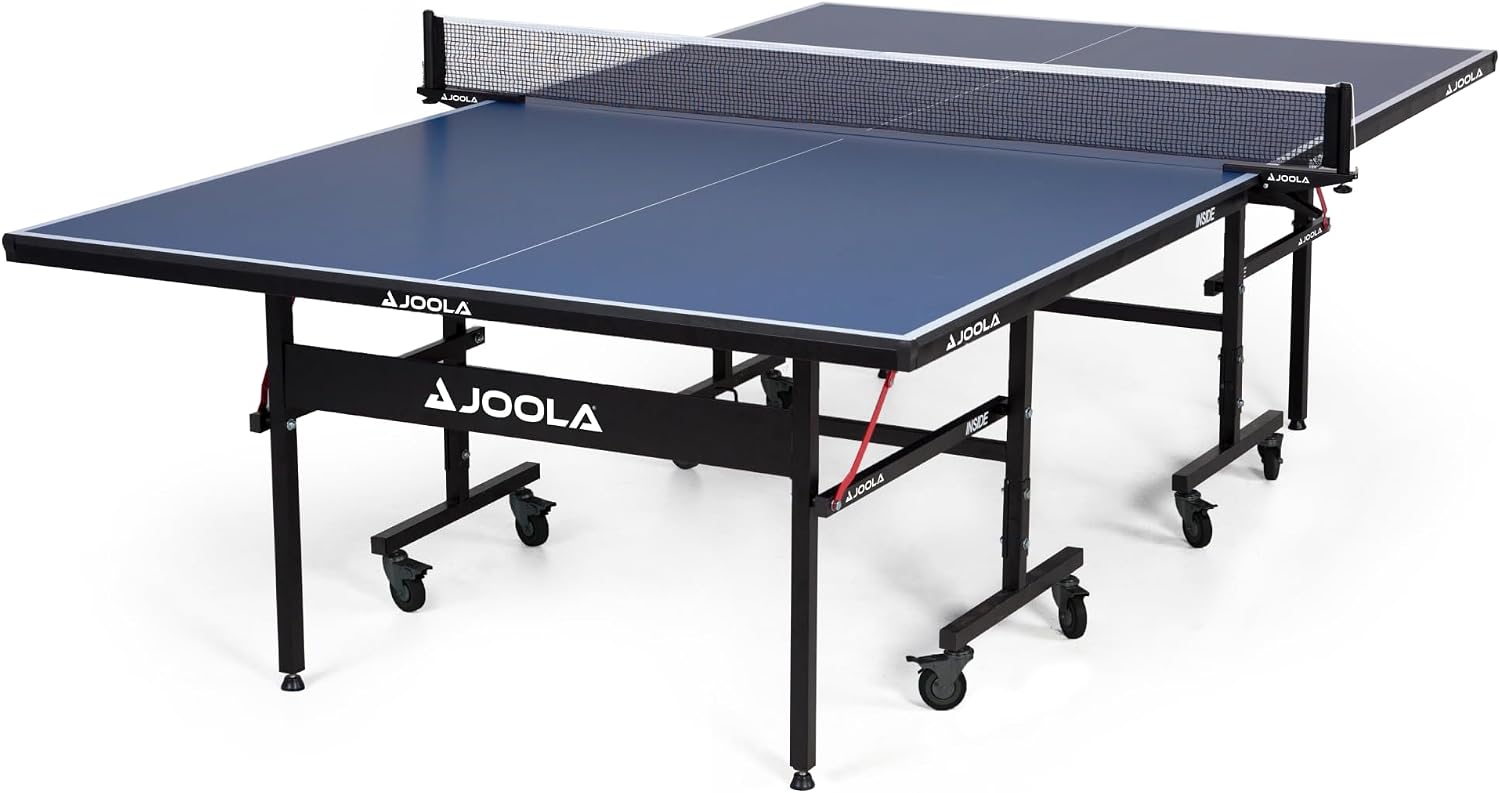
Our pick: JOOLA Inside Professional MDF Indoor Ping Pong Table with Quick Clamp Table Tennis Net and Post Set - 10 Minute Easy Assembly - Tournament Quality - Foldable with Single Player Playback Mode
 Visit on Amazon →
The JOOLA Inside is the one I would point a family to first. Look at what the name actually promises: an MDF playing surface, a quick clamp net and post set, assembly in about ten minutes, a folding frame, and single player playback mode. Check current Amazon price.
The quick clamp net set is not a small detail. Bolted or screw-clamped nets are where I see the most stripped hardware, and a net that sits a few millimeters higher on one side changes every serve you practice. A clamp system you can move and reseat without tools is the single easiest upgrade to the way a home table plays.
The ten minute assembly figure is realistic with two adults and a floor to work on. It is not realistic alone on a stair landing with the box half open, so wait for a second person.
Playback mode is the feature that keeps a table from becoming a laundry rack. You fold one half up, push the other half against a wall, and you can serve and practice alone. That is the difference between a table that gets used on Tuesday nights and one that gets used twice a year.
Flaws but not dealbreakers: The product name does not spell out the tabletop thickness, and that is the first thing I check with calipers. Verify the thickness in the current listing before you commit, and if it comes in under 15mm, walk away. It is also an MDF top, which means it does not enjoy a damp garage that swings 40 degrees between January and July. A cover is not optional in that room.
Anyone with a dry basement, a kid who plays a few times a week, and a spare wall to fold the table against will be well served here.
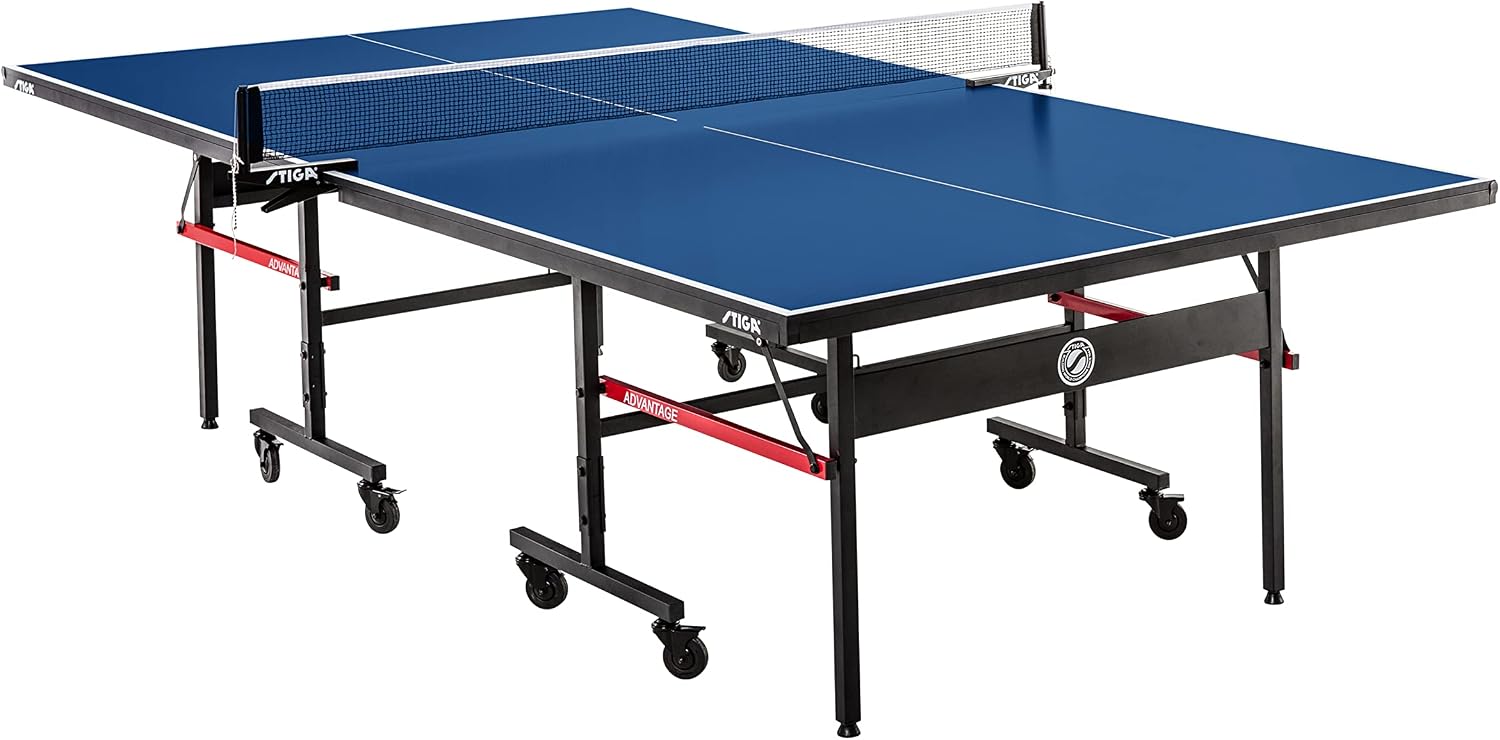
Runner-up: STIGA Advantage Series Indoor Ping Pong Table, Foldable Table Tennis Table - 13, 15, 18, and 25mm Tabletops - Quickplay 10 Minute Assembly - Playback Mode - Recreational- to Tournament-Level
 Visit on Amazon →
The STIGA Advantage Series is sold with 13, 15, 18, and 25mm tabletops, and understanding that one fact is the entire buying decision. Those are four different tables wearing the same series name, and the difference between them is not cosmetic. Check current Amazon price.
If a kid is going to practice three or four times a week on this table, I would not go below 18mm. That is the club standard for a reason: at 18mm and up, the surface stops flexing under a hard drive, and the ball leaves the bat the way the player intended instead of the way the table decided. The 25mm option in this line is the closest thing here to what I would put on a club floor. The 13mm and 15mm versions belong in a rec room where the table is mostly for guests and holidays.
The Advantage also lists quickplay ten minute assembly and a playback mode for solo practice, so the practical features line up with the JOOLA: fold it, clamp the net, play, fold it flat against the wall when the car needs the garage. It is positioned as recreational up to tournament level, which is exactly the range this series covers depending on which top you buy.
Flaws but not dealbreakers: Because one series name spans four thicknesses, it is very easy to buy the wrong one by clicking the cheapest listing on the page. Read the thickness in the title of the exact listing before you add it to the cart. Also confirm the caster spec in the listing; if the wheels do not lock, chock them.
Anyone who wants the option of an 18mm or 25mm surface and can read the listing carefully enough to pick the right one should look here first.
The setup, step by step
This is the part that separates a table that bounces true from a table that fights you for five years.
Step one: pick the spot before you open the box. You need the full 9 by 5 foot footprint plus room to swing. For real play, plan on roughly 19 by 11 feet of clear space, and check your ceiling. Low basement joists ruin lobbing more than a cheap table does. Also decide now which wall the folded table will live against, because that wall decides which way the playback half faces.
Step two: two people, and open it where it will live. A folded table is heavy and awkward. Carrying an assembled table through a doorway is how aprons get cracked and hinges get tweaked. Take the pieces out in the room.
Step three: assemble with the bolts hand tight, then square the frame. This is the step everyone skips. Assemble the legs and apron per the manual but leave every bolt loose enough that the frame can still move. Then measure the two diagonals of the frame, corner to corner. Push and pull until they are equal. Equal diagonals mean a square frame. Tighten from the center outward in stages. A racked frame is the number one cause of a table that wobbles and a ball that kicks.
Step four: install the net and posts. With a quick clamp set, clamp both posts, then check the height at both ends and the tension in the middle. If the posts lean inward, back the clamp off a quarter turn. A net that sits high on one side will train a bad serve.
Step five: level it on the actual floor. Not on the box, not on the driveway. Use the adjustable feet and a torpedo level across all four corners and both diagonals. Then put a ball on the surface. If it rolls on its own, keep adjusting. An eighth of an inch of slope at one corner is a consistent pull that your brain will quietly compensate for, which is exactly how bad habits get built.
Step six: check the folding locks and the casters. Open and close the table once with two hands, confirm both locks engage with a click, then grab the frame and wiggle it. Lock every caster, and if the wheels have no brake, chock them immediately.
Step seven: bounce test it. Nine drops, described below. Do this before the first match, not after the first complaint.
Step eight: storage. Fold it the way the manual says and not the way that seems faster. Keep heavy things off the surface when it is folded, keep it out of standing water, and put a cover on it if the room is damp.
The nine point bounce test
Drop a ball from 30cm, measured from the bottom of the ball to the surface, at nine points: four corners, four edge midpoints, and the center. A competition table under ITTF spec should rebound the ball to roughly 23cm. What I care about more than the average is the spread between the highest and lowest reading.
If the center reads high and the corners read low, the core is hollow in the middle or the table has absorbed moisture unevenly. If one corner reads low every time, your frame is still not square or the floor is still not leveled. If all nine readings track within a centimeter or so, stop working and start playing. That is a good table.
You do not need a meter for this. A ruler taped to a wall, a permanent marker line on a strip of tape, and 30 seconds of patience will do it. The point is to write the nine numbers down the first time, once, and then never think about it again unless something changes.
Where home tables actually fail
The tables that die young in my experience are not the cheap ones, they are the ones that got set up in the wrong room. A garage that hits 95 degrees in July and 20 degrees in January will warp any MDF top over two or three winters. There is no brand that fixes that.
Then there is the marketing. Any table advertising itself as tournament grade at 12mm is telling you that the words on the box are decoration. I have taken apart enough of them to know that a hollow 12mm top with wide internal ribs will bounce inconsistently within a month of garage storage. If a listing brags about thickness and hides the core construction, assume the core is the problem.
Outdoor tables are a separate product with a different material science, and a different conversation. They are not part of this article and they should not be part of this decision. If your table is going on a patio, buy for the patio; if it is going in a basement, buy for the basement.
Also worth ruling out early: combination tables that fold into a pool table, air hockey, or a dining surface. Every folding mechanism I have had to repair on one of those was the hinge that carries two jobs instead of one. One table, one job.
What this all costs
Do not anchor on the price tag. Anchor on cost per day. Whatever you pay, divide it by the 1,825 days you will own the table if it lasts five years. A table that survives five years of Tuesday night practice and Saturday morning drills costs a few cents a day no matter which of these two you pick.
The expensive mistake is buying twice. A table that bounce tests badly at month six gets replaced at month twelve by someone who is now shopping with a grudge. That is the worst possible way to spend the money.
Both of the tables above are worth a look, and you can check current Amazon price on either without leaving the page. The honest math is this: whatever the number is, the twenty minutes you spend squaring the frame, leveling the feet, and running nine drops is worth more than the difference between the two boxes.
The table is maybe ten percent of your game and ninety percent of your headaches if you set it up wrong. Set it up right once. Then forget about it and go practice.