Most people who ask me about indoor ping pong table setup are already past the hard part and don't know it. The table is unfolded, the net is clamped, the ball is bouncing, and something feels off. Nine times out of ten it isn't the table. It's the floor under it, a leg that never got leveled, or a net pulled tight at one end and slack at the other.
I've set up and torn down more tables than I can count, first as a junior in Brno and now at a community club in a converted Milwaukee warehouse with six tables on the floor. The sequence is the same whether you spent a little or a lot. What changes is how much forgiveness the table gives you when the room doesn't cooperate.
This is the order I run every time, plus the two indoor tables I'd start with if you're buying new.
Why you should trust me
I played competitively in the Czech Republic as a teenager, immigrated at 20, and now run a community table tennis club in Milwaukee out of a converted warehouse. Six tables, six days a week, juniors in the afternoon and adults at night.
I have leveled tables on concrete, on carpet, and on a garage slab that sloped two inches toward the door. I have replaced folding mechanisms that died after two seasons, and I have watched a table roll into a car door because the casters didn't lock. I measure top thickness with calipers, bounce with a dropped ball, and frame squareness with a carpenter's square, because those three things predict whether a table is worth keeping.
I don't review paddles. I don't review outdoor tables. Different products, different material science. This is about the table and the room it lives in.
How I picked and how I tested
Two indoor tables are on the list below, and they're the two I'd tell a family or a small club to look at first.
My method is boring and repeatable. Bounce first: a ball dropped from 30cm at nine points, the four corners, the four mid-edges, and the center. The standard says a ball dropped from that height should come back up about 23cm. What I'm listening for is consistency, because a table that bounces 22cm everywhere is a better practice surface than one that bounces 24cm in the middle and 18cm over a leg. Thickness is not the same thing as quality. A thick table with a hollow core bounces worse than a thin one with a solid core, and I've found the dead spots to prove it.
Second, the frame. A carpenter's square across the corners, plus a diagonal check. If the frame isn't square, the net sags in the middle and the ball takes a funny hop near the edges. Third, the hardware: the folding latch, the caster locks, the net clamp. Folding mechanisms are where tables die. I've fixed around forty of them, and almost every one failed because somebody folded the table with the net still clamped or rolled it with the locks off.
The two tables worth building a room around
Both are indoor tables with folding halves and playback mode, which means one person can practice alone by folding one half up. That single feature is worth more to a junior than any badge on the box.
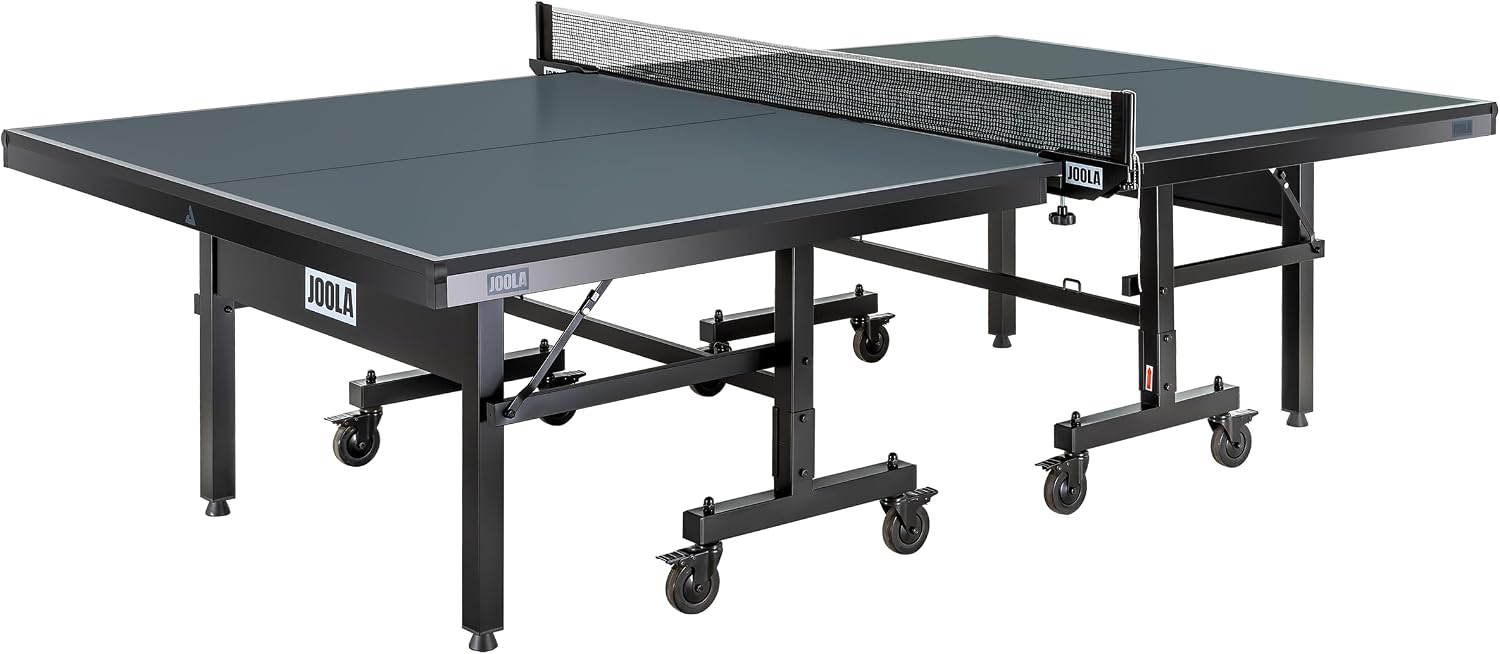
Our pick: JOOLA Inside Professional MDF Indoor Ping Pong Table with Quick Clamp Table Tennis Net and Post Set - 10 Minute Easy Assembly - Tournament Quality - Foldable with Single Player Playback Mode
 Visit on Amazon →
Check current Amazon price, then read the rest of this paragraph, because the net is why this one is first.
JOOLA ships the Inside with a quick clamp net and post set in the box. That sounds small until you've priced a decent net separately or fought the flimsy screw-on posts that come with cheap tables. A net that clamps on and holds tension is the difference between a table you practice on and a table you get annoyed at. The name also says tournament quality, which is marketing until you check the frame, so check the frame.
The build is MDF with folding halves and single-player playback mode, and the assembly claim is ten minutes. Ten minutes is realistic for two people who read the instructions once and lay the halves on cardboard first. It is not realistic for one person doing it in a stairwell.
What I'd verify before you order: the folding latch on the underside of each half and the caster locks. Locking casters are non-negotiable in my book. I've watched an unlocked table roll into a car door in a garage, and the door lost.
Flaws but not dealbreakers: The supplied name doesn't put a thickness figure on the box the way some tables do, so if top thickness is your deciding spec, confirm it in the listing before you commit. And MDF is MDF. Keep it out of a damp garage and it holds its shape for years.
Anyone setting up a first serious table in a basement or a spare room should start here.
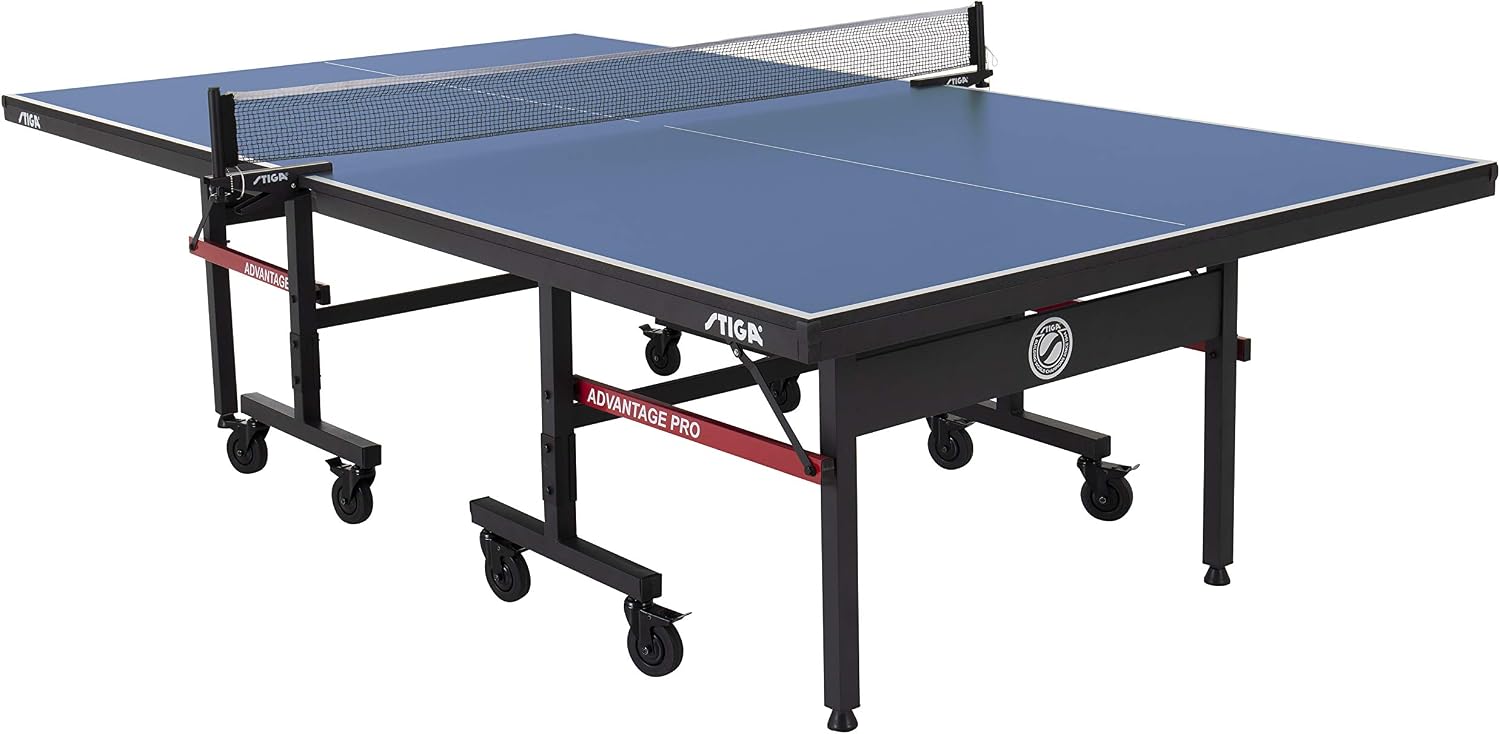
Runner-up: STIGA Advantage Series Indoor Ping Pong Table, Foldable Table Tennis Table - 13, 15, 18, and 25mm Tabletops - Quickplay 10 Minute Assembly - Playback Mode - Recreational- to Tournament-Level
 Visit on Amazon →
Check current Amazon price and then decide which version of this table you're actually buying, because that's the whole point of the Advantage line.
STIGA sells the Advantage with 13, 15, 18, and 25mm tabletops, and the model line tells you which one you're getting. That's more honest than most of this market, where tournament-grade gets printed on a thin top and nobody blinks. My position is simple: 18mm is the club standard for a reason, and if you're buying for a garage, 15mm with a solid core will do. The 25mm version is the one I'd want under a junior who is actually training. The 13mm is a rec-room table, full stop.
The Advantage also folds, plays back for solo practice, and claims the same ten-minute assembly. STIGA's folding hardware has been around long enough that replacement parts exist, which matters more than people think. When a latch breaks on an off-brand table, you throw the table away.
Flaws but not dealbreakers: Buying by thickness means you can order the thin one by accident and blame the brand. Read the model line twice. The playback latch and the net posts are the two things to check on arrival.
Families who want to choose their own thickness and keep a table for a decade should look here.
How to set up an indoor ping pong table, step by step
Step one: Measure the room before you cut the tape. A full-size table is 9 feet by 5 feet and 30 inches high, so the table alone eats most of a small basement. You want about 5 feet of clear space on each side and 4 feet behind each end for a real swing, which puts your practical footprint near 19 feet by 11 feet. If you don't have that, buy a smaller table and be honest about it instead of buying a full-size one and playing sideways.
Step two: Pick the floor. Concrete is fine. Carpet is fine but it eats bounce and hides slope. Garage slabs are the worst offender because they're poured with a slope toward the door, which means one end of the table will always be low. Level the table, not the floor. Shim under the feet or the caster plates, never under the middle of the top.
Step three: Assemble with two people and a sheet of cardboard. Lay the halves face down on cardboard so you don't scratch the playing surface, attach the legs and undercarriage hardware, then flip the whole thing as a unit. Both of these tables claim ten-minute assembly, and both claims assume two people who aren't arguing.
Step four: Level it with a bubble level on the aprons. Not on the playing surface. The aprons are the frame rails under the top, and they're the straight reference. Check both long aprons and both short ones, and adjust the feet until the bubble sits in the same place everywhere.
Step five: Square the frame. Measure corner to corner diagonally across the table, then measure the other diagonal. If the two numbers don't match, the table is a parallelogram, and a parallelogram gives you a net that sags in the middle and a weird hop near the corners. Loosen the leg bolts, rack it square, and tighten again.
Step six: Clamp the net and set the height. The net should sit tight to the table at both posts and roughly 6 inches high at the center. A net pulled tight at one end and loose at the other is the most common setup mistake I see, and it costs you nothing to fix. On the JOOLA, the quick clamp set does this without tools. On the STIGA, check that the posts are fully seated before you tension anything.
Step seven: Run the bounce test. Ball, 30cm, nine points. Drop it, don't throw it. Listen for the dull thud that means a dead spot, and compare the nine rebounds to each other. If the center is lively and one corner is dead, check the frame and the floor before you blame the table. A table that bounces the same everywhere is a table worth keeping.
Step eight: Practice in playback mode, then learn the fold. Fold one half up, lock the casters, and hit against the upright half. A solo rally exposes a bad bounce faster than a game does. When you're done, take the net off or unclamp it, fold the halves, engage the latch, and check the safety catch before you roll it anywhere. Folding locks that pinch fingers are real, and you avoid them by keeping your hands on the frame rails, not the hinge line.
Where both tables fall short
Neither of these is a club table, and I want to be clear about that. A table that survives six hours of daily play is a different animal, and it costs more than either of these. What you're buying here is a home table that won't teach bad habits.
MDF and moisture don't get along. A damp garage in a Milwaukee winter will move any MDF top, and once a top warps, no amount of leveling fixes it. If your only space is an unheated garage, plan on a cover and a dehumidifier, or accept that the table has a lifespan.
The casters on both are for moving the table across a smooth floor, not for rolling it over a threshold or down a step. Lock them every time, even for a five-minute session. And keep the net off the table when it's folded, because a clamped net under a folded half is how latches get bent.
What I left out and why
Conversion tops that sit on a pool table are not the same product, and I don't recommend them to anyone who actually wants to practice. They bounce wrong and they slide.
Cheap foldables that advertise tournament play without telling you the top thickness are the thing that makes me angriest in this market. If a box claims tournament grade and hides the number, it's telling you something.
Outdoor tables are a different material science, and I don't review them. If you want to play on a patio, buy an outdoor table and read a guide written by someone who tests them.
Paddles are not my department either. Get a decent one from a specialist and spend your setup time on the table.
What this all costs
The math on a table is not the purchase, it's the years. A table you keep for ten years and play three times a week is a few cents a day. A table that warps in year two and gets shoved behind the furnace is the most expensive thing in the room.
So the money question is really a question about the room. If you have a dry basement with a level floor, either table on this list will serve you for a long time. If you have a damp garage with a sloped slab, spend what you can on thickness and spend your weekend on the leveling, because that's what the bounce actually depends on.
Check current Amazon price on both, measure your room, and set the table up once, properly. Then stop thinking about the table and go hit.