Most people who ask me about buying a table start with the wrong question. They want to know which brand is the good one, or which table the professionals use, and they end up comparing a folding basement table to a concrete-slab outdoor unit as though the two were interchangeable. I run a six-table club in a converted warehouse in Milwaukee, and I have assembled, leveled, and repaired enough tables to know that the phrase ITTF approved table tennis table describes one narrow slice of a much bigger decision. Approval tells you something about the playing surface. It tells you nothing about whether the folding lock will still work in three years.
The reader problem is simple. A table is a large, awkward object you will keep for a decade, and the marketing around it is written to make a twelve-millimeter top sound like a tournament surface. Families buy on thickness and brand name, get a table that bounces differently at the two ends, and then blame their own stroke. Clubs buy on price and spend the next five years tightening bolts. The fix is to decide what the table has to do before you compare anything: indoor or outdoor, fixed or folding, club hours or weekend hours. Everything below is organized around that.
Related: How to Level a Folding Table on an Uneven Garage Floor →
Quick answer
There is no single table that covers every situation, so the honest answer is a short set of matches. For indoor play where the surface has to hold up to regular use and storage space is tight, a folding table with an ITTF approved playing surface is the right category. For a park, schoolyard, or campus, a fixed outdoor table built from weather-resistant materials is the right category, and it is a different product with different trade-offs. For paddles, a carbon-blade racket aimed at control suits players working on technique, while a multi-racket set with balls covers a household or a casual group. Match the category first, then compare within it.
Four useful options
| Model | Best fit | What stands out |
|---|---|---|
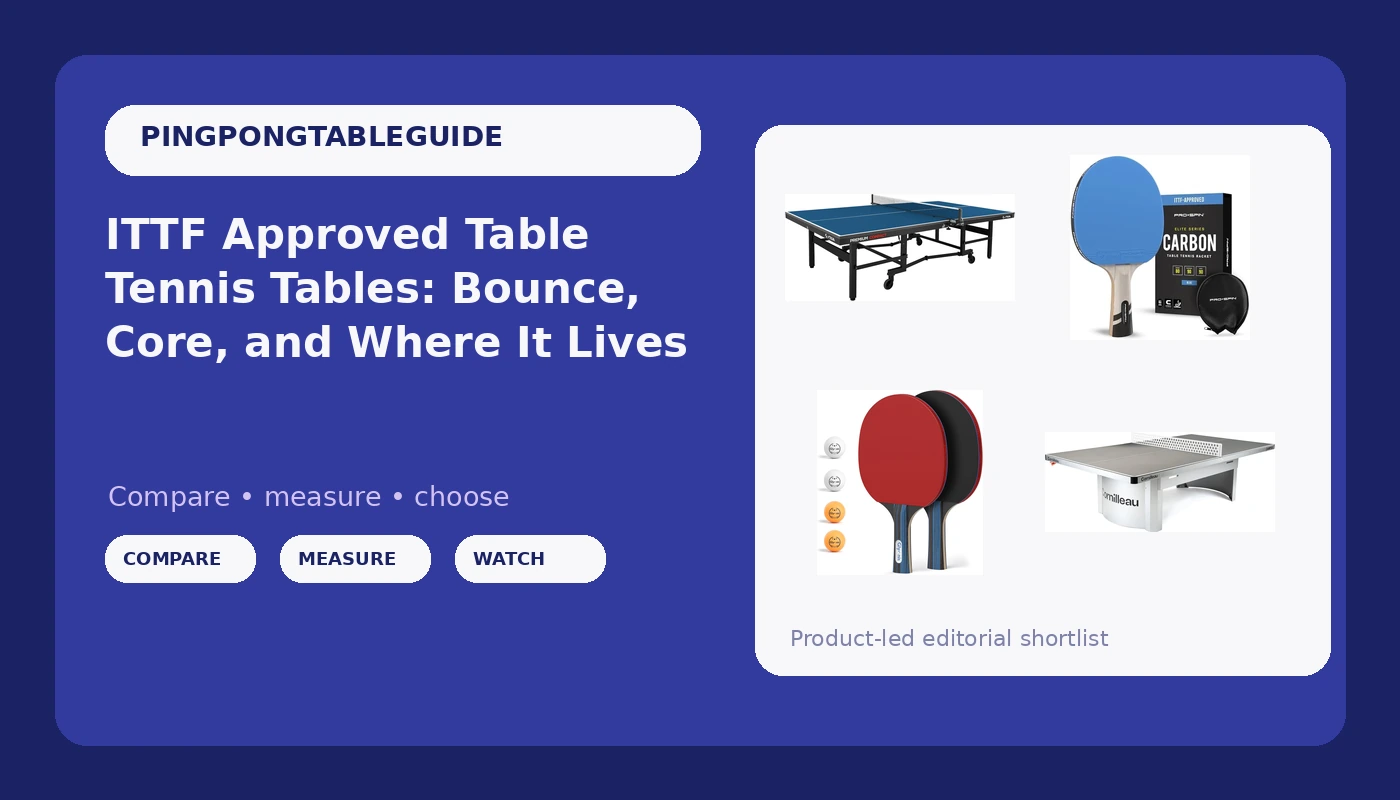
| STIGA Premium ITTF Approved Compact Tennis Table, Folds to Minimal Storage Dimensions and Comes Fully Assembled | Indoor play with limited storage | ITTF approved playing surface and a compact folded footprint |
| PRO-SPIN Ping Pong Paddles, ITTF Approved Professional Table Tennis Rackets with Carbon Fiber for Superior Control, 7-Ply Blade, Premium Rubber, 2.0mm Sponge | Players working on control and spin | 7-ply blade with carbon fiber and a 2.0mm sponge |
| Glymnis Ping Pong Paddles Set of 4/2, Table Tennis Rackets Set and Balls | Households and casual groups | Multiple rackets plus balls in one purchase |
| Cornilleau Outdoor 510 Fixed Campus Ping-Pong Table for Communities and Schools, Competition Bounce (Blue or Grey 7mm), FFTT Leisure and School Approval (Grey) | Permanent outdoor installation | Fixed frame and a 7mm outdoor top |
Indoor anchor: STIGA Premium ITTF Approved Compact Tennis Table
The trade-off with any folding indoor table is the hardware, not the top. Hinges, latch plates, and the folding locks carry the load every time the table goes up and down, and they are the first parts to loosen. That is also why the folded footprint matters more than the playing footprint when you are standing in a garage deciding where this thing lives. If you plan to store it upright against a wall, check that the folded depth leaves you a walking path, and confirm the casters lock so the table does not drift while it is parked.
Control paddle: PRO-SPIN Ping Pong Paddles
Paddle selection is a specialist subject and I stay out of the deep end of it, but one point belongs in a table article. A junior practicing at home on a fast racket with dead rubber learns to block instead of swing. A blade with a carbon layer and a sponge that grips gives the ball somewhere to go when the stroke is technically correct, and that is what keeps a kid from grooving a bad habit in the basement. Rubber is a wear item. When the surface glazes over and stops grabbing, no blade in the world will fix it.
Family set: Glymnis Ping Pong Paddles Set of 4/2
Sets like this are not where spin is learned, and they are not pretending to be. Their job is to make sure four people can stand around a table on a Saturday without taking turns holding the same two rackets. If your table is a social object, a set with balls included removes an entire shopping trip. If your table is a training tool, buy one serious racket and let the set handle the visitors.
Permanent outdoor table: Cornilleau Outdoor 510 Fixed Campus
Outdoor tables are a different material science, and I generally hand outdoor questions to people who install them for a living. What I can say from the club side is that a fixed table changes your planning order. There is no storage question, no folding question, and no moving question. Instead there is a pad, drainage, and sun exposure question, and all three get answered before the crate shows up. A table bolted to a slab that holds water will disappoint you in a way no spec sheet predicts.
Prices and availability may change. Product images, names, and retailer links are matched to verified listings. No current price, rating, stock status, or measured result is stated here without current evidence.
What ITTF approval actually covers
Approval is category-specific, and that is the part buyers miss. On a table, approval is about the playing surface: how high a standard ball rebounds from a controlled drop, whether that rebound is uniform across the whole surface, and how the surface behaves under friction. On a racket, approval applies to the rubber covering, which has to appear on the authorized list maintained by the sport's governing body. The listing phrase "ITTF approved" is therefore a claim about one component, not about the product as a whole.
Nothing about approval covers the folding mechanism, the frame, the apron under the top, the casters, the paint in the bounce zone, or the storage footprint. That is why a table can carry an approved surface and still be a poor fit for your garage: the surface is fine, but the hinge plates are thin, the legs do not level on a sloped slab, and the wheels do not lock. Approval is a floor, not a ceiling. It tells you the top is not a toy. It does not tell you the table will survive six years of being folded twice a week.
Thickness, core, and bounce consistency
Thickness is the number every listing shouts and the least useful one on its own. A thick top built around a hollow core can bounce worse than a thinner top with a dense core, because the ball is responding to what is under the surface, not to the millimeter count on the box. This is why I care about consistency before I care about any single figure.
The check is simple and it needs no instruments beyond a ball. Drop a ball from roughly 30cm above the surface at nine points: four corners, four mid-edges, and the center. Watch where it comes back to. A surface that returns the ball to a similar height at all nine points is doing its job. A surface that returns noticeably lower at one corner or noticeably higher along one edge has a problem, whether that is a warp, a soft spot in the core, or a frame that is not square.
Two more checks belong in the same session. Put a carpenter's square against the frame and the apron to see whether the table is actually rectangular, because a table that is racked will play differently at the two ends no matter how good the top is. Then put a spirit level on the surface in both directions, because legs that will not level on a garage floor tilt the entire playing plane and turn every bounce into a small surprise.
A five-step way to decide
- Measure the storage path first, including door widths, stair turns, and ceiling height where the table will stand folded.
- Decide fixed or folding. A table that lives outdoors year-round should be fixed. A table that shares a room with a car should fold.
- Compare surface and core construction, not just the thickness number on the marketing panel.
- Inspect the hardware that fails first: folding locks, hinge plates, and locking casters.
- Plan the leveling before delivery, with a spirit level, shims, and one flat spot you have already checked.
Practical guidance before you order
- Measure the folded footprint, not the playing footprint, if storage is the constraint.
- Keep the storage spot dry. Humidity warps tops slowly and quietly, and you notice it a year later.
- Test folding locks with the table empty before children use it, because pinch points are real.
- Confirm the casters lock before you roll a table across a driveway or a sloped garage floor.
- Budget for a cover and a wall strap if the table will be stored upright between sessions.
- For an outdoor fixed table, settle the pad and the drainage question before the delivery date, not after.
Which option should you choose?
Choose the STIGA Premium ITTF Approved Compact Tennis Table when the table will live indoors, needs to fold away between sessions, and you want an approved playing surface on a frame that arrives assembled. Choose the PRO-SPIN Ping Pong Paddles when someone in the house is working on control, spin, and placement rather than just getting the ball back. Choose the Glymnis Ping Pong Paddles Set of 4/2 when the table is a social object and you need several rackets and balls in one purchase. Choose the Cornilleau Outdoor 510 Fixed Campus when the table is going outdoors permanently, at a school, a park, or a community site, and installation planning matters more than portability.
The caveat is the same one I give at the club. I have not measured these specific listings, and no bounce figure, thickness measurement, or durability result is claimed here beyond what the manufacturers state. My opinions come from years of setting up, leveling, and repairing tables, not from a lab test of these four items. Paddle selection in particular is a specialist subject, and outdoor installations depend on materials and site conditions I do not control.
The bottom line
The table is a small part of your game and a large part of your headaches, so buy for the room and the routine, not for the label. An ITTF approved surface is worth having indoors, but it will not save you from weak hinges, unlocked casters, or a slab that tilts the whole plane. Decide fixed or folding, measure the storage path, check the core rather than the thickness number, and put your hands on the hardware before you commit. Do that and the table disappears into the background, which is exactly where it belongs while you are playing.