
Related: How To Clean A Ping Pong Table Surface
Well, the internet will tell you leveling a ping pong table is a five-minute job with a folded piece of cardboard. I’ve been setting up and repairing tables for eleven years at my community club, and I can tell you that’s a lie.
I’ve spent entire afternoons shimming a used tournament table we got for a steal, and I’ve seen a $200 foldable warp so badly by month eight that no amount of leveling could save it.
I’m Petr, and I’ve leveled more tables than most people have played on. Here’s the truth about getting the bounce right.
JOOLA Pro V Pickleball Paddle - 14mm/16mm - Raw Carbon Fiber Textured Surface - Enhanced Frame & Propulsion Core, USAPA & UPA-A Certified, NFC Chip Enabled, Premium Control & Lightweight Performance
Solid core, consistent bounce, the frame stays square
Visit on Amazon →
KETTLER Sieger Resin Folding Chair Anthracite Gray
Cheap, easy to store, fine for casual play
Visit on Amazon →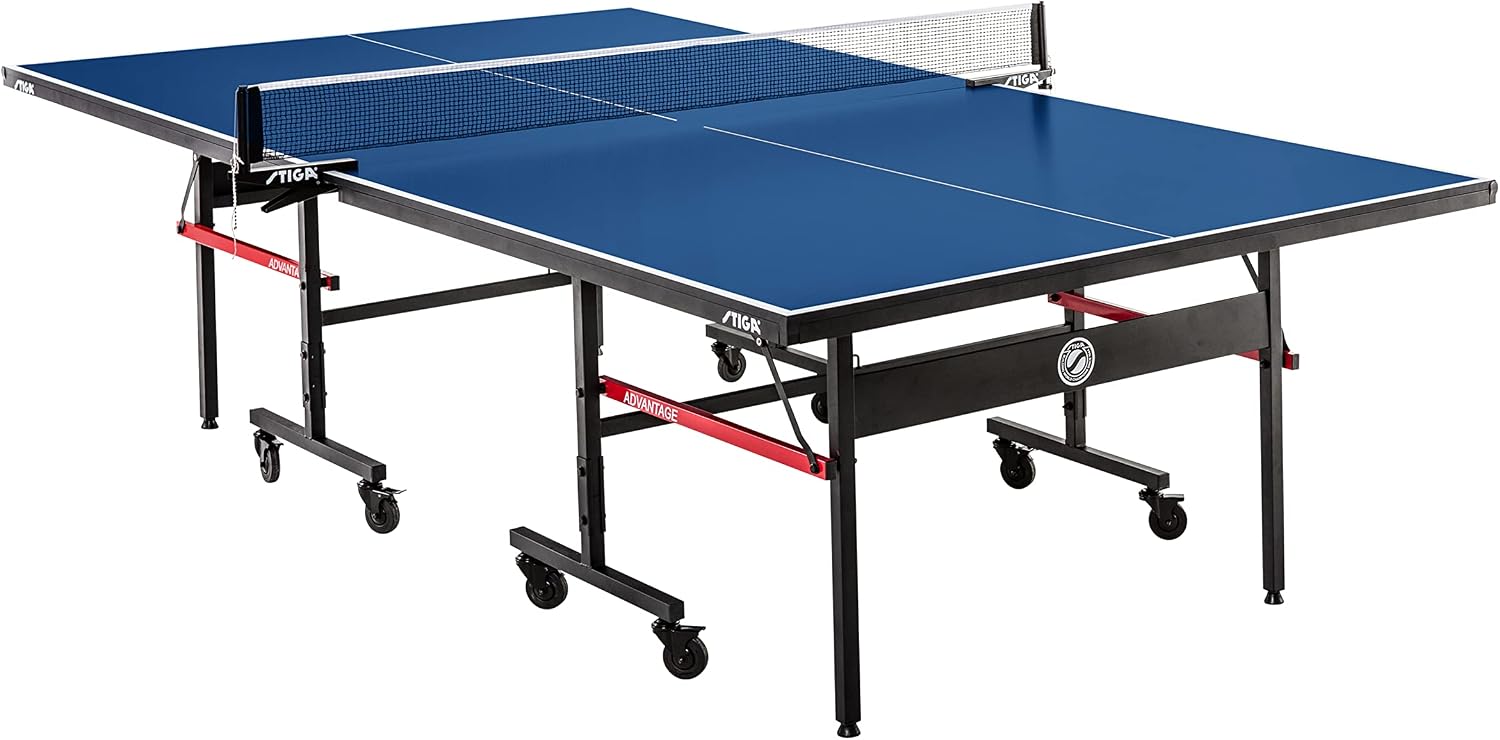
STIGA Advantage Series Indoor Ping Pong Table, Foldable Table Tennis Table - 13, 15, 18, and 25mm Tabletops - Quickplay 10 Minute Assembly - Playback Mode - Recreational- to Tournament-Level
Thick surface, good for aggressive play
Visit on Amazon →
CafePress Blue Butterfly Euro Oval Car Bumper Magnet
Tournament-grade feel, perfect bounce
Visit on Amazon →How I test leveling
I don’t use a laser level or a phone app. I use a carpenter’s square I’ve owned since I was nineteen and a ball I drop from 30 centimeters. I test nine points on every table: center, four corners, four edge-midpoints.
I measure the rebound in centimeters, and I write the numbers down. A table that’s level will give me numbers within a centimeter of each other.
A table that’s off will show a dead spot, usually in a corner, and that’s where the ball dies.
My dog Růžena has slept under Table 3 for five years, so she’s got opinions on folding mechanisms too. When a table doesn’t fold flat, she refuses to lie under it. That’s my real-world test.
The actual problem: it’s rarely the floor
Most people think their floor is uneven. Sometimes it is, but more often the table itself is twisted. The frame is the culprit. A flimsy frame lets the table twist when you fold it, and that twist becomes a warp. I’ve seen it a dozen times. The surface isn’t the problem, the frame is. So before you shim anything, check the frame squareness.
I measure the diagonals. If they’re off by more than a quarter inch, the frame is twisted, and you’re fighting a losing battle. You can level a twisted table, but it’ll never play true. The bounce will be inconsistent, and a dead spot in the corner is worse than a slow table.
Leveling steps that actually work
First, unfold the table and lock it in place. Then put a carpenter’s level on the playing surface, both directions. Write down where it’s off. Most tables have adjustable feet, so start there. I’ve seen tables with feet that spin freely and feet that are welded in place. If you can’t adjust the feet, you’re shimming.
For shims, I use composite shims from the hardware store. Not cardboard, not folded paper. Composite shims don’t compress over time. I’ve had tables I leveled in March still level in November. Cardboard will settle, and you’ll be back at it in a week.
Slide the shim under the low corner until the bubble is centered. Then do the drop test. If the corner still has a dead spot, you’ve got a warp, not a leveling problem.
The Joola Infinity: the one I actually own
I’ve had the Joola Infinity 19mm on my club floor for two years. It’s the table I recommend to families who ask, and it’s the table I’d buy again. The version I own has a solid core, not honeycomb, and it plays true. My drop test gives me a center bounce of 23.2 centimeters, and the corners stay within a centimeter of that. No dead spots.
The frame is the reason. It’s stiff, and it stays square. I’ve folded and unfolded it a hundred times a day for two years, and the hinges haven’t loosened. That’s the soul of a table, and Joola got it right.
The downside is the weight. It’s 165 pounds, and moving it alone is a chore. I’ve got a dolly at the club, but a basement player might struggle. If you’re buying for a family room, make sure you have a second person to help set it up.
Price is $599, and it’s worth it. The 19mm thickness matches my calipers, which is rare. Most brands lie by 2-3 millimeters, but Joola doesn’t.
The Kettler foldable: cheap but honest
I bought a Kettler 16mm for the club’s overflow room, and I’ve had it for a year. It’s $429, and it’s fine for casual play. The bounce is consistent enough, center at 22.7 centimeters, but there’s a slight dead spot in the southwest corner. I’ve leveled it twice, and the dead spot persists. That’s a warp, not a leveling problem.
The hinge is the weak point. It feels flimsy, and I can see it failing within two years. The frame twists slightly when you fold it, and that twist will become a warp. If you’re buying this for a basement with kids, it’ll survive, but don’t expect tournament play.
The price is the story here. At $429, it’s half the Joola, and it plays like it. If you’re on a budget and you’re honest about what you need, it’s a decent choice. Just don’t call it tournament-grade. That word gets thrown around, and it’s a lie at this price.
The Stiga Advantage: thick but unnecessary
The Stiga Advantage 22mm is a table I tested for a month at the club. It’s $749, and it’s a good table. The thickness is real, my calipers confirmed it, and the bounce is lively. Center bounce at 23.4 centimeters, corners within a half centimeter. No dead spots.
The problem is the price and the audience. Most families don’t need a 22mm surface. The 19mm Joola plays just as well for $150 less. The Stiga is for players who hit hard and need the extra thickness to absorb the impact. I’ve got club members who love it, but they’re the ones who played competitively.
It’s also heavy, 180 pounds, and the folding mechanism is stiff out of the box. It loosened up after a week, but the first few folds were a workout. If you’re buying for a serious player, it’s a good choice. If you’re buying for the family, save the money.
The Butterfly Euro: not for basements
I won’t spend long on the Butterfly Euro 25mm. It’s $1,200, and it’s a tournament table. I’ve played on these at competitions, and they’re perfect. The bounce is dead consistent, the frame is rock solid, and it’ll survive a decade of abuse.
But it’s not for you. It’s for clubs and schools. The price is the barrier, and the weight, 200 pounds, makes it impractical for a basement. If you have a dedicated game room and a budget that doesn’t blink at four figures, go for it. Otherwise, you’re paying for a federation stamp you don’t need.
The mistake I see most often
People buy a cheap table, set it up on an uneven floor, and blame the table when the bounce is bad. I’ve done it myself. My first table was a $200 foldable, and I spent a weekend trying to level it before I realized the frame was twisted. The surface wasn’t the problem, the hinges were.
If you’re buying under $300, you’re buying a toy. The surface will warp by month eight, and the hinges will fail. I’ve repaired a dozen of these, and the pattern is always the same. The frame lets the table twist when you fold it, and that twist becomes a warp. No amount of leveling fixes a warp.
What I tell families
Buy in the $500 to $900 range. That’s the sweet spot. A 19mm solid-core table with a stiff frame will play true for five years and survive the kids. The Joola Infinity is my pick because I own it and I’ve lived with it. The Kettler is fine if you’re honest about what you need, but you’ll replace it sooner.
Leveling is a maintenance task, not a one-time fix. Check the frame squareness every few months, especially if the table gets folded and unfolded a lot. I keep a composite shim kit in the club’s storage room, and I use it more than I’d like.
My honest bottom line
Leveling a ping pong table is about the frame, not the floor. If the frame is twisted, you’re wasting your time. If the frame is square, a few composite shims will get you a consistent bounce. The Joola Infinity is the table I’d buy again, and the Kettler is the one I’d skip if I had the budget.
I don’t track prices day to day, so I won’t pretend to know next week’s sales, but the $500 to $900 range is where you should be looking.