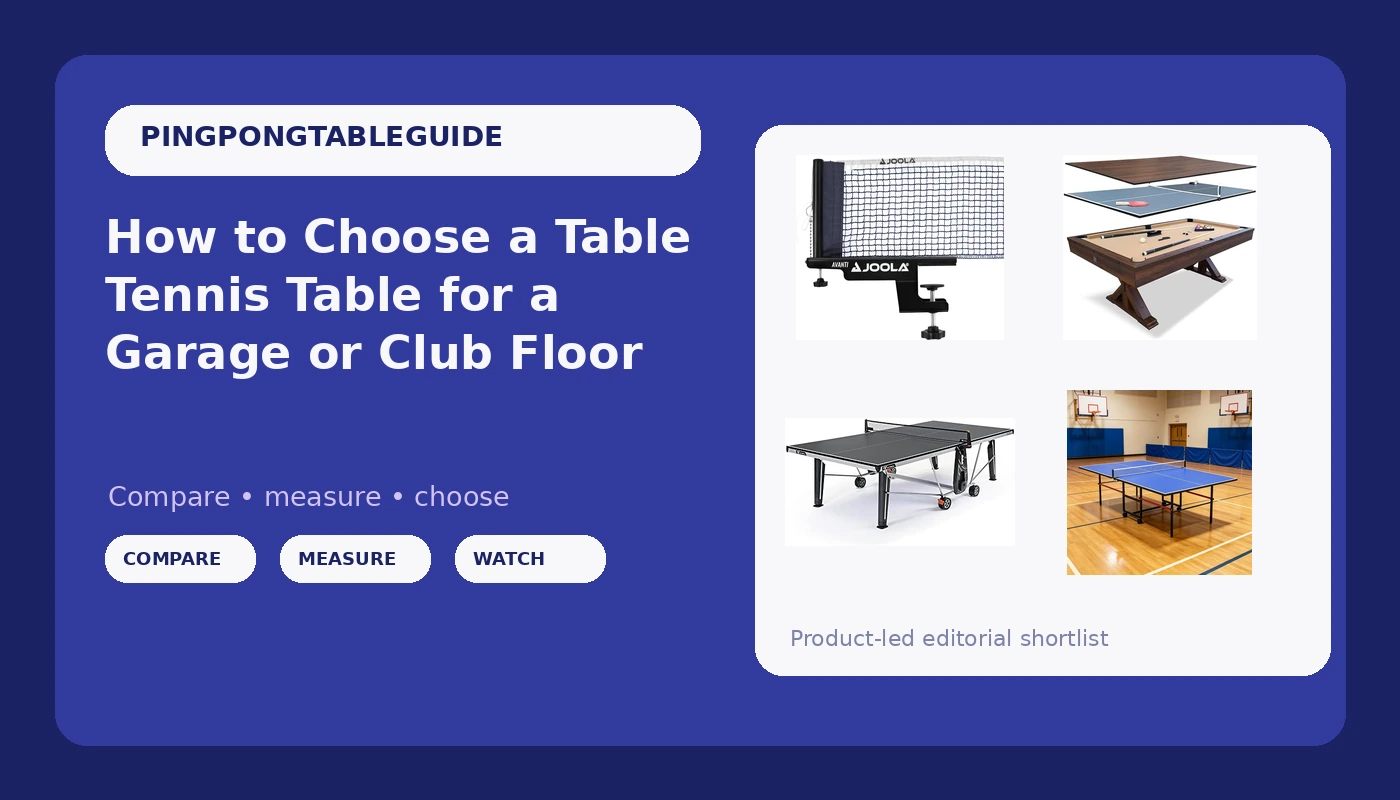
Most people who start shopping for a table tennis table are solving one of two problems, and the search results make those problems look identical. One buyer wants a training surface for a junior player who practices at home between club sessions. The other wants something in the basement that the family drags out on a rainy Sunday. Both get shown the same mix: folding tables, dedicated indoor tables, multi-game combos with a dining top, and net-and-post sets. Those are not competing versions of the same object. Buying across categories is the mistake that costs the most money, because a table that folds beautifully is not automatically a table that bounces well, and a table that bounces well is often a table you cannot move by yourself.
This guide explains what each category is actually for, what a spec sheet does and does not tell you, and which of the four options here fits which room.
Related: Ping Pong Table Thickness: What the Numbers Actually Change →
Quick answer
Match the category to the room before you compare models. If you need one purchase that folds, stores, and covers family play out of the box, the 8 FT Foldable Ping Pong Table is the most complete single package here, because it ships with a net, two paddles, and three balls. If you already own a table and the net is the weak point, the JOOLA Premium Avanti net and post set is the cheaper fix. If the room has to work as a game room and a dining room, the Freetime Fun 3 in 1 combo covers both jobs. If you want an indoor table meant for regular practice rather than storage, the Cornilleau Indoor 500 is the one built for that role. Confirm playing dimensions, top thickness, and hardware details inside each listing, because those are the numbers that decide how the table behaves after the first month.
Four useful options
| Model | Best fit | What stands out |
|---|---|---|
| 8 FT Foldable Ping Pong Table, Full Size Regulation Table Tennis Table with Net, 2 Paddles & 3 Balls | Garages, basements, and rooms that need the floor back | Folding full-size table that ships with a net, two paddles, and three balls |
| JOOLA Premium Avanti Table Tennis Net and Post Set | Upgrading the net on a table you already own | Screw-on clamp mounting with a portable, easy-setup design |
| Freetime Fun 7 FT 3 in 1 Multi Game Pool Table with Dining Top | Rooms that must serve as game room and dining room | Converts between games and includes accessories and tennis paddles |
| Cornilleau Indoor 500 Indoor Table, New 2023 | Dedicated indoor practice space | Cornilleau indoor table, 2023 model, sold as a complete table |
The complete folding setup: 8 FT Foldable Ping Pong Table
This is the category most families should start with, and it is also the category with the widest quality spread. A folding table lives or dies on two things: whether the playing surface stays flat when the halves are locked together, and whether the folding hardware survives being opened and closed a few hundred times. Neither of those shows up in a bullet list. What you can check in the listing is the stated top thickness, the frame and apron description, and whether the wheels are described as lockable. Locking casters matter more than people expect, because a folding table that rolls is a folding table that can roll into a parked car or a water heater.
If your goal is tournament-style training, look closely at the stated playing dimensions before ordering. Full tournament play uses a larger surface than most folding home tables, and an eight foot table is a home compromise, not a competition floor. For basement rallies, that compromise is fine. For a junior practicing between club nights, it is the difference between grooving a stroke and compensating for a short table.
The accessory fix: JOOLA Premium Avanti Table Tennis Net and Post Set
Nets are the most neglected part of a home setup. A net that sags in the middle or sits at the wrong height changes the bounce of every ball that touches it, and a net with a torn bottom band makes cheap plastic balls skid underneath. Clamp-on sets solve this for a fraction of what a new table costs, and they are the right answer when the surface underneath is still flat and the frame is still square.
The trade-off is that clamp style nets depend on the table edge they grip. Thick aprons and unusual edge profiles can make a clamp fit awkwardly, and a net that shifts when a ball hits it is worse than no net at all. If you are replacing a net, check the thickness of your table edge before you buy, and check whether the clamp is described as screw-on, which holds position better than a spring clip on most home tables. This is also the sensible purchase for anyone who bought a used table at a garage sale and found out afterward that the net was missing.
The multi-game combo: Freetime Fun 7 FT 3 in 1 Multi Game Pool Table with Dining Top
Combination tables are honest about what they are, and the honest answer is that they trade bounce quality for floor space. A seven foot convertible with a dining top is a furniture decision as much as a sports decision. If the alternative is no table at all because the dining room is the only available space, this category wins by default, and the dining top is what makes that argument work.
What you give up is the thing club players care about most: a consistent bounce across the whole surface and a table that stays put during fast play. Combo tables also carry more moving parts, which means more places for hardware to loosen over years of conversion. If your household plays pool more than ping pong, that trade is easy. If a junior is training seriously on it, you will eventually want a dedicated table. The right question is not whether a combo table plays like a club table, because it does not, but whether it gets used. A convertible in the dining room gets used.
The dedicated indoor table: Cornilleau Indoor 500 Indoor Table
This is the category where you pay for the surface and the frame instead of the folding mechanism and the storage wheels. Indoor tables from established table tennis manufacturers are designed around bounce consistency, which is why they show up in clubs, schools, and basements that have been converted into practice rooms.
The trade-off is commitment. An indoor table is heavier, it usually wants to stay where you put it, and it needs a room with enough clearance around all four sides for a real forehand. If you cannot leave a table set up, this category is the wrong purchase no matter how good the surface is. Before ordering, read the listing for the actual playing dimensions, the stated top thickness, and how the table folds or stores, because manufacturers handle those three things very differently across a product line.
Prices and availability may change. Product images, names, and retailer links are matched to verified listings. No current price, rating, stock status, or measured result is stated here without current evidence.
What a spec sheet tells you and what it hides
Top thickness is the number buyers fixate on, and it is only half the story. A table top is a sandwich: a playing surface, a core, and often a frame or apron underneath. Two tables with the same stated thickness can play completely differently if one has a solid core and the other is hollow. A hollow core tends to produce a duller, less predictable bounce, and it is the reason a cheap thick table can feel worse than a well-built thinner one.
The other half of the story is the frame. The apron and the rails are what keep the surface flat over time. A table with a flimsy frame will develop a low spot where players lean on it, and a low spot is permanent. Once a surface warps, no amount of adjusting the net or replacing the balls brings it back.
What the spec sheet usually hides is the bounce itself. You cannot read bounce consistency off a product page. The practical way to judge it in person is to drop a ball from a fixed height at several points across the surface and listen for a consistent sound and a consistent rebound. A table that is dead in the middle and lively at the ends is a table that will teach bad habits, which is exactly the problem for a junior practicing at home.
Size is the third variable, and it is where marketing language gets slippery. "Full size" and "regulation" get used loosely on home tables. Tournament play uses a specific surface dimension, and many folding tables are a few inches short of it in one direction. If you want to train toward competition, read the stated dimensions in the listing rather than trusting the headline.
Why the hardware decides how long a table lasts
The folding mechanism is where home tables fail. Hinges loosen, locks get sloppy, and the joint between the two halves stops lining up. That joint is the most important seam on the whole table, because a misaligned center joint creates a dead band right where most rallies happen. When you evaluate a folding table, look at how the halves lock and whether there is a safety catch that prevents the table from collapsing while someone is reaching under it.
Casters are the second failure point. Wheels that do not lock let a table drift during play, and a table that drifts is a table that eventually rolls into something. Locking casters are worth insisting on. Storage position matters too: a folded table that has to stand on its edge in a garage is exposed to moisture and temperature swings, and that is how surfaces warp in the first place.
Indoor and outdoor use are genuinely different engineering problems. Materials that handle sun and rain behave differently than materials designed for a climate-controlled room, and a table marketed for both is making a compromise in one direction or the other. If your table lives outside year round, that is a separate conversation from this one.
How to decide in five steps
- Measure the room and the storage path, not just the playing area. Include the space you need behind each end for a full stroke, and measure the doorway the table has to pass through.
- Decide whether this table is for training or for recreation. Training means a dedicated surface. Recreation means folding convenience and multi-use furniture.
- Read the stated playing dimensions and top thickness in the listing, and treat "regulation" as a claim to verify rather than a fact.
- Check the folding hardware, the safety lock, and whether the casters lock. These decide whether the table is still flat in three years.
- Decide whether you need a complete table or just the missing part. If the surface is still good, a net and post set is the honest purchase.
What to check before you order
- Clearance: at least enough room behind each end to swing a paddle without hitting a wall.
- Ceiling height: a basement with low joists changes how high you can loop the ball.
- Floor level: garage floors slope toward the door, so leveling feet or shims matter more than people plan for.
- Surface storage: a folded table leaning against a damp wall will not stay flat.
- Accessories: check whether a net, paddles, and balls are included, because buying them separately adds up quickly.
Which option should you choose?
Choose the 8 FT Foldable Ping Pong Table when you need one table that folds away, ships with a net, paddles, and balls, and works in a garage, basement, or covered patio. Choose the JOOLA Premium Avanti Table Tennis Net and Post Set when you already have a flat, square table and only the net needs replacing. Choose the Freetime Fun 7 FT 3 in 1 Multi Game Pool Table with Dining Top when the room has to serve as a game room and a dining room and floor space is the real constraint. Choose the Cornilleau Indoor 500 Indoor Table when you have a dedicated indoor space and want a table built around the playing surface rather than around storage.
One caveat applies to all four: this guide compares categories using the descriptions and specifications published in each listing. It does not report measured bounce results, thickness readings, or long-term durability data for these specific tables, because none of that is verified here. Verify dimensions, materials, and included accessories in the listing before you buy.
The bottom line
The table you should buy is the one that matches your room and your reason for playing, not the one with the longest feature list. A folding table with a net, paddles, and balls covers most households in one order. A clamp-on net set rescues a table that is otherwise fine. A multi-game combo buys you floor space at the cost of bounce quality. A dedicated indoor table gives you the best surface of the group and asks you to leave it set up. Get the category right first, then compare the specs inside it, and check the folding hardware before anything else.