Most people lose their table tennis table setup in the first twenty minutes, before they ever hit a ball. They unbox it in the driveway, drop the legs, flip it over, and call it finished. Three weeks later the ball hops at the far corner, the net sags in the middle, and the table gets blamed.
It is almost never the table. It is the floor, the leg feet, the hinge where the two halves meet, or the folding mechanism nobody checked. I have set up, leveled, and repaired more tables than I can count, and the pattern never changes: the setup decides more about how a table plays than the spec sheet does.
What follows is the walkthrough I give to parents at my club. It takes about an hour with a second person, needs three tools you probably own, and it turns an inexpensive folding table into something a junior can actually practice on without developing bad habits.
Why you should trust me
I run a community table tennis club in a converted warehouse in Milwaukee with six tables on the floor. I played competitively in the Czech Republic as a teenager, which means I learned the game on equipment that was already old when I got to it, and I learned early that a dead corner is a dead corner no matter how good your forehand is.
I measure top thickness, bounce height with a dropped ball, and frame squareness with a carpenter's square. I have repaired roughly 40 folding mechanisms, some of them twice, and I keep a notebook of which latches fail and how. My juniors practice at home on tables their parents bought, and I see the results of bad home setups every Saturday morning: kids who cannot push short because the ball sits up, kids who cannot block because the bounce is different at each end.
I do not review outdoor play surfaces. That is a different material science, and I leave it to people who test it. What I care about here is what happens indoors, where the table is going to live for the next five years.
How I picked and how I tested
This guide is about the setup, not about a shootout between twenty tables. But a setup walkthrough is useless if the table underneath it cannot hold an adjustment, so the two tables below are the ones I used to build and photograph the process.
I looked for four things. A mid-size or compact footprint, because most basements and spare rooms cannot take a full 9 by 5 foot table with playing clearance. Legs that adjust, because almost no home floor is flat. A folding mechanism with a real latch. And a price that does not make a family choose between a table and a car repair.
The tests I ran are the same ones I run on anything that comes through the club door. Thickness measured at the edge with calipers. Squareness checked corner to corner with a carpenter's square, plus the diagonal trick: measure from opposite corners both ways, and if the two diagonals match, the frame is square. The nine-point bounce test, which is a ball dropped from 30 cm at the four corners, the four mid-edges, and the center. The ITTF standard says a ball dropped from 30 cm should rebound about 23 cm on a properly bedded top. I am not looking for one perfect number. I am looking for the nine numbers to agree with each other. A table that reads 23 everywhere is a table you can practice on. A table that reads 23 in the middle and 19 in one corner is a table that teaches you to compensate for a defect.
I also timed the fold and unfold, because that is the operation that wears out first, and I checked whether the casters lock and whether the locks hold when the folded table is pushed.
The two tables I used for this guide
Both of these are compact enough for a home, and both have a role depending on how much room you have and how you plan to use it.
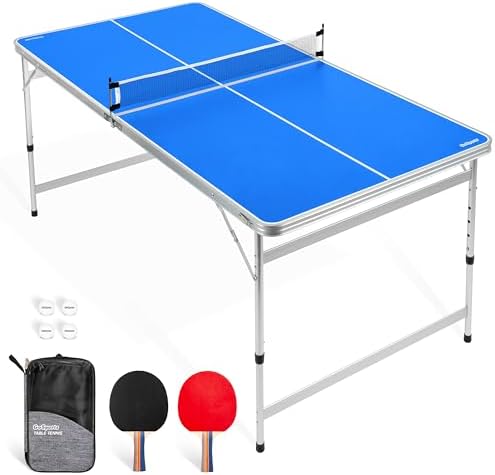
Compact-space pick: GoSports 6 x 3 ft Mid-Size Table Tennis Table Set with Adjustable Height - Green or Blue
 Visit on Amazon →
Check current Amazon price. This is the table I point parents toward when the room is a two-car garage bay or a finished basement corner. The 6 by 3 foot footprint is three quarters of a full-size table, which sounds like a compromise until you realize that a full-size table in a room that is too small is a table you never unfold. The adjustable height in the name matters more than it sounds, because it means the legs give you something to work with when the floor slopes.
The tradeoff of a mid-size top is that the ball arrives at your opponent slightly sooner than it would on a full-size table, so your footwork gets a little quicker than the real thing. For a family, that is fine. For a junior training for tournaments, it is a supplement, not a substitute. Set it up with the steps below, and it will play honest for years.
Flaws but not dealbreakers: Mid-size means mid-size. If you have the room for 9 by 5 feet and playing clearance around it, buy the bigger table. This one is for rooms that cannot take it.
Anyone with limited floor space who wants a table that gets used instead of stored should start here.
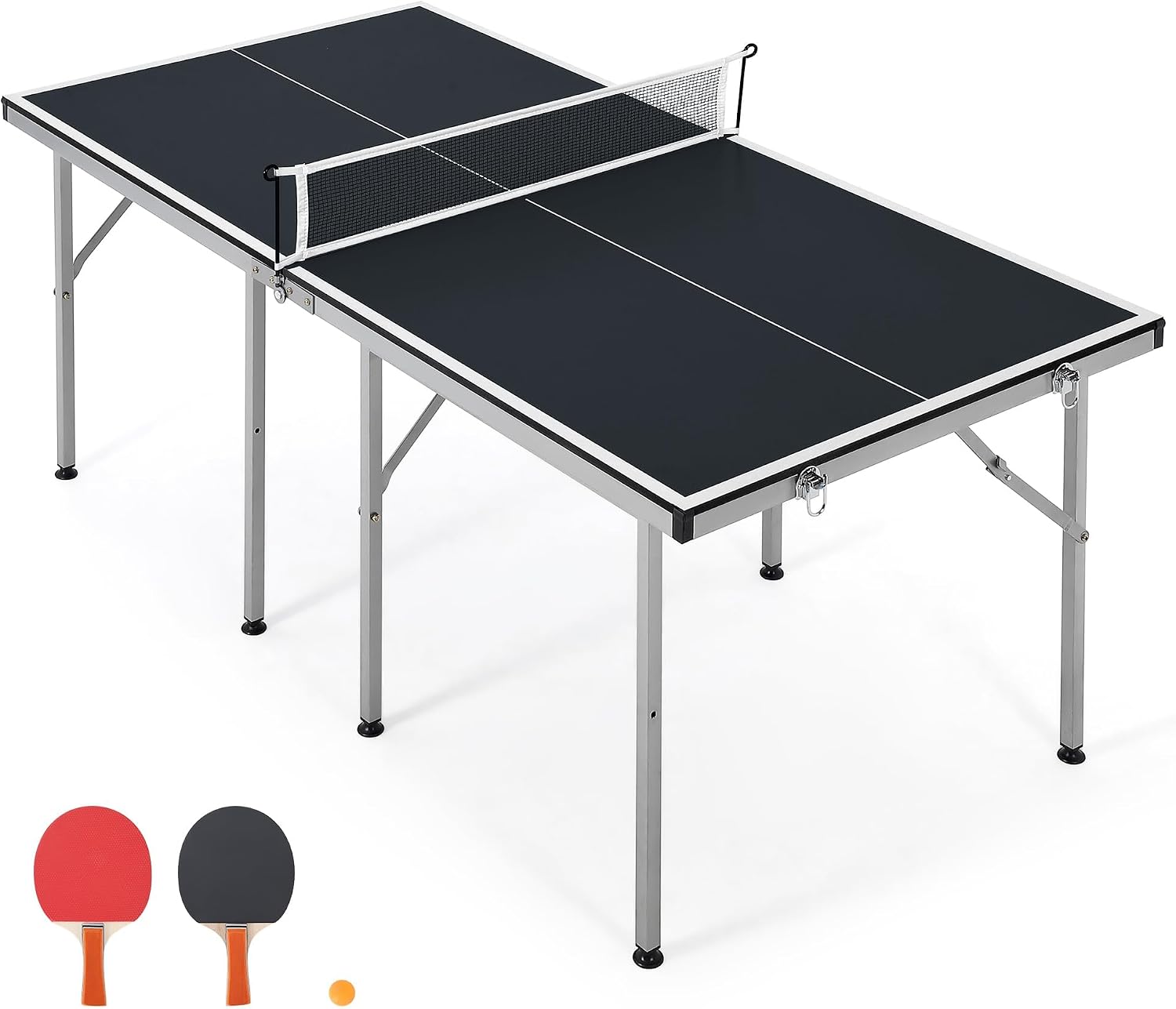
Versatile pick: Garvee Indoor/Outdoor Table Tennis Tables Multiple Styles Ping Pong Tables
 Visit on Amazon →
Check current Amazon price. This listing covers more than one configuration, which is both the appeal and the thing to be careful about. Multiple styles means you need to pick the style that matches your room before you order, not after the box arrives. Read the listing and confirm the footprint and the top you are actually getting.
As I said above, I do not review outdoor play. What I can tell you is that a table marketed for indoor and outdoor use is built around a compromise, and the compromise usually shows up in how the top handles a ball. That does not make it a bad buy. It makes it a table where setup and leveling matter more, because you are asking one surface to behave well in two very different environments.
Flaws but not dealbreakers: The style choices mean two buyers can order the same listing and get different tables. Decide which one you want before you click, and check the surface and leg details on the specific style you pick.
Anyone who wants one table for a covered porch in summer and a garage in winter, and who understands they are buying a flexible table rather than a club table, will get along with it.
The actual setup workflow
Now the part you came for. This works on any folding table, mid-size or full.
Step one: Choose the floor before you choose the spot. Concrete garage slabs slope toward the door. Basement floors have low spots. Carpet swallows the leg feet and lets the table rock. Walk the area with a level before you unbox anything. If the only flat spot is against a wall, measure your playing clearance first. You want roughly 4 feet behind each end and 2 feet on each side, or you will be playing defense with your elbow against drywall.
Step two: Unbox in the room where the table will live. I have watched three different families assemble a folded table in a driveway and then try to get it through a 30 inch doorway. Assemble it where it is going to stay, or at least in the room next to it.
Step three: Follow the manual for the first assembly. The halves and the hinge hardware are the one part of this process where improvisation costs you. Get the hinge bolts snug, not torqued to the point where the top starts to bow.
Step four: Level the legs, not the table. Put the table on its legs, then lay a four-foot level across the surface front to back and side to side. Adjust the leg feet until the bubble reads the same in both directions. On a floor that slopes, you may end up with one leg extended and the opposite leg nearly collapsed. That is correct. A level table on a sloped floor is the goal, not a table that matches the floor.
Step five: Check squareness with the carpenter's square. Then do the diagonal check: measure corner to corner one way, then the other. Equal diagonals mean a square frame. Unequal diagonals mean the hinge is loose or the frame is racked, and no amount of leg leveling will fix a racked frame. Tighten the hinge hardware and re-measure.
Step six: Run the nine-point bounce test. Take a three-star ball and drop it from 30 cm, measured from the bottom of the ball to the surface, at nine points. Watch the rebound height. The ITTF reference is about 23 cm. What matters is consistency: if eight points agree and one is short, that corner is dead. Check the leg under it, check that the top is fully seated on the frame, and check that the hinge is not pulling the surface down.
Step seven: Set the net properly. The net height is 15.25 cm above the surface at the posts and along the whole length, not just in the middle. A net that sags in the center turns every push into a pop-up. Tighten the clamp until the cord is firm and the net touches the table as closely as the hardware allows.
Step eight: Test the folding mechanism twice, with your fingers out of the way. Fold and unfold the table two full cycles before you trust the latch. Listen for the click. Then test the casters: lock them, push the folded table sideways, and confirm it does not move. I have seen a folded table roll into a car door because nobody checked the lock. Locking casters are not a luxury feature, they are the reason your car has paint.
Step nine: Mark the spot. Put a strip of tape on the floor at each caster, in both the playing position and the storage position. Now the table goes back to the exact same place every time, and you never repeat steps four through six.
The competition and why it lost
The tables I left out of this guide fall into three groups, and each one was left out for a reason.
The 12 mm foldables that advertise themselves as tournament-grade. Thickness is not quality, and a thin top over a hollow core bounces worse than a slightly thicker one with a solid core. Marketing that puts the word tournament on a table that would not survive a single club session is the reason so many families end up with a table that warps in the first winter.
The $1,200 club tables. I would love every junior in my program to practice on the 19 mm solid-core tables we use at the club. Families cannot spend that, and they should not have to. A properly set up mid-size table in a spare room beats a club table that stays folded because there is no room for it.
The dedicated outdoor tables. Different material science, different failure modes, and a different guide. If your table is going to live outside in the rain, buy for that, and do not expect an indoor setup procedure to apply.
What this all costs
Both tables in this guide sit in the same tier, and the difference between them is footprint and flexibility, not quality bracket. Check current Amazon price on each listing and compare, because the number moves and the two listings are not far apart.
The honest way to think about the cost is per session. A table that lasts eight years and gets used twice a week is a few cents per session, and a table that warps in year two because it was never leveled and stored damp is expensive no matter what you paid. Add the tools if you do not own them: a four-foot level, a carpenter's square, and a tape measure. Those three items cost less than one replacement net set and they will outlast the table.
The hour you spend on setup is the cheapest part of the whole purchase, and it is the part that decides whether the table plays straight in October and still plays straight in April. Do the nine-point test once, mark the floor, and get on with the actual game.