Most table tennis tables are bought in a burst of enthusiasm and set up in a hurry, and that order is backwards. Table tennis table setup is the part that decides whether the next five years of practice are worth anything, and it costs you an afternoon, a level, and one ball.
I have walked into a garage, dropped a ball on a table that looked perfectly fine from the doorway, and watched the bounce die three inches from the corner. A table like that does not just play badly. It teaches everyone in the house to flinch, and flinching is the hardest habit to unlearn.
I run a community club in a converted warehouse in Milwaukee with six tables. I played competitively in the Czech Republic as a teenager, and I have spent the last fifteen years setting up, leveling, and repairing club tables, school tables, garage foldables, and a few outdoor slabs that should never have left the factory. My tool bag holds a carpenter's square, a four-foot level, a tape measure, and a bag of composite shims.
My rule is simple. The table is 10% of your game and 90% of your headaches. Bounce consistency is the only spec that matters, and it is the one spec nobody prints on the box. What follows is how to pick the right kind of table for where it will actually live, and then how to set it up so it stays honest.
Why you should trust me
I have kept six club tables alive through six hours of daily play, and I have fixed more than forty folding mechanisms, most of them on tables that were fine until someone dragged them across a floor with the casters unlocked. I check my club tables with a carpenter's square and a dropped ball every Monday before the juniors arrive, because a table that drifts out of level during the week will quietly change how a kid swings.
I am not a paddle guy. If you want rubber advice, go to a specialist, because that is a different science and I will not pretend otherwise. This is about the slab under your feet, which is the part I actually know from experience.
How I picked and how I tested
Here is my honest framing, because you deserve it. The two tables below are recommendations from their build and their intended job, not claims that I camped in a showroom with a stopwatch. What I can give you is the method I run on every table that comes through my door, and it is the method you should run on whatever arrives at yours.
Every table gets the same treatment: a level check in both directions, a corner-to-corner diagonal measurement for squareness, a net-tension check, and the nine-point bounce test with a ball dropped from 30 cm. Thickness numbers on a box are marketing until a ball proves them. I have seen thick tops with hollow cores bounce worse than thin tops with solid ones, and I have seen a cheap table that measured beautifully at the middle go dead at the corners.
So I organize these picks by situation, not by spec sheet. A garage table is a different product from a club table, and reviewing them the same way is how people buy the wrong thing.
The table for a spot that never moves
If the table will sit outside or stay in one place indoors, do not pay for folding hardware you will never use. Weight and rigidity are your friends here, and anything that hinges is a place where the playing surface can eventually sag.
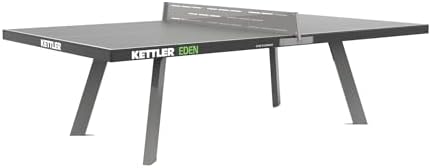
Permanent outdoor pick: KETTLER Eden Weatherproof Stationary Outdoor Table Tennis Table with Galvanized Steel Legs and Permanent Net and Post System
 Visit on Amazon →
I usually tell people to keep their money indoors, because an outdoor table is a different material science and the surface plays differently from a club table no matter how good it is. But if your only space is a patio or a side yard, then this is the category to shop in, and the KETTLER Eden is built the way an outdoor table should be built: weatherproof construction, galvanized steel legs, and a stationary frame with no folding mechanism to fail.
That last point matters more than people realize. Folding mechanisms are where tables die, and I have repaired enough of them to say it plainly. A stationary table removes that entire failure point. The permanent net and post system does the same thing for the net, since there is nothing to clip on and nothing to lose tension between sessions.
What you give up is portability. This table does not fold and does not roll into a corner for the winter, so it needs a permanent footprint on a flat, well-drained surface. It also needs a level base, because the legs are not going to invent flatness that your patio does not have.
Flaws but not dealbreakers: You cannot bring it in for a storm, so location is everything. Plan its spot before you order, not after.
Anyone with a dedicated patio pad and a family that will actually use it outdoors should start here.
The table for a garage, a basement, or a tight space
Not everyone has room for a full-size footprint, and pretending otherwise is how you end up with a table that lives folded against a wall forever.
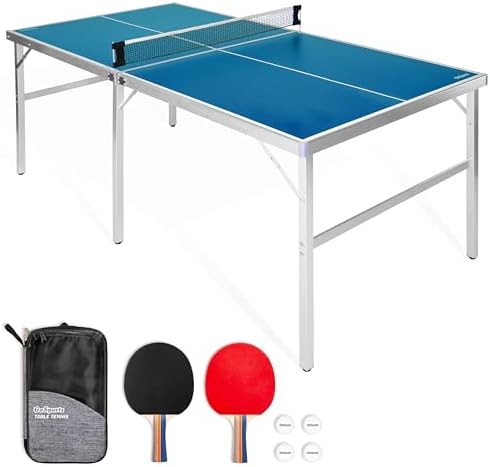
Portable pick: GoSports Mid-Size Table Tennis Game Set - Red or Blue - Indoor/Outdoor Portable Table Tennis Game with Net, 2 Table Tennis Paddles and 4 Balls
 Visit on Amazon →
The GoSports mid-size game set is the right answer for an apartment, a dorm, a kid's first year of the sport, or a family that wants to play on the patio and put everything away afterward. It is a mid-size game, not a regulation table, and I want to be blunt about that distinction because it is the whole point. It comes with the net, two paddles, and four balls, so it is a complete start rather than a top you have to accessorize.
Set your expectations honestly. A mid-size surface will not teach you the footwork or the angles of a full-size table, and the bounce will not match a club table. What it will do is get a family playing today, indoors or out, with no footprint and no assembly project. That has value, and for a lot of households it is the difference between playing and not playing.
The tradeoff is durability under hard use. Portable gear is portable gear, so store it dry, keep it out of standing water, and do not leave it set up on a lawn that soaks through.
Flaws but not dealbreakers: It is a small table by design, so serious juniors will outgrow it. If your kid is already training, buy the permanent option above or a full-size table, not this.
Anyone short on space, short on budget, or buying for kids who just want to play will get real use out of this.
The actual setup workflow
This works on any table, folding or stationary, indoor or outdoor. Do it once, properly, and you will not think about it again for years.
Step one: Decide where the table lives before you open the box. A table that moves twice a week needs locking casters and hardware you trust. A table that never moves does not. Write the location down. If you cannot answer this question, you are not ready to buy.
Step two: Fix the floor, not the table. Outdoors, that means a concrete pad or tightly fitted pavers, because grass and gravel settle and take your level with them. Indoors, check the slab or the garage floor with a four-foot level before assembly. If the floor drops across the footprint, no adjustable foot will save you. Shim under the legs with composite shims, not wood, because wood crushes and stops being a shim.
Step three: Unbox onto cardboard and inspect the edges. Slide the tops out flat rather than tipping them up onto a corner. Shipping damage almost never shows in the middle of the surface. It shows along the rails and at the corners, so look there first and photograph anything questionable before you assemble a thing.
Step four: Assemble the undercarriage in the order the manual gives you. Half the folding tables on the market are built upside down first, and people fight them for an hour because they are reading the pictures wrong. First assembly follows the manual exactly.
Step five: Check square by measuring the diagonals. Measure corner to corner across the frame in both directions. If the two numbers differ, the halves will not meet flush and the table will not fold flat. Loosen the frame bolts, work it square, retighten.
Step six: Level in both directions. A level laid across the short dimension, then the long one. Outdoors, aim for dead flat rather than tilted to drain, because standing water under a table is what kills the frame first.
Step seven: Set the net to spec. The top of the net should sit 15.25 cm above the playing surface at the center. Tension it so a ball hit into it drops straight down instead of kicking back. A sagging net turns every serve into guesswork.
Step eight: Run the nine-point bounce test. Drop a ball from 30 cm at nine points in a rough grid. Write down each rebound height. I care about the spread, not the average. If the middle gives you one number and the corners give you another, you have a warped top or an unlevel floor, and you should fix it or return it before you spend a season practicing on it.
Step nine: Lock the casters and check the folding locks every single time. I have watched a table roll into a car door. I have also seen a kid get a finger pinched in a lock that snapped shut. Make the check a habit and nobody gets hurt.
Step ten: Recheck level and bounce at the start of every season. Wood and composite move with humidity, and a table that was perfect in October is not automatically perfect in May.
The competition and why it lost
The club-standard 19mm indoor tables from the tournament brands are excellent tables and the wrong answer for most homes, mostly because the price has nothing to do with how much better your basement game gets. That is a real purchase for a real club, not for a family.
A ball machine, a set of upgraded rubbers, and a club membership are all worth your money eventually, and none of them belong in this article. Neither does a paddle review, which I do not write. Get the table square and level first. Everything else is a smaller variable than the slab you are standing at.
What this all costs
The money splits into two piles. The table is the one-time purchase, and the balls and paddles are the recurring one, which is why I would rather you spend once on the right table than twice on the wrong one. Both tables here show their live numbers on the product pages, so check current Amazon price before you commit, and compare that against how often the table will actually get used.
The setup itself costs nothing but an afternoon. A four-foot level and a bag of composite shims will run you less than a decent meal, and they are the tools that make the difference between a table that plays and a table that argues with you for five years.
That is the job. Buy for the spot you have, set it up square, level it properly, and test the bounce with a ball before you play a point on it. Your table was built to do this. Let it.