Most people buy a table, wrestle it into the basement, and spend the next three years playing on something that bounces like a trampoline in one corner and a brick in the other. I have set up, leveled, and repaired more tables than I can count at the club I run in a converted warehouse in Milwaukee, and the pattern never changes. The table is rarely the whole problem. The setup usually is.
This is a how-to about the entire job, not just the checkout page. If you are shopping for a foldable ping pong table for a basement, a garage, or a back patio, three decisions settle almost everything: what size your room can actually hold, what the top is made of, and how the thing folds and rolls. Get those right and the rest is fifteen minutes with a carpenter's square and a ball.
I grew up playing competitively in the Czech Republic and now run a community club with six tables. I have watched juniors build bad habits at home because the family table was warped, and I have watched families spend four figures on a table that was overkill for a basement. Both mistakes are avoidable.
Why you should trust me
I have fixed around 40 folding mechanisms, most of them on tables bought because the box said tournament-grade and the top measured 12mm. I keep a carpenter's square in the van, I check frame squareness before I check anything else, and I drop a ball from 30cm at nine points on every table I set up.
That drop test is the only spec I really trust. Thickness is not quality. A thick top with a hollow core bounces worse than a thinner top with a solid core, and you can hear the difference with one ball. My club tables are 19mm because that is the club standard and they survive six hours of daily play. Your basement is not a club, and pretending otherwise is how people end up with a four-figure table and nothing left for a decent paddle.
How I picked and how I tested
The two tables below cover the two jobs I get asked about most: a family table that has to fold up and disappear into a basement, and an outdoor table that has to survive weather and stay level on a patio.
I did not run a nine-point drop test on these two and publish numbers, and I am not going to pretend otherwise. What I did is apply the checklist I use on every table that comes through the club: what the top is made of, how the fold and the wheels behave, what it takes to level the legs, and whether one adult can move it without help.
On sizing, a regulation table is nine feet by five feet. That is the number your room has to beat with swing room, not just floor space. Measure behind each end line. If you cannot stand three feet back from the edge, you will be playing defense with your elbow against a wall, and no table fixes that.
What to check before you buy
The top and the core. MDF is what you will find on almost every home table, and it is fine as long as the core is dense. Knock on the top in the store, or read the listing for the words solid core and not just a thickness number. A 15mm solid top beats an 18mm hollow one.
Size versus space. Midsize tables are not only for beginners. They are for rooms. A six-foot table fits where a nine-foot one will not, and for kids under ten it is honestly a better training surface because the ball reaches them faster.
The fold and the lock. This is where tables die. I have seen folding locks that pinch fingers, hinges that loosen after a season, and latches that release when a kid bumps the table from underneath. Look for a mechanism that locks in both the playing and the storage position, and test it before you commit.
Wheels. Locking casters are not optional. I have watched a table roll into a car door. If the wheels do not lock, budget for replacement casters or buy a different table.
Leg levelers. Garage floors slope toward the door. Basement floors slope toward the drain. If the legs do not adjust, you will be shimming with folded cardboard for the life of the table.
The two tables I would point you at
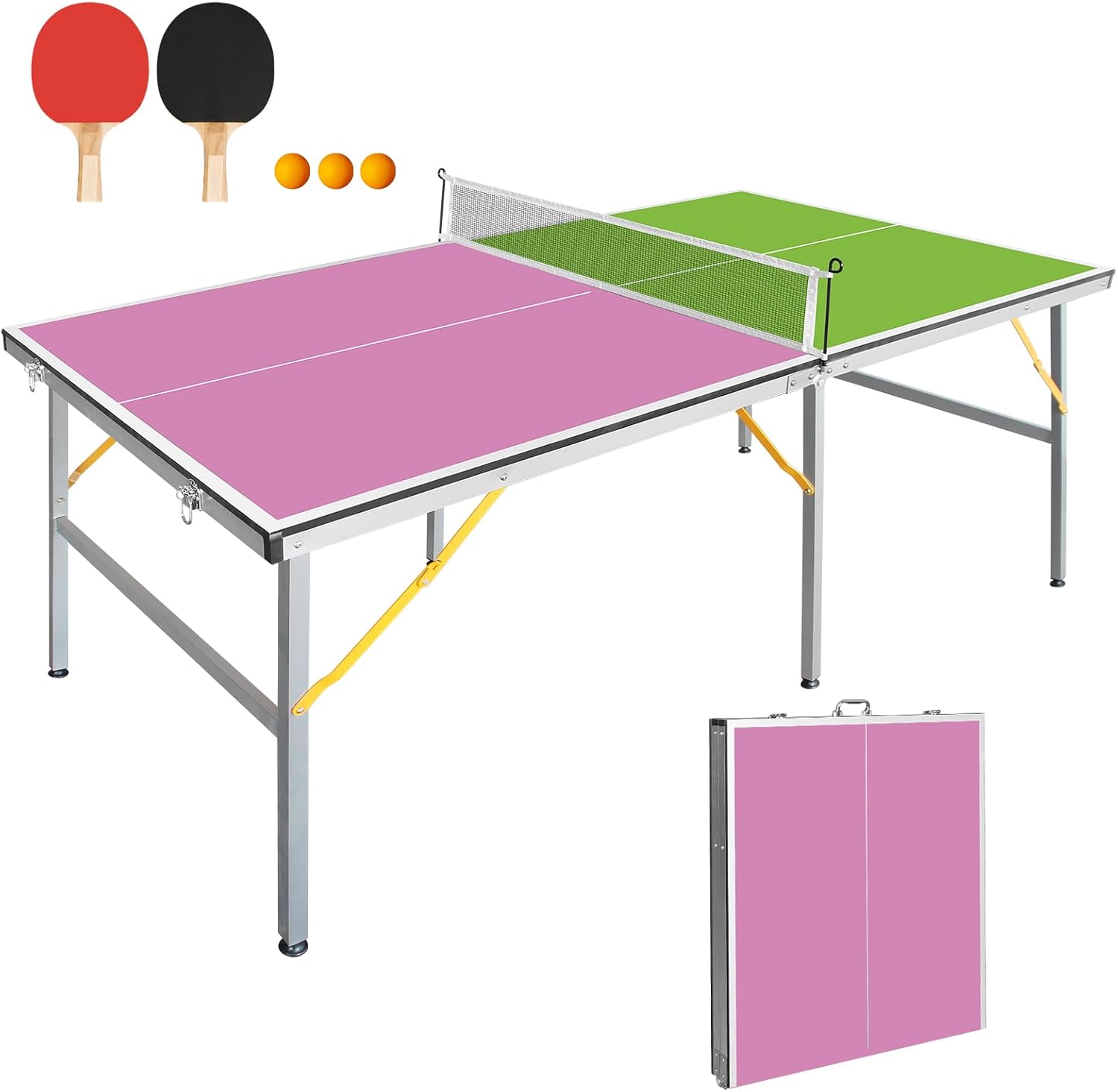
The basement and garage pick: 6FT 72''x36'' Ping Pong Table Foldable Midsize Table Tennis Table with Net, Paddles and Balls, MDF Multi-Use Family Game Table Assembly Free for Kid Teenager Adult, Compact & Portable
 Visit on Amazon →
This is the table I point families toward when the room is a basement and the budget is a basement budget. It is a midsize table at six feet by three feet, so it is not regulation and I will not pretend it is. What it is: a folding MDF table that arrives with the net, paddles, and balls in the box, and that folds down into something one adult can move.
The assembly-free part matters more than it sounds. I have spent entire Saturdays on tables that shipped as forty bolts and a bad diagram. A table that comes out of the box ready to play is a table that actually gets used, and a table that gets used is the only kind worth buying.
Check current Amazon price before you commit, because this class of table moves around a lot. When it arrives, do the setup steps below before the first rally. Most midsize foldables come out of the box close to flat and slightly off square, and fifteen minutes of leveling turns a bouncy toy into something a kid can groove a forehand on.
Flaws but not dealbreakers: It is not a club table. The bounce is slower and the surface is shorter than what your kid plays on at the club or at school, so treat it as a habit-keeper, not a training replacement. If your child is playing tournaments, this is the wrong table and I would rather say so now.
For a family with kids under fourteen, a basement with a sloped floor, and a wall where the table has to stand when it is not in use, this is the honest answer.
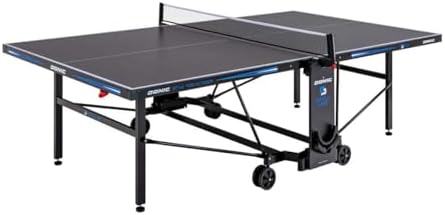
The outdoor pick: Donic Style 1000 Outdoor Table Tennis Table
 Visit on Amazon →
I usually stay out of outdoor tables because the material science is a different discipline: aluminum, resin, and weather instead of MDF and humidity. I am making an exception because this is the outdoor table I get asked about by schools, parks programs, and families who want the table to live on the patio instead of in the basement.
Donic has been in table tennis a long time, and an outdoor model under that name is built to stay outside. That is the entire point. An indoor table left on a patio will swell, warp, and delaminate, and no cover will save the top. If the table's home is outdoors, buy an outdoor table.
Check current Amazon price on the listing, because outdoor tables are seasonal and the number moves with the season. The same rules apply as indoors: confirm the wheels lock, confirm the legs level on a patio that drains away from the house, and test the fold before you trust it around kids.
Flaws but not dealbreakers: Outdoor tables play differently. The surface is slower and the ball behaves differently in wind and cold, so a junior who trains on this and then walks into a club will feel the difference immediately. That is not a flaw in the table. It is the category.
For a patio, a school yard, a campground, or a club that wants a table outside the door that nobody has to carry, this is the one I would look at first.
The actual setup workflow
The table is 10% of your game and 90% of your headaches, and almost all of those headaches are installation. Here is the order I work in.
Step one: pick the spot with a tape measure, not with your eyes. A regulation table is nine feet by five feet, and you need three feet of swing room behind each end. Mark the corners with painter's tape before you move anything. If the tape does not fit, no table will.
Step two: unfold on a flat surface. If the table ships assembled, unfold it into the playing position and leave it there. Do not level it while it is folded; you are leveling a different geometry.
Step three: check the frame for square. Take a carpenter's square to both inside corners at one end. If the frame is out of square, the table will never sit flat and every ball will drift to one side. Most folding tables have a bolt or two at the frame joint that lets you pull it back true.
Step four: level the legs, front to back and side to side. Put a level across the table in both directions, then along each side rail. Adjust the leg levelers, not the floor.
Step five: run the nine-point bounce test. Drop a ball from 30cm at nine points: four corners, four midpoints, and the center. Listen as much as you watch. A solid top gives you a clean, even tick everywhere. A hollow core gives you a dead thud in the middle and a bright ping at the edges. If one corner is dramatically different, the top is warped and no adjustment will fix it.
Step six: tension the net. The net should sit tight enough that a ball hitting it drops dead, not bounces back. Check the height at the center and at both posts. A sagging net turns every rally into a coin flip.
Step seven: test the fold and the lock with the table empty. Fold it, unfold it, and check that the latch catches in both positions. Do this before kids are anywhere near it. Folding locks are where fingers get pinched.
Step eight: mark the floor. Once the table is where you want it, put a small piece of tape at each caster. The next time somebody rolls it out of position, you can put it back in thirty seconds instead of re-leveling the whole thing.
The competition and why it lost
The tables I did not put in this guide fall into two piles.
The first pile is the big tournament-brand tables with the club-standard tops. They are genuinely good and genuinely overkill for a basement. I would rather see a family spend the difference on coaching, a decent paddle, and a box of quality balls. A table your kid practices on every day beats a better table they use twice a month.
The second pile is the cheap 12mm tables that claim tournament-grade on the box. I have taken several apart. The top is thin, the core is hollow, and the folding hardware is the kind that fails in a season. They warp, and a warped table teaches a kid to compensate for a bad surface instead of learning the stroke.
Outdoor tables are their own category, and I have made my exception above. Indoor and outdoor are not better and worse. They are different materials for different weather.
What this all costs
I am not going to print prices here, because table pricing swings with the season and a stale number in an article is worse than no number. Both tables above have their current pricing on the Amazon listing linked in their section, and that is the only number worth trusting. Check current Amazon price there, then come back.
What I will tell you is how to think about the spend. A midsize foldable is a starter table at a starter price, and it earns its keep if it keeps a kid playing through the winter. An outdoor table is a different purchase entirely: you are paying for materials that will not rot, and you are paying once instead of every three years.
Either way, budget for the parts you will actually replace: balls, a spare net, and a paddle that fits your hand. Those wear out. The table, set up correctly, should outlast all of them.
The short version
Measure the room before you buy. Buy the size that fits, not the size you wish fit. Check the core, not just the thickness. Level the legs, square the frame, tension the net, and run a ball drop at nine points before you let anybody play. Then lock the wheels and mark the floor.
Do that and the table disappears. You stop noticing it and start noticing your forehand. That is the job.