Most home ping pong table setup jobs fail before the first ball is hit. The box gets opened, the legs get bolted on, the net gets clamped, and the family plays on a table that sits a couple of degrees out of level with a soft spot in the middle. Nobody notices until a slow ball breaks sideways at the worst possible moment, and then everyone blames the paddle.
I have set up, leveled, and repaired more tables than I can count, including the six that live in the community club I run out of a converted warehouse in Milwaukee. The routine I use is boring and it works: square the frame, level it on the actual floor it will live on, then run a bounce test at nine points before anyone plays a match.
Home ping pong table setup is maybe 20 percent assembly and 80 percent the two things nobody does, leveling and bounce testing. Do them once, on the day the table arrives, and you will not fight the table for the next five years.
Why you should trust me
I learned this game in the Czech Republic as a teenager, played competitively, and immigrated at 20. My club runs six tables, four of them bought used, and I have rebuilt the folding mechanisms on around 40 tables over the years. Most of those failures came from people dragging a folded table across a garage floor instead of lifting it.
When a table comes into my warehouse, it gets measured. I check panel thickness, bounce height with a ball dropped from 30cm, and frame squareness with a carpenter's square. I keep a dated list of predictions about the equipment market and score it every January, which is a habit that keeps me honest about what actually changed and what I just assumed.
I do not review paddles, and I do not review outdoor tables. Paddle rubber is a specialist's conversation, and outdoor tables are a different material science. What I know cold is the table itself and the room it sits in.
How I picked and how I tested
This is a two-item guide, not a catalog. A home room needs a table that survives family use and a house set of paddles and balls so guests are not digging through your good gear. Those are the two decisions that matter, and the rest is setup.
For the table, I look at four things in this order. Frame squareness out of the box, because a table that arrives twisted never fully recovers. Core construction, because thickness alone tells you nothing. The folding mechanism, because that is where tables die. And the net system, because a clamp net you can tension and remove in half a minute gets used, while a bolt-on net that takes ten minutes gets left sagging.
For the set, I look at whether it is honest about what it is. A house set is for guests, kids, and the friend who shows up in jeans. It is not a tournament paddle, and any set that markets itself that way is telling you something about the marketing, not the rubber.
The table and the set that make a home room work
Two products, two jobs. One is the surface everything else depends on, and one keeps the surface from being abused by visitors who grab whatever is closest.
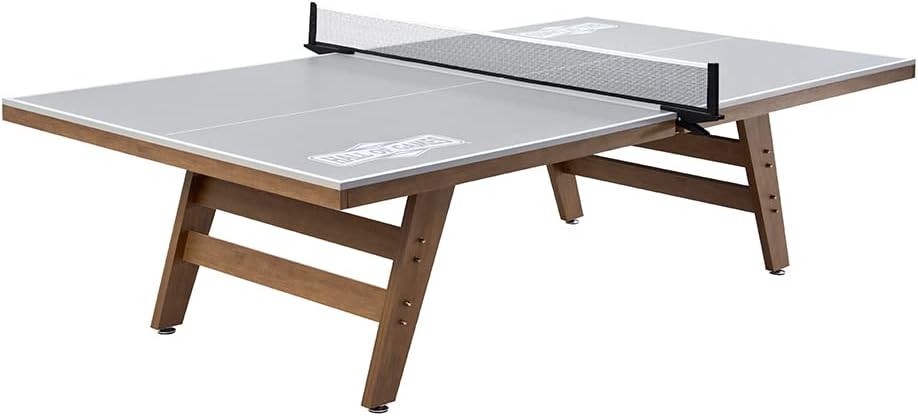
The family-room table: Hall of Games Table Tennis Tables Multiple Styles, Furniture Quality Ping Pong Tables with Easy Clamp Nets, Perfect for Family Game Rooms
 Visit on Amazon →
This is the table I point families toward when the room is a family room first and a table tennis room second. The name says furniture quality, and that is the honest framing. It is built to look right in a finished basement or game room, and the multiple style options mean you can match the room instead of dropping a blue slab in the middle of it.
The easy clamp net is the feature I care about most here. A net you can tension properly in under a minute is a net that stays at the right height, and net height is one of the few things in this sport that is not negotiable. Being able to pull it off for movie night and put it back without tools is a bigger deal than it sounds.
Check current Amazon price before you order, because stock and pricing on furniture-style tables move around. Then read the spec sheet for panel thickness and core construction, since that is what decides bounce quality.
Flaws but not dealbreakers: Furniture-first tables trade some club-level rigidity for looks. If you are training for tournaments, this is not the table you want in your basement. If you are playing family matches and the occasional serious practice, it is exactly the right compromise.
Anyone with a finished basement or a game room that has to look presentable the other 350 days a year will be happy with this one.
The house set: STIGA Premium 2-Player Table Tennis Set
 Visit on Amazon →
This is the set that lives in the drawer under the table, not in your tournament bag. Two paddles and balls for whoever walks in the door, so nobody reaches for the gear you actually compete with and nobody plays with a paddle that has been sitting in a hot car since June.
Check current Amazon price on it. At the accessory end of the market, the question is not whether a set like this will outplay a serious paddle, because it will not. The question is whether it gives a beginner a consistent enough surface to learn a basic stroke without fighting the equipment, and whether it survives being handed to a twelve-year-old who leaves it on the floor.
Flaws but not dealbreakers: These are house paddles. The rubber is built for durability and forgiveness, not spin. If someone in your family gets serious, that is a separate purchase and a separate conversation with a specialist.
Anyone who wants guests to be able to play the moment they walk in the door should have a set like this on hand.
The setup workflow, step by step
Now the part that actually decides how the table plays. Set aside an hour and a half and get one other person to help.
Step one: Pick the room before you pick the table. You need roughly five feet of clearance on every side, more behind the ends than on the sides. A table jammed against a wall teaches bad habits, because nobody can step around a serve.
Step two: Check the floor. Garage floors slope toward the door. Basement floors slope toward the drain. Concrete settles. Put a level on the floor where the legs will land and note where the low spot is, because that is the leg that will need shimming.
Step three: Assemble upside down. Lay the two halves face down on a blanket and bolt the frame and legs with the playing surface protected. Two people, not one. A table half dropped on a corner is a table half that never sits flat again.
Step four: Square the frame before you flip it. Run a carpenter's square into both corners and measure the diagonals. If the two diagonal measurements do not match, the frame is racked, and you loosen the bolts and pull it square before tightening them back up.
Step five: Flip it and level each leg. Use the adjustable feet, and shim under them if the floor is badly out of level. A carpenter's level across the two ends and across the two sides tells you which corner is high. Do not trust the bubble on the table frame alone, because the frame can be level while the floor underneath it is not.
Step six: Set the net. Clamp it, then tension it until the cord is firm and the top of the net is level across its full length. A sagging net in the middle is the most common thing I fix at other people's houses.
Step seven: Lock the casters. If the table has wheels, every one of them gets locked the moment it lands in position. A table that rolls an inch during a rally is a table that is moving while you play. I have seen a table roll into a car door, and I do not want to see it again.
Step eight: Run the bounce test. Details below. Do it before the first match, not after.
The bounce test, with numbers
Drop a ball from 30cm above the surface at nine points: four corners, four mid-sides, and dead center. Let it bounce and watch the height, and listen to the sound.
What you want is consistency. The ball should come back to roughly the same height at all nine points, and the sound should be the same dull thud everywhere. If the center bounces lower than the corners, the core is soft or the frame is not supported underneath. If one corner bounces noticeably higher or lower than the others, that corner is not level or the panel is warped.
The test takes four minutes and it tells you more than any spec sheet. It is also the reason I say thickness is not quality. A thick table with a hollow core bounces worse than a thinner one with a solid core, and the ball does not care what the marketing copy says about millimeters.
Write the results down the day the table arrives. Re-run the test every few months, especially after a humid summer or a cold winter in a garage. Tables move. Knowing how yours moves is how you catch a problem while it is still a shim and not a replacement.
Where home tables go wrong
The failures I see are predictable. Humidity in a garage swells the core and the surface ripples, which is why a climate-controlled room beats a shed every time. Direct sun through a window over a few summers will lift paint where the ball lands, and that spot plays different forever.
Folding locks pinch fingers, so keep kids away from the mechanism while an adult folds it, and never drag a folded table across concrete. Locking casters are not optional on any table that gets moved, and if a table you are considering does not have them, keep looking.
And be skeptical of anything calling itself tournament grade at 12mm. Tournament tables live at 18mm and up with a solid core, and a thin foldable with a tournament sticker on the box is still a thin foldable. That word on a product page is the single most reliable warning sign in this market.
What this all costs
Two line items do the work here: the table and the house set, both linked above with Check current Amazon price. Everything else in this guide is either free or close to it. A carpenter's square, a level, a few shims, and a ball for the bounce test.
The math that matters is not the purchase price, it is the cost per year. A table that plays straight for a decade is cheaper per session than a cheap one that warps in eighteen months and gets replaced, and that is before you count the bad habits a warped surface teaches a kid who is learning to read spin.
The bottom line
Buy a table that fits the room you actually have, set it up with a second person and a carpenter's square, level it on the floor it will live on, and run the bounce test before anyone plays a match. Keep a house set of paddles within reach so your good gear stays out of the wrong hands.
None of that is complicated. It is just the part of home ping pong table setup that most people skip, and it is the part that decides whether the table plays the same in year five as it did on day one.