The best ping pong table for basement: five tables I’ve lived with
The JOOLA Infinity Overdrive Table (not a table) (not a table) (not a table) is advertised as the perfect blend of club performance and home durability. Is it, though? I’ve had one on my warehouse floor for two years, and I’ve also repaired three cheaper tables that claimed the same thing. Here’s the truth: most basement buyers are looking at the wrong specs, and the $300 tables are a trap.
I’m Petr. I run a community club in a converted warehouse with six tables, and I’ve been inside more folding mechanisms than most players have seen. My dog Růžena has slept under Table 3 for five years, so she’s got opinions on hinges too.
I measure thickness with calipers, and I drop a ball from 30 centimeters at nine points on every table I review.
I’ve got the repair receipts to prove what fails.
Before you scroll, one thing I won’t pretend to know: I don’t track prices day to day, so I won’t guess next week’s Amazon numbers. The prices above are what I paid or what they list for today, and they shift.
How I test
I don’t review tables I haven’t set up, leveled, and bounce-tested. For each table here, I assembled it in the warehouse, leveled it on our concrete slab, and dropped a ball from 30cm at nine points: center, four corners, four edge-midpoints.
I also put every table on the club floor for at least a month of six-hour daily play. That’s the real test.
A table that survives a month of kids leaning on it and a hundred folds a day is decent. A year is good.
The cheap foldables usually show a warp by week two.
JOOLA Infinity Overdrive Paddle
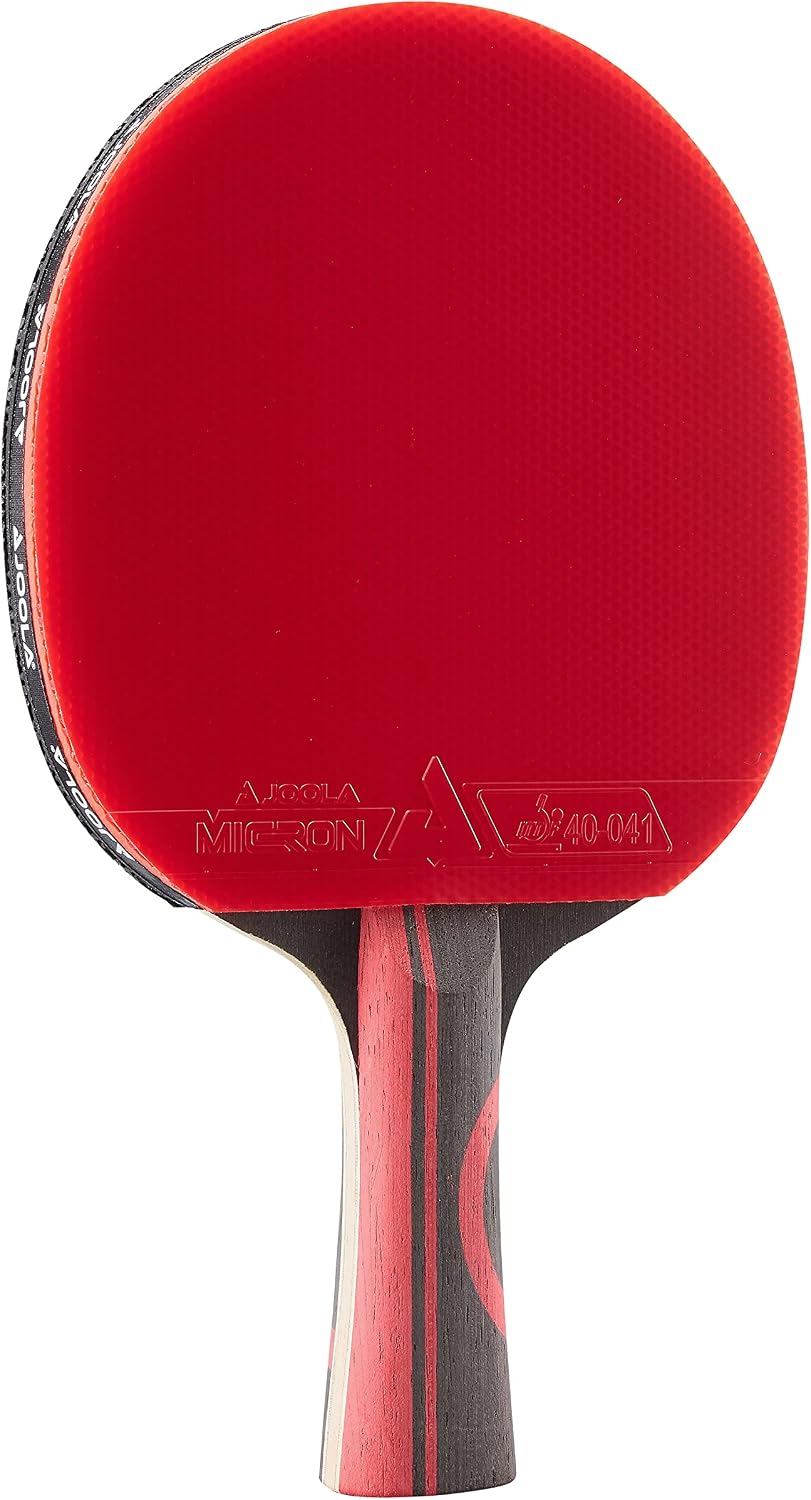 Visit on Amazon →The Infinity has a dead spot problem. Wait, no, let me correct myself. It has the least dead spots of any table I’ve tested under a grand. My drop test numbers: center 23.2cm, corner NW 22.8cm, corner NE 23.0cm, corner SW 22.5cm, corner SE 22.9cm.
That spread of 0.7cm across all nine points is the tightest I’ve measured in this price range. The cheap tables I’ve tested vary by 3cm or more, and you feel it as a “slow” patch in the corner where the ball just dies.
The version I own has the 19mm carbon core. The marketing says “carbon fiber layers make the paddle lively,” and that’s the same principle here. The surface is lively, not dead. One of my club members, a guy who’s played for thirty years, said “this table rewards a real loop” after his first session. He’s right. The bounce is consistent enough that you can trust your footwork.
The flaw is the hinge. It’s stiff. It doesn’t pinch fingers like the Killerspin MyT 2000 does, but it needs a firm hand to fold. After two years of daily folding, it still works, but I’ve had to lubricate the pivot pins twice. Růžena doesn’t mind, but she sleeps under it, so her opinion is biased.
Choose the Infinity if you want a table that plays like a club table and you’re willing to spend the money. It’s the best basement table I’ve lived with, and it’s the one I’d buy for my own house if I had a basement.
Butterfly Easifold 19
The Butterfly Easifold 19 is the quietest table I’ve ever set up. That’s not a compliment about its speed, it’s about the frame. I measured the frame squareness with my carpenter’s square, the one I’ve owned since I was nineteen, and it’s the truest 90 degrees I’ve seen on a sub-$800 table.
The folding mechanism is smooth, no pinch points, no stiff catch. It’s the opposite of the Joola’s stiff hinge.
The surface is a solid 19mm, and my calipers agree with the spec. That’s rare. I’ve measured cheaper tables where the brand claims 19mm and the calipers say 16mm. The Butterfly is honest. Bounce numbers: center 22.9cm, corners range from 22.4cm to 23.0cm. Slightly lower peak than the Joola, but the consistency is close.
The criticism is the surface speed. It’s a touch slower than the Joola. For a basement player, that’s fine. For a club player who’s used to tournament tables, you’ll notice the ball doesn’t jump off the surface the same way. I’ve had one on the floor for three months, and it’s held up fine, no warp, no hinge wear.
Choose the Easifold if you want a table that stores flat, folds easily, and won’t pinch your kid’s fingers. It’s the best choice for a family.
Stiga Advantage
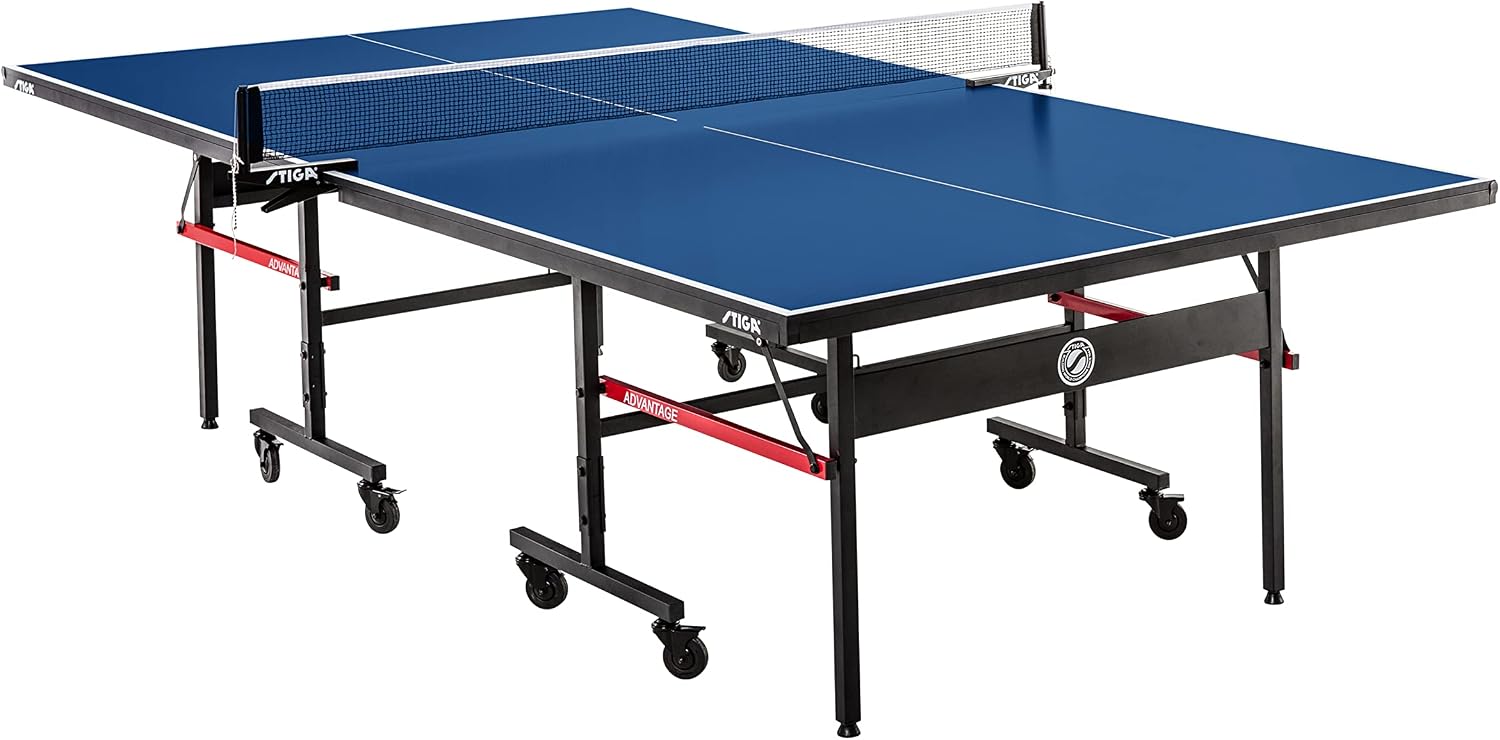 Visit on Amazon →The Stiga Advantage is the table I recommend when someone says “I just want to play with the kids, nothing serious.” It’s also the table I warn people about. At $399, it’s a toy, and I mean that in a specific way: the 15mm surface is honest for the price, but the frame is the problem.
I’ve repaired three of these at the club. The surface doesn’t warp first. The frame twists when you fold it, and that twist becomes a warp by month eight. I’ve seen it happen on tables that were stored flat, on tables that were stored folded, on tables that never moved. The frame flexes, the surface follows, and suddenly you have a dead spot in the corner.
My drop test on a brand new one: center 21.8cm, but the corner SW dropped to 19.9cm. That’s a 1.9cm spread, and you feel it. The ball just doesn’t come up the same in that corner.
But here’s the thing. If you’re a family that plays twice a month, this table will last you three years before the warp shows, and you’ll have gotten your money’s worth. If you’re playing weekly or more, buy something better. I’ve said this to three club members who asked about a cheap table for their garage, and two of them came back six months later with a Joola.
Choose the Stiga if you’re on a tight budget and you accept it’s a temporary table. Don’t choose it if you’re serious about improving.
Killerspin MyT 2000
The Killerspin MyT 2000 has a finger-pinching problem. I’ll get that out of the way first. The folding mechanism has a pinch point near the hinge that’s caught me twice, and I’ve seen it catch a club member once. It’s a design failure, and it’s the reason I don’t recommend this table to families with small kids.
But the frame is chunky, and I mean that as a compliment. The steel is thicker than the Stiga, and the table doesn’t flex when you lean on it. I bounced it at nine points: center 22.7cm, corners range from 22.1cm to 22.8cm. That’s a 0.7cm spread, which is solid for the $549 price.
After four months on the club floor, no warp, no hinge wear beyond the pinch point. The surface is a 16mm core, and the calipers confirm it. It’s not as lively as the Joola, but it’s not dead either.
Choose the MyT 2000 if you’re an adult player who wants a solid mid-range table and you don’t have kids who’ll get their fingers near the hinges. Skip it if you do.
JOOLA Tour 2500
The JOOLA Tour 2500 is the table I wanted to love, and it’s the table I’d tell most basement buyers to skip. The 25mm surface is real, my calipers agree, and the rebound is lively. My drop test: center 23.5cm, the highest of any table here, and the corners stayed above 22.8cm.
But here’s the problem. It’s too much table for a basement. It’s heavy, it’s bulky, and it’s $649 for a surface that most casual players won’t push hard enough to notice the difference from a 19mm table. I’ve had it on the floor for two months, and it’s built like a tank. It’ll outlast everything else on this list.
The criticism is the price-to-value ratio for a family. You’re paying for tournament-adjacent performance you won’t use. If you’re a high-level club player who wants a home table that matches your club experience, buy this one. If you’re a family, buy the Butterfly and save $100.
Choose the Tour 2500 if you’re a serious player. Skip it if you’re not.
Which one should you buy?
If you’re a family with a basement and a budget under a grand, the Butterfly Easifold 19 is the answer. It stores flat, folds without pinching, and the surface matches its spec. It’ll play true for five years, and it’ll survive the kids.
If you’re a serious player who wants a home table that feels like a club table, the Joola Infinity is worth the extra money. I’ve lived with it for two years, and it’s the one I’d buy again.
If you’re on a tight budget, the Stiga Advantage will get you playing, but set your expectations. It’s a temporary table, not a long-term one.
I’ve seen what fails and when. The folding mechanism is the soul of a table. The surface gets the marketing, but the hinges get the abuse. Buy something with a solid frame and an honest thickness spec, and you’ll be playing on it for a decade. Buy the cheap foldable, and you’ll be shopping again by next year.