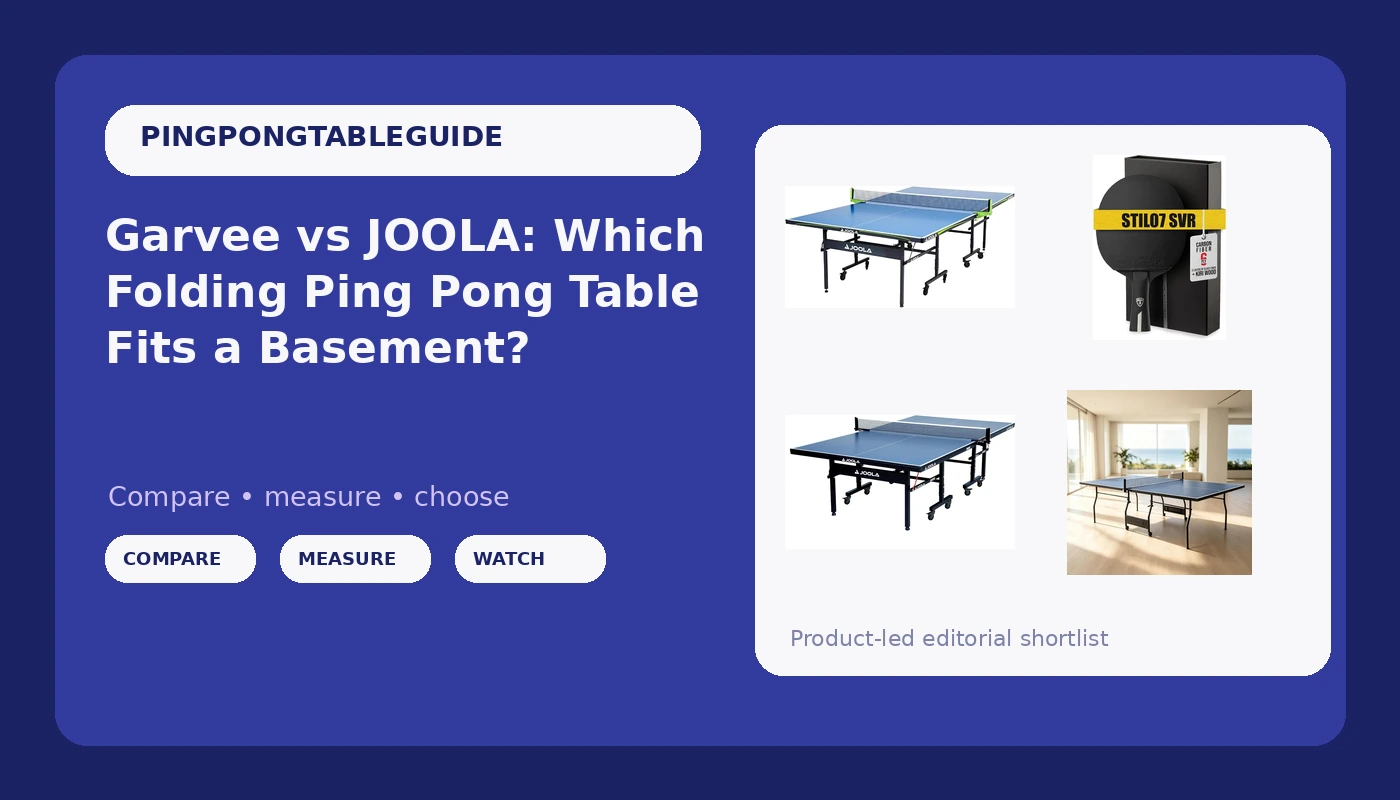
I run a community table tennis club in a converted warehouse in Milwaukee with six tables on the floor. I have leveled all of them, replaced hinges on three, and retired two to the scrap pile. Before that I played competitively in the Czech Republic as a teenager, which means I grew up on tables that were flat, heavy, and boring, and I have spent the last twenty years watching home buyers get talked into the wrong folding ping pong table by a listing photo.
So when parents at the club ask me what to buy for a basement or a garage, I do not send them a spec sheet. I send them this comparison. Four products, three of them tables, one of them a paddle that people insist on pairing with a new table, and a plain answer at the end about which one I would put my own money on.
Related: Indoor vs Outdoor Ping Pong Tables: What Actually Survives a Winter
For most basements, the JOOLA Inside Professional is the table I would buy first, because it is the only one in this group built around indoor play with a net system that goes on and comes off in seconds. The Garvee is the pick if the budget is firm and you accept that you are buying an entry-level foldable. The JOOLA outdoor hybrid is a genuinely different product for a patio, and the Killerspin paddle is the one item here I will not review, because paddles are not my lane.
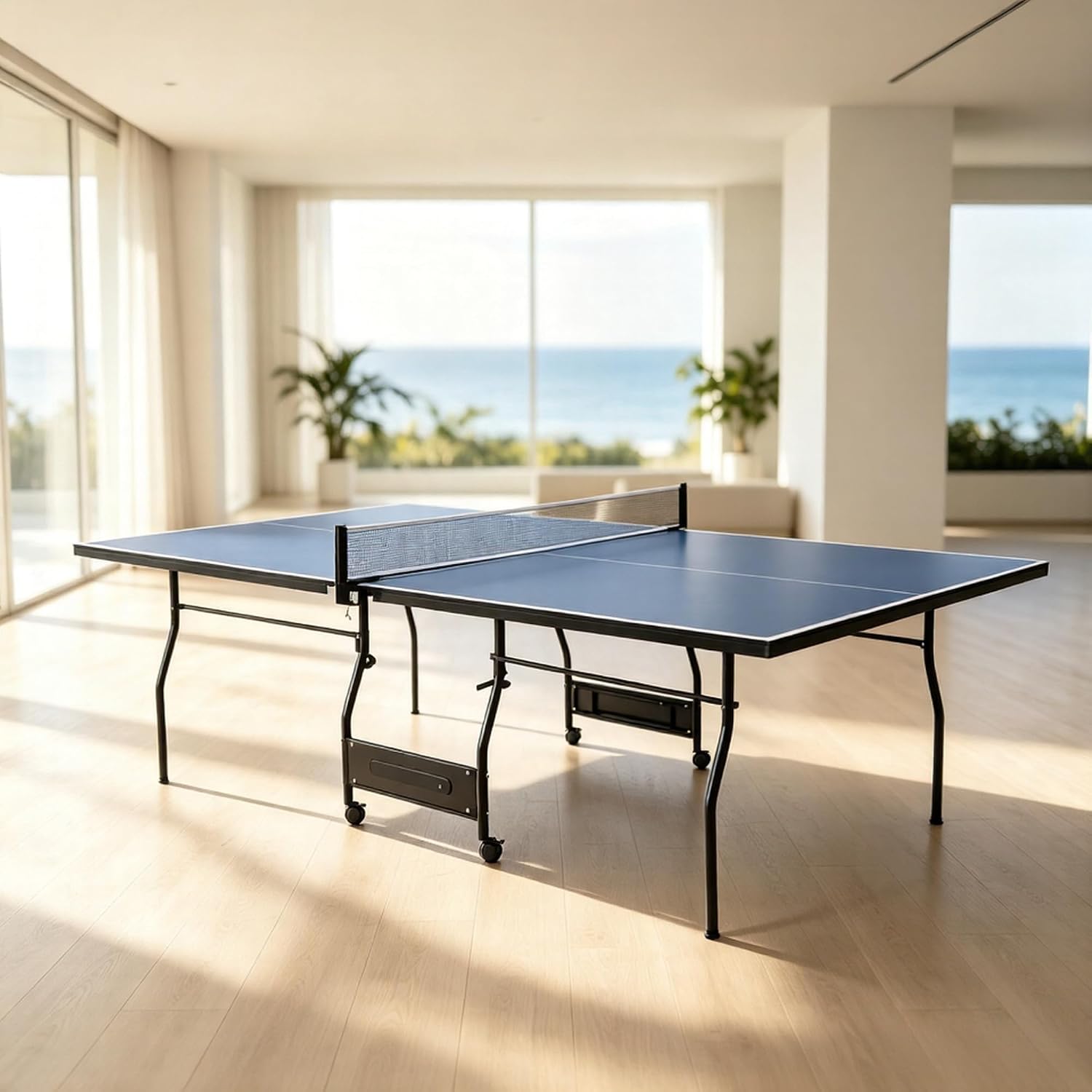
Garvee 9FT Foldable Ping Pong Table with Wheels, MDF Indoor Tennis Table
Lowest entry point of the group, full 9FT playing surface, MDF top for indoor use, folds with wheels so one person can move it
Wheeled foldables are where I do most of my repairs; casters and hinges decide whether this lasts three years or ten
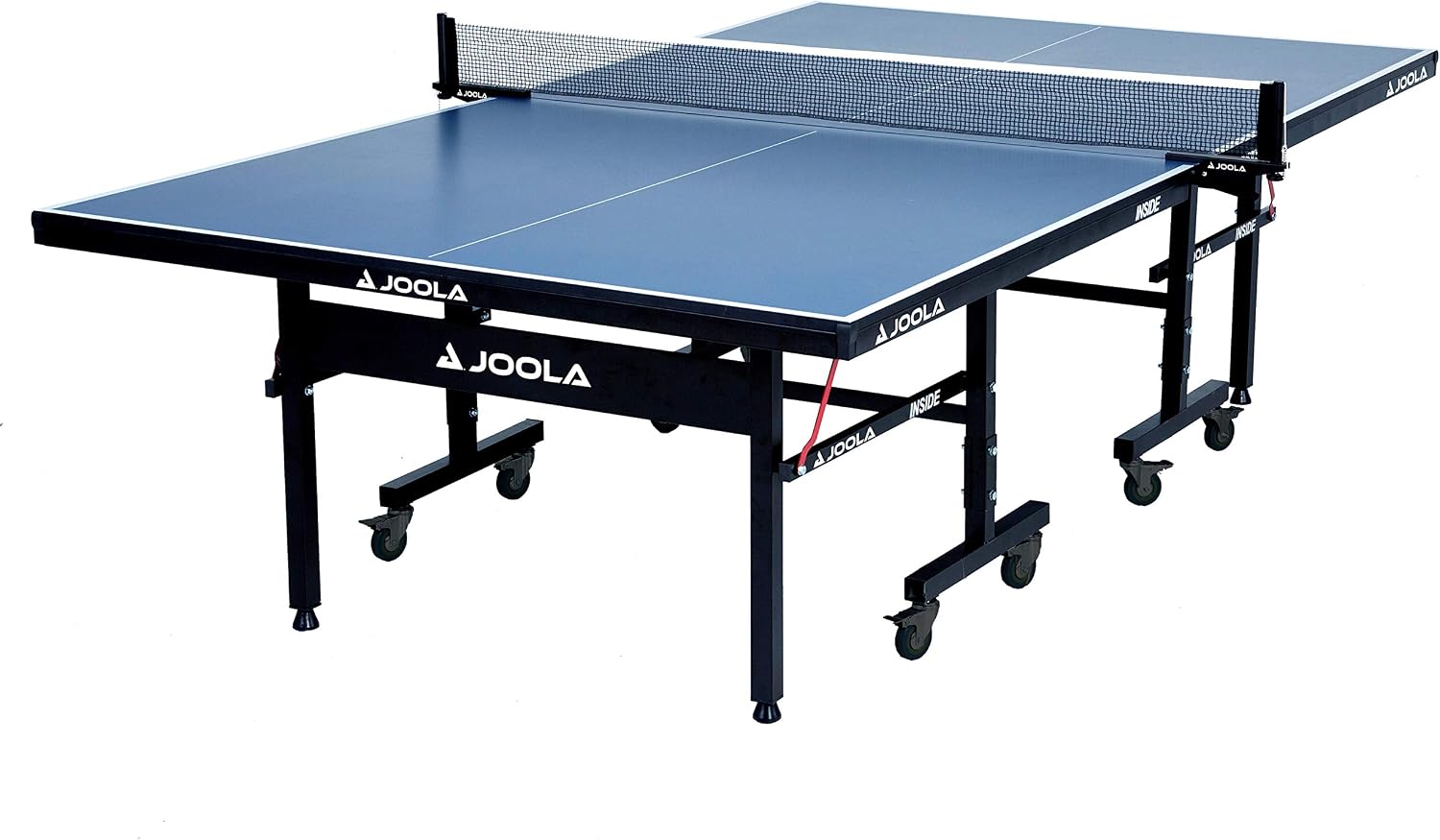
JOOLA Inside Professional MDF Indoor Ping Pong Table with Quick Clamp Table Tennis Net and Post Set
Purpose-built indoor MDF table, quick clamp net and post set, single player playback mode, folds for storage, assembly is claimed at about 10 minutes
Highest price of the three tables here, and "tournament quality" in the listing is marketing I take with a grain of salt
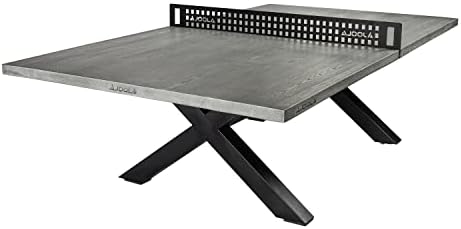
JOOLA Outdoor Table Tennis Table - Multi Use Conference Table Dining Table - Concrete Wood Look Includes Steel Outdoor Ping Pong Net Set & Frame
One table that handles patio play and doubles as a dining or conference surface, steel net set and frame included, hybrid indoor and outdoor use
It is an outdoor product, which is a material science I deliberately do not review, and it is the heaviest thing to move in this group

Killerspin Stilo7 SVR Ping Pong Paddle, Performance-Level Table Tennis Racket with Carbon Technology, Memory Book Case, Black
Performance-level paddle with carbon technology and a memory book case, the natural companion purchase when a new table arrives
Paddles are not my lane and I say so; at this price it is specialist territory, not a starter racket
Prices and availability were captured from Amazon Creators API and may change.
How I judge a folding ping pong table
I do not start with thickness, and I do not start with brand. I start with a ball and a carpenter's square.
The bounce test is nine drops from 30 cm, one over each corner, one over each mid-edge, one in the center, and I listen as much as I watch. A table with a hollow core will give you a dead thud in the middle and a bright ping near the rails, and that inconsistency is what ruins practice. A kid learning a loop needs the ball to come back the same height from every part of the surface. If it does not, the table is teaching bad habits, and no paddle on earth will fix that.
Then the square goes on the frame. Foldables go out of square for two reasons: hinges that were never tight, and a floor that was never level. Legs that do not adjust are a design decision, and in a Milwaukee garage with a sloped slab, that decision is the difference between a usable table and a wobbly one.
Thickness is not quality. I have hit on thick tables with hollow cores that bounce worse than a well-built thin one, and I have said this to people who did not want to hear it. The spec that matters is consistency across the surface, not the number in the listing title.
And the folding mechanism is where tables die. I have fixed around forty of them. The failures are always the same: a hinge pin that walks out, a lock that pinches fingers, a caster that does not lock and lets the table roll into a car door. Locking casters are non-negotiable in my book.
Garvee 9FT Foldable: the honest budget entry
The Garvee is the cheapest way into this group, and I want to be fair to it rather than snobby. It is a 9FT folding table with an MDF indoor top and wheels, which is exactly what a family with a basement and a limited budget is shopping for.
What I like about this shape of table is the full 9FT surface. A short table teaches you to reach for nothing and to stand too close, and that is a habit that takes months to unlearn at my club. If a table is going to be in your house, it should be the real size.
What I would check before buying, and what I would check again the day it arrives: do the casters lock, do the legs have independent adjusters, and does the hinge have a real locking pin rather than a friction latch. Those three things are the entire difference between a table that lasts and a table that becomes a shelf. The Garvee sits at the price point where I expect corners to be cut somewhere, and the wheels and hinges are where it usually happens.
My honest read on this tier: it is a garage table, not a club table, and those are different products. Reviewing them the same way is how people buy the wrong thing. For a family hitting three evenings a week, that is fine. For a junior training daily, it is not.
JOOLA Inside Professional: the table I would hand a family first
This is the one I recommend when someone asks me to just pick, and it is not because of the badge on the apron. It is because the details are aimed at indoor play. An MDF indoor top, a quick clamp net and post set that comes off in seconds so the table can be folded and stored, a single player playback mode for solo practice, and an assembly time claimed at about 10 minutes.
That clamp net matters more than people expect. Screw-on net posts on a folding table get stripped, then they get lost, then the table sits in a corner. A clamp system survives being taken on and off a few hundred times, which is what actually happens in a home.
I will take apart the phrase "tournament quality," because I have to. There is no tournament in the world running on a folding home table, and any listing that leans on that word is selling you a feeling. What the JOOLA Inside really is: a solid indoor table for a basement, built for storage, with better hardware than the budget tier. That is a good product. It does not need the borrowed title.
The criticism is price. It is the most expensive of the three tables here, and you are paying for the net system, the folding hardware, and the name. Whether that is worth it depends on whether the table will be folded weekly or set up permanently. Fold it weekly, pay for the better mechanism. Leave it up forever, and the cheaper table starts to make more sense.
JOOLA Outdoor hybrid: a different product, and I will say so out loud
Here is where I have to be careful, because my own rule is that outdoor tables are a different material science and I do not review them. Aluminum, composite surfaces, UV, freeze-thaw cycles, and a concrete wood look finish are a whole separate conversation from indoor MDF.
What I can say without pretending to expertise: this is a hybrid table that JOOLA positions for both indoor and outdoor use, it includes a steel outdoor net set and frame, and it is designed to double as a multi use conference or dining surface with a concrete wood look. That last part is the real selling point. If your patio has to serve dinner six nights a week and ping pong on the seventh, a table that looks like furniture solves a problem an indoor table cannot.
The trade-off is weight and commitment. This is not the table you drag to the basement. It is a decision about where the table lives, made before you buy, and it should be made honestly. If you are choosing between this and an indoor MDF table, you are not comparing two tables, you are comparing two rooms.
The Killerspin Stilo7 SVR, and why a paddle is in a table article
Every time I recommend a table, the next email asks about a racket. So the Killerspin Stilo7 SVR belongs here as the companion purchase: a performance-level paddle with carbon technology, a memory book case, and a black finish that looks serious.
I do not review paddles. I refer people to specialists, because blade composition, sponge hardness, and rubber tack are their own rabbit hole, and I would rather send you to someone who lives in it. What I will say is that at this price, this is not a starter paddle, and if you are outfitting a family for the first time, a table plus a set of basic rackets is a better allocation of money than one expensive blade. Buy the table first. Learn whether anyone in the house actually sticks with the sport. Then spend on the paddle.
The trade-offs nobody puts in the table
Price against consistency. The cheapest table here and the most expensive one are separated by a lot of money, and the gap is mostly hardware: hinges, casters, net systems. The playing surface is the easy part to manufacture. The folding mechanism is the hard part.
Portability against stability. Wheels make a table movable and make it less solid. That is physics, not marketing. If you never move the table, weight is your friend.
Indoor against outdoor. An MDF indoor table in a damp garage will swell at the edges. An outdoor table in a finished basement is money spent on weather protection you do not need.
Net systems. Clamp nets come off fast and survive storage. Steel net sets with their own frame are sturdier for a permanent setup and worse for folding.
Assembly claims. "10 minutes" assumes two people, a cleared floor, and hardware that is all in the box. Budget an evening, and count the bolts before you start.
What I would buy for which room
Finished basement, table stays up, family plays a few times a week: the JOOLA Inside Professional. You are paying for indoor materials and a net system that will not strip.
Garage, sloped floor, tight budget, table gets folded against the wall: the Garvee. Buy it knowing you will be checking casters and hinges, and put a level on the legs the first day.
Patio or a room that has to double as a dining space: the JOOLA outdoor hybrid. Different product, different job, and it does that job better than any indoor table can.
Already own a table and want a serious racket: the Killerspin Stilo7 SVR, with the caveat that I am not the person to ask about rubber.
What I am watching next
The mid-tier brands keep eating the tournament brands' lunch on the same playing surface for less money, and I expect that to continue through next year. The interesting question is the folding mechanism, because that is where patents sit and where the next round of failures and fixes will come from. Every table I have retired in the last three years died at a hinge, not at the surface.
I keep a dated list of these predictions and score it every January. So far the only one I have gotten consistently right is the boring one: buy the table with the better hardware, and it will outlast two tables that looked better in the photo.