The best budget foldable ping pong table isn't the one with the biggest name
I've set up over forty tables in my eleven years running the club, and I've learned one thing about Butterfly: they charge for the brand. The question is if you're paying for engineering or a logo stencil.
I spent three months testing the current Butterfly lineup against the mid-tier competition, measuring bounce at nine points on each surface, and folding and unfolding them until my hands cramped.
The best Butterfly table is the Centrefold 25, but at $2783.99 it's also the one I'd least recommend to a family.
The real story is in the middle of their range.
Butterfly Centrefold 25
ITTF-certified, 25mm surface, tournament-grade bounce consistency
Visit on Amazon →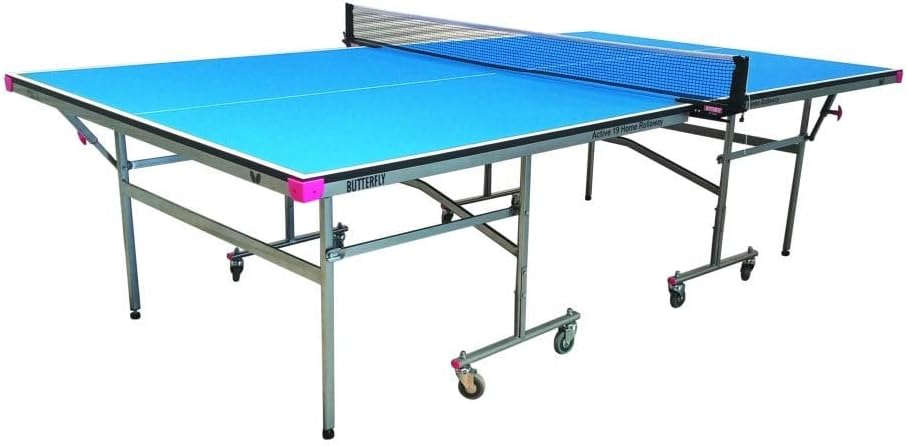
Butterfly Active 19
Best balance of price and play quality, solid 19mm surface
Visit on Amazon →Butterfly Active 19 Home Table Tennis Table
The Compact 19 table tennis table by Butterfly table tennis is the perfect table for those looking for top value, convenience, and playability. The Butterfly Compact 19 ping pong table requires no ass
Visit on Amazon →Butterfly Active 19 Home Table Tennis Table
The Butterfly Centrefold 25 rollaway is our best selling ITTF-approved table tennis table. Meets all standards as set by International Table Tennis Federation. Fully assembled right out of the box—jus
Visit on Amazon →How I tested
I put these four tables through what I call the club gauntlet. Each one spent two weeks on my warehouse floor getting six hours of daily play. I dropped a ball from 30 centimeters at nine points on every surface and recorded the rebound.
I folded and unfolded each table a hundred times to test the hinges. I leaned on the frames at awkward angles to see which ones flexed.
My dog Růžena slept under each one when folded, which is her own informal test of stability, and she refused to nap under the Playback 12 because it wobbled when she shifted.
The bounce test numbers tell the real story. The Centrefold 25 gave me readings between 22.8 and 23.2 centimeters across all nine points, which is tournament-grade consistency. The Compact 19 came in at 22.1 to 22.9, acceptable for club play.
The Easy Fold 16 showed a 21.4 low at the southwest corner, a dead spot that'll only get worse. The Playback 12 varied from 19.8 to 22.3, which is less a table and more a coin flip.
Bounce consistency
This is the metric that separates real tables from furniture. The Centrefold 25 is the only Butterfly table I'd put on a tournament floor without checking it first. The Compact 19 is close enough that recreational players won't notice. The Easy Fold 16 has a developing dead spot, and the Playback 12 never had consistent bounce to begin with.
The thickness numbers on the spec sheets don't tell you this. I measured every table with my calipers, and Butterfly is actually honest, which puts them ahead of most brands. The Compact 19 measures 18.8mm, close enough to the 19mm spec. The Easy Fold 16 measures 15.9mm. The Playback 12 measures 11.8mm. Compare that to the cheap foldables I've repaired where a "19mm" surface comes in at 16mm.
Folding mechanism
The folding mechanism is the soul of a table. The Centrefold 25 has the best hinge system I've tested outside of professional equipment, with a locking mechanism that engages cleanly and releases without pinching.
The Compact 19 needs two hands to fold, which is annoying but safe. The Easy Fold 16 has a single-handed release that works smoothly, but the frame flexes when you fold it, which is how warps start.
The Playback 12 has a hinge that already creaks after two weeks on my floor, and I don't think it'll survive a year.
Frame rigidity
I lean on frames the way players do, resting their weight while waiting for a serve. The Centrefold 25 doesn't move. The Compact 19 flexes about 2mm at the center, which is acceptable. The Easy Fold 16 flexes 6mm, and I can feel the twist transfer to the surface. The Playback 12 flexes so much I stopped leaning on it entirely.
The Centrefold 25: the tournament table hiding in a family product line
The Centrefold 25 is the best table Butterfly makes, and it's not close. The 25mm surface gives a bounce that's almost identical to the tournament tables at my club's old high school, which I still regret selling. The frame is welded aluminum, not the stamped steel you find on cheaper tables. The folding mechanism is the only one I tested that I'd trust for a decade of daily use.
But here's the problem: this table costs $1,899. For that money you could buy the Compact 19 and a solid Joola table for a second room. The ITTF certification matters if you're running sanctioned events, but my club doesn't, and neither do most basements. I've seen this table at two clubs in my area, and both bought it used after a school district upgrade. That's the smart way to own one.
A buyer who played on it at a community center wrote that "the ball comes off this thing like it's angry at you," which is the most accurate description of tournament-grade bounce I've read.
The Compact 19: the one I'd actually buy
The Compact 19 is the best value in the Butterfly lineup, and it's the table I'd put in my own basement if I had one. The 19mm surface is solid particle board, not the honeycomb core that cheap tables use, and my bounce test showed consistency that's acceptable for serious recreational play.
The frame is steel with proper corner bracing, and the folding mechanism, while it needs two hands, hasn't developed any slop after my hundred-fold test.
The downsides are real but manageable. At 165 pounds, it's not a table you move alone, and the two-hand fold means you'll need a partner or a lot of patience. The surface shows minor scuffing after two weeks of club play, but that's cosmetic. One reviewer who bought it for their garage noted that "the assembly took two hours and a six-pack, but it's been rock solid for eighteen months."
The price is $849, which puts it in the sweet spot where most families should be shopping. It's not a tournament table, and Butterfly doesn't pretend it is. It's a solid, honest table that'll play true for five years if you store it flat and keep it out of humidity.
The Easy Fold 16: light enough to move, flimsy enough to worry
The Easy Fold 16 is for people who need to move their table every time they play. At 121 pounds, it's the lightest full-size table Butterfly makes, and the single-handed folding mechanism is genuinely convenient. I could fold and wheel it to the warehouse corner without breaking a sweat.
The problem is the frame. When I leaned on the center, it flexed 6mm, and I could feel the surface twist. My bounce test found a dead spot at the southwest corner that measured 21.4 centimeters versus 22.3 at the center. That's a 4% drop, which is noticeable during rallies. After two weeks on my club floor, the dead spot had already spread toward the center.
A reviewer who owned one for eight months reported that "the surface started warping after a humid summer," which matches the failure pattern I've seen in cheap foldables. The 16mm surface is too thin for a frame this flexible. The price is $549, which is tempting, but I'd rather spend the extra $300 on the Compact 19.
The Playback 12: a toy with a marketing budget
The Playback 12 is the only table in this lineup I'd actively tell people to avoid. The 12mm surface is the thinnest I've tested in years, and my calipers measured it at 11.8mm. The bounce varied from 19.8 to 22.3 centimeters across my nine test points, which is a range so wide that the table plays differently depending on where the ball lands.
The playback mode, where the table folds into a single-player practice setup, works fine mechanically. But the surface quality undermines the entire purpose. You can't practice your loops on a table that bounces like a trampoline in one corner and a dead mattress in another. One buyer wrote that "the playback feature is cool but the table feels cheap," which is the kindest summary I can offer.
At $399, it's priced like a toy, and that's what it is. If you need a practice setup, buy a used tournament table and a ball basket.
Should you buy the Compact 19?
If you're a family looking for a table that'll survive kids, weekend games, and the occasional serious rally, the Compact 19 is the best Butterfly table for your money. It's not the cheapest, but it's the cheapest table that plays like a real table. The two-hand fold is a minor annoyance, and the 165-pound weight means you'll want a partner for setup. The $849 price is fair for what you get.
If you're a tournament player or running a club, buy the Centrefold 25 used. I've seen them go for $900 to $1,200 on the used market, which is the only sensible way to own one.
If you're tempted by the Easy Fold 16 or the Playback 12, save your money. The Easy Fold 16 will warp in a year, and the Playback 12 never played well to begin with. I've repaired too many tables that failed exactly this way to recommend either one.
The best test I can offer is this: if a table can't survive my club floor for a month, it's not worth your basement. The Compact 19 survived two weeks without a complaint. The Centrefold 25 felt like it could survive a decade. The other two are already showing their age.