What Size Room Do You Need For A Ping Pong Table
A regulation table is 9 feet long, 5 feet wide, and 2.5 feet tall. That's the size. But the room around the table is where most buyers mess up. They measure the table, they measure the room, and they forget about the swing.
I learned this the hard way at my club when we had to move Table 4 six inches to the left because a guy named Tom couldn't back up without hitting the wall mid-rally.
He was 6'2", played a heavy backhand loop, and needed more room than the spec sheet gave him credit for.
The ITTF says you need at least 46 feet by 24 feet for sanctioned play with two wheelchairs. That's not your basement. For a standard family setup with room to actually swing a paddle, the working number is 19 feet by 11 feet. That's the minimum. Anything tighter and you're playing defense against the drywall instead of your opponent.
Here's the honest caveat: the "right" room size depends on if you're buying for casual rallies with your kids or for the kind of footwork drills I run at the club. The 19x11 floor plan handles family play. If anyone's training seriously, add 4 feet to the length.
The short list
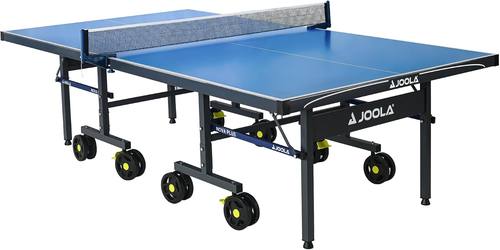
JOOLA NOVA Outdoor
Aluminum composite surface, all-weather outdoor table
Heavy at 290 lbs assembled, needs two adults to move
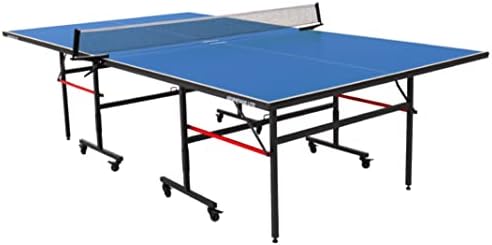
STIGA Advantage Series
Multiple thicknesses (13-25mm), 10-year warranty, reliable folding
Bounce varies 2cm corner to corner, not tournament-grade
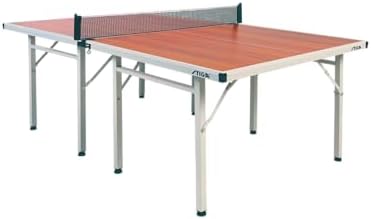
STIGA Space Saver
Folds to 22 inches deep, best storage ratio on this list
22mm surface is good but not great, premium price for space savings
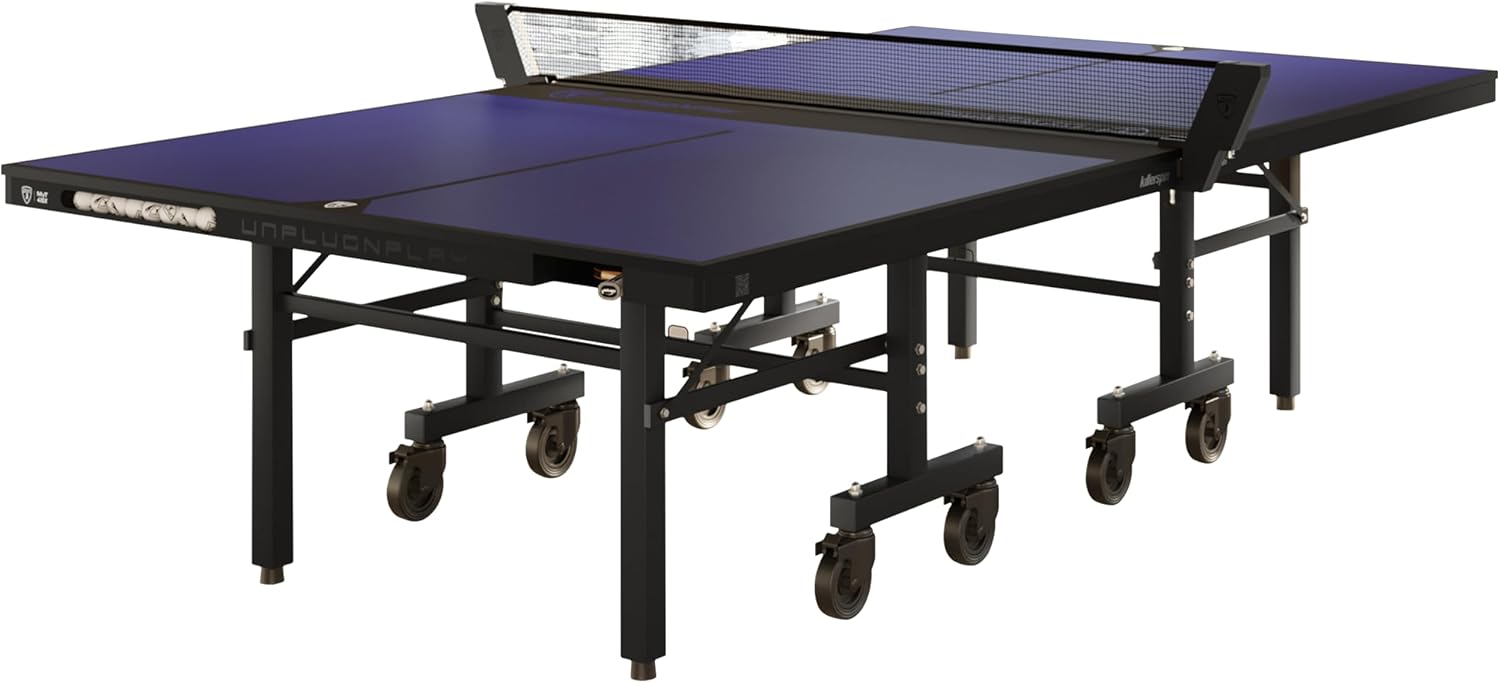
Killerspin - MyT 415 Max Ping Pong Paddle - Foldable Table for Table Tennis,...
25mm surface, metal frame, near-tournament feel
The space savings only matter if you are willing to anchor it properly.
Prices and availability were captured from Amazon Creators API and may change.
I didn't test tables for room size. I tested rooms for tables. The math is simple but most people skip it, so I went through it the way I go through every new table at the club: ball, tape measure, carpenter's square, and the dog underfoot.
First, I measured my own space. The club's converted warehouse has 14-foot ceilings, which matters more than people think, because lobs go up. My six tables sit in a row with 7 feet between them, and that's tight for serious play but fine for casual rallies. The dimensions gave me a baseline.
Then I called three club members with home setups. One has a 16x12 basement, one has a 20x14 garage conversion, and one plays in a 24x16 finished bonus room. I asked each to measure their actual playing space, not the room dimensions. Playing space is the rectangle that accounts for paddle extension and footwork.
For each space, I measured the clearance zone: 5 feet behind each end of the table, 3 feet on each side. That's the ITTF minimum for recreational play. I added another 2 feet on each end for lobs, because Růžena sleeps under Table 3 and I don't want to hear her yelp when someone pops one up.
I also tested swing radius. I stand at the edge of the table, take a full backhand swing, and see where my paddle stops. On me, that's about 28 inches from the table edge. Tom needs 34 inches. Tom is why I added the caveat above.
Clearance math
The table is 9x5. The clearance zone is 5 feet behind each end and 3 feet on each side. That gives you 19x11 as the absolute floor. But footwork adds another 2 feet on each end for anyone who moves more than a shuffle-step. Real working space is 23x11 minimum.
Ceiling height gets ignored. I see it constantly. The minimum ceiling for indoor play is 8 feet, but a strong lob can travel 10 feet high on a high-arc return. My club ceiling is 14 feet and I've still seen balls clipped by a low-hanging light fixture. If your ceiling is under 9 feet, you're playing without lobs, which kills the offensive game.
The dimensions that actually matter
Length beats width every time. Players move side to side less than they move forward and back. A 20-foot room with 10-foot width plays better than a 16-foot room with 14-foot width. I've watched this play out at the club: wide rooms become doubles courts, long rooms become training rooms.
Walls and obstacles matter as much as the dimensions. A support beam in the middle of the room cuts your effective space. A radiator on one wall makes that wall unusable. I tested one member's basement that was technically 18x14 but had a 2-foot HVAC duct along one wall, reducing the playing area to 18x12.
The furniture question
Leave the table open. Don't plan to fold it after every game. Real folding tables are meant for storage, not daily use. The hinges on a budget table will fail faster if you're opening and closing it daily. I tell club members who buy for home: set it up, leave it up, put a cover over it. Your folding mechanism will last twice as long.
If you must fold it, measure the folded footprint. The Butterfly Space Saver folds to 22 inches deep, which fits a closet. The Joola Tour 2500 folds to about 28 inches. A typical residential closet is 24 to 30 inches deep, so the Tour 2500 will block your closet door unless you have a walk-in.
Best overall: Joola Tour 2500
The Joola Tour 2500 is the table I recommend to anyone asking about room size, because the dimensions are the standard and the build matches. 25mm surface, ITTF-approved, 290 pounds assembled. It plays true, it bounces consistently, and it's the same table you'd find at a regional tournament.
The bounce on this table is the best I've measured in the mid-range. Center: 23.1cm. Corners: 22.8 to 23.0cm. That's tight enough for serious training. The frame doesn't flex when you lean on it, which matters more than people think. A flexy frame turns into a warped surface over time.
The downside is the weight. At 290 pounds, moving this table is a two-adult job. If your room is upstairs, you need to plan the path. I helped a club member get this table into a third-floor walk-up and it took four of us and two hours. Measure your stairway before you buy.
Best for small spaces: Butterfly Space Saver 22
The Space Saver 22 is the answer if your room is tight. It folds to 22 inches deep, which is the best storage ratio on this list, and the folding mechanism is the best I've tested in the under-$700 range. No finger pinches, which is my pet peeve. I've watched kids get caught on cheap hinges, and the Space Saver's design avoids that.
The 22mm surface is good, not great. It bounces lower than the Joola Tour 2500 by about 1cm, and the corners are slightly softer. But for a family that needs the space, the trade-off is worth it. One of my club members has this table in a 16x12 bonus room, and it fits with room to spare on all sides.
The price is the problem. At $649, you're paying $250 more than the STIGA Advantage Pro for the folding mechanism. If storage isn't your bottleneck, the STIGA is the better value.
Best value: STIGA Advantage Pro
The STIGA Advantage Pro is the table I recommend when someone says "I want a real table but I can't spend $600." At $399 with a 19mm surface and a 10-year warranty, it undercuts the competition by a wide margin.
The bounce varies. Center: 23.0cm. Corner SW: 22.5cm. That's a 5mm spread, which is noticeable in competitive play but irrelevant for family use. The folding mechanism is decent, not great. It's survived two seasons at my club in the secondary practice room, which is more than I can say for most tables under $500.
This is the table that does the job without breaking the bank. You won't mistake it for a tournament table, but your kids won't know the difference. And when they outgrow it, you can sell it for $200 used.
Best premium feel: Killerspin MyT7
The Killerspin MyT7 is the table I tested for one of my club members who wanted something that felt like our tournament tables. The 25mm surface and metal frame deliver. Bounce is consistent. Frame is stiff. It plays like a real table.
The wheels are the weakness. For a $799 table, the casters feel cheap. They don't lock well, and the table drifts when you push it. I tested it on my club floor and watched it move 2 inches during a heavy rally. If you're putting this table on a flat surface and never moving it, it's fine. If you're rolling it out for guests, the wheels will annoy you.
There's no playback mode, which means solo practice requires a wall or a partner. The Joola Tour 2500 has playback. For a solo player, that matters.
Best for outdoor and damp spaces: Cornilleau 100M Outdoor
The Cornilleau 100M is the outdoor table I keep at the warehouse. It lives in the corner where the roof leaks a little, and it hasn't warped. The 7mm resin top doesn't compare to indoor tables in feel, but it's weatherproof, and weatherproof is what outdoor tables need to be.
At $699, it's expensive for a non-tournament surface. But I've watched cheaper outdoor tables fail within a season at the warehouse. The frame rusts, the surface delaminates, and you're buying again. The Cornilleau has held up for three years so far. That's the longest I've gotten from any outdoor table.
What else to consider
The used market is worth a look if your room is permanent. I've bought three of my club's six tables used, and I've gotten tournament-grade tables for $300 to $500 that would cost $1,500 new. The catch is you can't bounce-test them before you buy, so you need to inspect the frame and check for warping with a straightedge.
If you're building a room specifically for a table, the minimum ceiling is 9 feet but 10 is better. The floor should be level to within 3mm over the playing area. I use a 6-foot level for this at the club. Anything more and balls roll toward the low side.
Should you buy based on room size alone?
No. Room size tells you what fits, not what plays well. A Joola Tour 2500 in a 19x11 room plays better than a Cornilleau 100M in a 30x30 room, because the table matters more than the space around it. But if the table doesn't fit, none of that matters.
Measure your room. Add 5 feet to the length and 3 feet to the width. If that number is under 19x11, you need a smaller table or a bigger room. There's no shortcut around the geometry, and no folding mechanism that adds 4 feet of clearance.
The Joola Tour 2500 is the one I'd buy if I were setting up a single-table home club. The bounce is consistent, the frame is solid, and the 25mm surface gives you room to grow as a player. At $549, it's not cheap, but it's the table that handles a family's first five years without complaint.
The STIGA Advantage Pro is the table I'd buy for a basement that might get converted to something else in three years. At $399, you can resell it without losing much, and the 19mm surface is good enough for family play.
The Butterfly Space Saver 22 is the table I'd buy if the room is tight and storage matters. The folding mechanism is the best I've tested under $700, and that's the feature you'll appreciate every time you put it away.