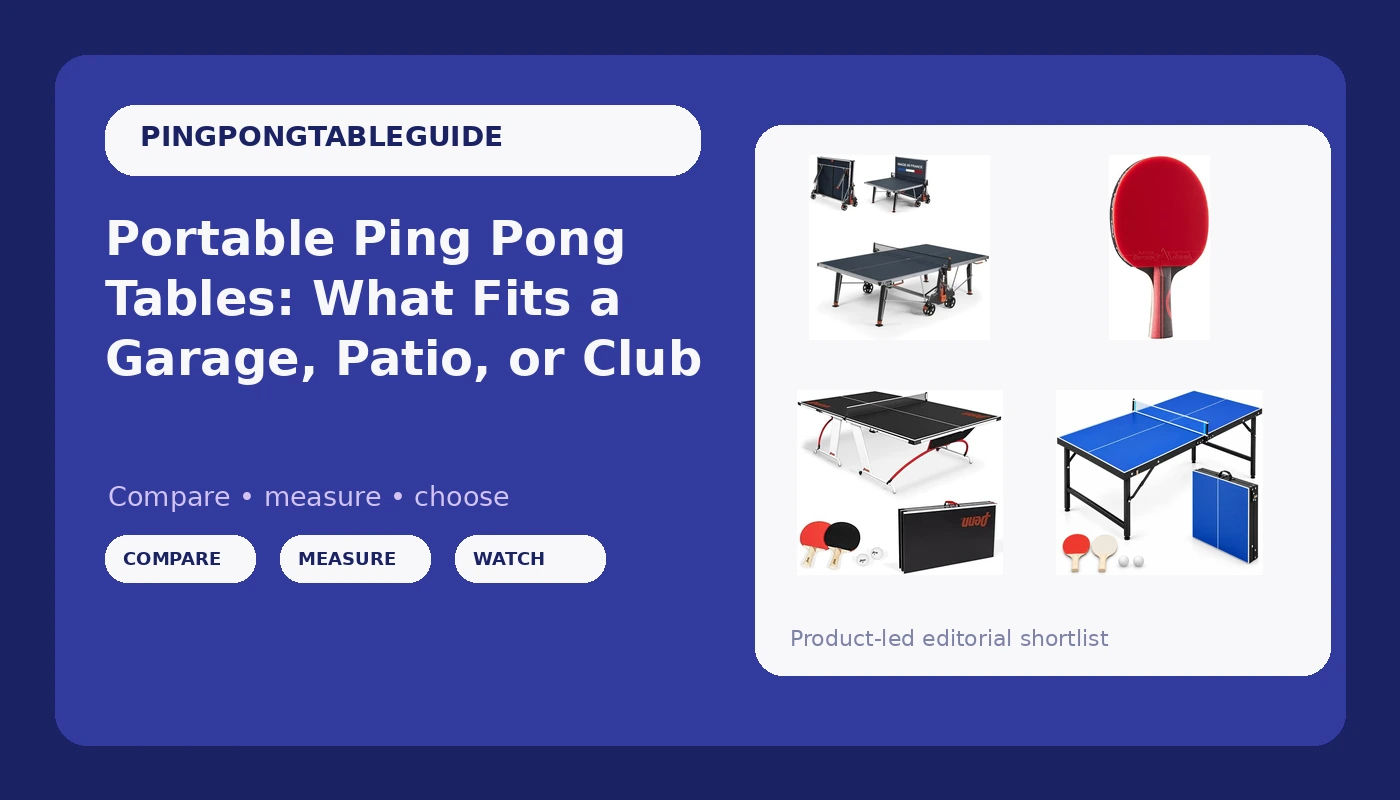
Most people searching for a portable ping pong table are not shopping for a tournament. They are trying to fit a real game into a garage, a spare bedroom, or a patio that has to serve three other purposes by Sunday. That is a different shopping problem from the one the equipment industry usually answers, and it is why so many folding tables end up leaning against a wall, warped, with a net that sags.
I run a community club in a converted warehouse in Milwaukee with six tables. I have set up, leveled, and repaired more of them than I want to count, and I have watched juniors develop bad habits on tables that were never flat to begin with. This article walks through four options that are actually available right now: what each one is for, where the compromise sits, and what to check before you carry a box into the house.
Related: How to Level a Ping Pong Table on an Uneven Garage Floor →
Quick answer
For most homes, the decision comes down to three questions: how much clear floor you have, whether the table lives indoors or outdoors, and whether the folding hardware will survive being opened twice a day. A 5 ft folding table is the honest answer for a small room, a bundled set is the fastest route to a first rally, a laminate outdoor table is the right pick for a patio even though it will never bounce like a club table, and a serious paddle is worth considering once the table itself is flat and level.
4 useful options
| Model | Best fit | What stands out |
|---|---|---|
| 5 ft Portable Ping Pong Table, Foldable Mid-Size Table Tennis Set | Small rooms and apartments | A 5 ft mid-size top that folds for storage |
| EastPoint Ping Pong Table, Table Tennis Set, 2 Paddles & 2 Balls, Black | Getting a first game going | Sold as a set with two paddles and two balls |
| CORNILLEAU - 500X Outdoor Table Tennis Table - Folding & Compact - Weather and Schockproof - 6mm Laminate Top - Point Counters - Corner Protection Pads - Blue or Black | Patios, decks, and driveways | 6mm laminate top described as weather and shockproof, with point counters and corner protection pads |
| JOOLA Infinity Edge - Tournament Performance Carbon Technology - Black Rubber on Both Sides - Competition Ready - Table Tennis Racket for Advanced Training - Designed for Speed | Advanced players who already have a flat table | Carbon technology construction with black rubber on both sides |
The space-saver: 5 ft Portable Ping Pong Table, Foldable Mid-Size Table Tennis Set
Do the math before you buy. A regulation table is 9 ft by 5 ft, and the commonly cited clear floor for comfortable full-size play is roughly 19 ft by 11 ft, which is more room than most basements have once the water heater and the bikes are counted. A 5 ft table cuts the footprint hard, but the ball still travels the same way, so a shorter table means longer rallies at the same effort and a different sense of distance. That is fine for family play and service practice. It is not how you prepare for a sanctioned match.
Two things to check on any folding table this size: the lock that holds the halves together when it is open, and whether the legs actually sit level on your floor. Garage slabs slope toward the door. A table that rocks will teach you to compensate with your wrist, and that habit is hard to unlearn.
The starter set: EastPoint Ping Pong Table, Table Tennis Set, 2 Paddles & 2 Balls, Black
Bundled sets are how most people start, and there is nothing wrong with that. The catch is that the listing does not state the top thickness or the core construction, and those are the two numbers that decide whether the table is still flat in three years. Bundled paddles also tend to be beginner-grade by design, which is fine for the first summer and limiting after that.
If a junior in your house is going to practice seriously on this table, ask the seller what the playing surface is made of before you commit. A thick top with a hollow core bounces worse than a thinner top with a solid core. I have seen this go both directions, and the marketing copy never tells you which one you are buying.
The patio option: CORNILLEAU - 500X Outdoor Table Tennis Table - Folding & Compact - Weather and Schockproof - 6mm Laminate Top - Point Counters - Corner Protection Pads - Blue or Black
Six millimeters sounds alarming if you have been reading indoor table specs, where the club standard is 18 to 19mm. It is not a trick. An outdoor top is a laminate panel bonded to a weather-resistant base, and it is engineered to shed water and resist UV instead of to deliver a tournament bounce. Expect a slower, deader ball than you would get indoors. What you get in return is a table you can leave on the patio.
The place outdoor tables fail is the folding mechanism, not the top. Grit works into the hinges, the pivot bolts corrode, and after a few winters the halves no longer meet flush. Keep the table covered when it is not in use, keep it out of standing water, and work the hinges a few times a season. If you live somewhere with hard freezes, storage indoors during the worst months will add years to the hardware.
The paddle pairing: JOOLA Infinity Edge - Tournament Performance Carbon Technology - Black Rubber on Both Sides - Competition Ready - Table Tennis Racket for Advanced Training - Designed for Speed
Here is the only paddle advice I give with confidence: once your table is flat and level, the paddle matters more to your game than the table does. A player with a decent racket on a modest table will improve faster than a player with a bargain racket on an expensive one, because the racket is what your hand learns. Speed-oriented rubber rewards clean contact and punishes sloppy technique, which is why this one is described for advanced training rather than for a first summer.
If you are buying for a beginner, do not start here. If you are buying for someone who already trains, talk to a coach about rubber and blade combinations before spending anything, because paddle feel is personal in a way that table thickness never is.
Prices and availability may change. Product images, names, and retailer links are matched to verified listings. No current price, rating, stock status, or measured result is stated here without current evidence.
What the thickness number really tells you
Thickness is the spec everyone quotes and the one most often misunderstood. The club standard sits at 18 to 19mm for a reason: at that thickness, with a solid core, the ball returns a predictable percentage of its energy across the whole surface. That predictability is what lets you practice a stroke and trust the result.
For a garage or basement, 12 to 15mm is workable if the core is solid and the frame is rigid. What ruins a home table is not thin material, it is a hollow core that bounces differently near the middle than near the edge, and a frame that flexes when the ball lands. A thick top on a flimsy apron will still play badly.
Two other specs matter more than the number printed on the box. First, the frame and apron: the rails that run under the playing surface. If they flex, the table is not flat no matter what the top measures. Second, the finish. Paint that lifts where the ball lands is a slow-motion failure, and it starts exactly where you practice most.
Outdoor tables sit outside this whole conversation. A laminate panel built to survive weather will not match an indoor top for bounce, and judging it on indoor terms is how people end up disappointed with a table that is doing its job correctly.
The five-point check before you buy
- Measure the clear floor, not the table. You need room behind both baselines to swing, and a low ceiling is a real problem if you loop the ball.
- Ask what the top is made of and what is under it. Thickness plus core construction plus frame rigidity is the whole story.
- Run the bounce test if you can find one assembled. Drop a ball from about 30cm at nine points, the four corners, the four edge midpoints, and the center. The height should be consistent. Any dead spot is a warp or a hollow core.
- Open and close the folding mechanism twice before buying. Listen for grinding, watch for pinch points where fingers go, and check that the halves lock flat without lifting them.
- Check the casters and the legs. Locking casters are not optional. Legs that will not adjust mean a table that rocks on a sloped garage floor for as long as you own it.
Room, storage, and safety notes
- Leave more clear space than you think you need. Full-size play is commonly cited as needing roughly 19 ft by 11 ft of clear floor, and a 5 ft table still needs room to swing behind both ends.
- Level the legs the day you set it up, not the day you notice the ball drifting. Garage floors and patios both slope.
- Insist on locking casters. I have watched a folded table roll into a car door, and the repair cost more than the table.
- Store the table folded and upright, off the floor, away from standing water and away from direct radiator heat. Humidity swings are what warp tops.
- Clean with a damp cloth. Skip solvents, which lift the finish right where the ball bounces, and keep paddles off the surface when they are not in play.
Which option should you choose?
Choose the 5 ft Portable Ping Pong Table, Foldable Mid-Size Table Tennis Set when the room is the constraint and you need something that folds away between games. Choose the EastPoint Ping Pong Table, Table Tennis Set, 2 Paddles & 2 Balls, Black when you want a first rally this weekend without a second order. Choose the CORNILLEAU - 500X Outdoor Table Tennis Table when the table is going to live outside and weather resistance matters more than bounce. Choose the JOOLA Infinity Edge racket when the player is already training seriously and the table underneath them is flat.
One honest caveat: the listings here describe construction and intended use, not measured performance. Thickness, core material, and frame rigidity are the details worth confirming with the seller before you buy, and a paddle choice is best made with a coach who can watch you hit.
The bottom line
The portable ping pong table that works is the one that fits your room, stays level, and survives being folded twice a day. Buy for the space you actually have, verify the top construction instead of trusting the word tournament on the box, and treat a bundled set as a starting point rather than a finished setup. The table is a small part of your game and a large part of your headaches, so get the boring details right first, then worry about the paddle.