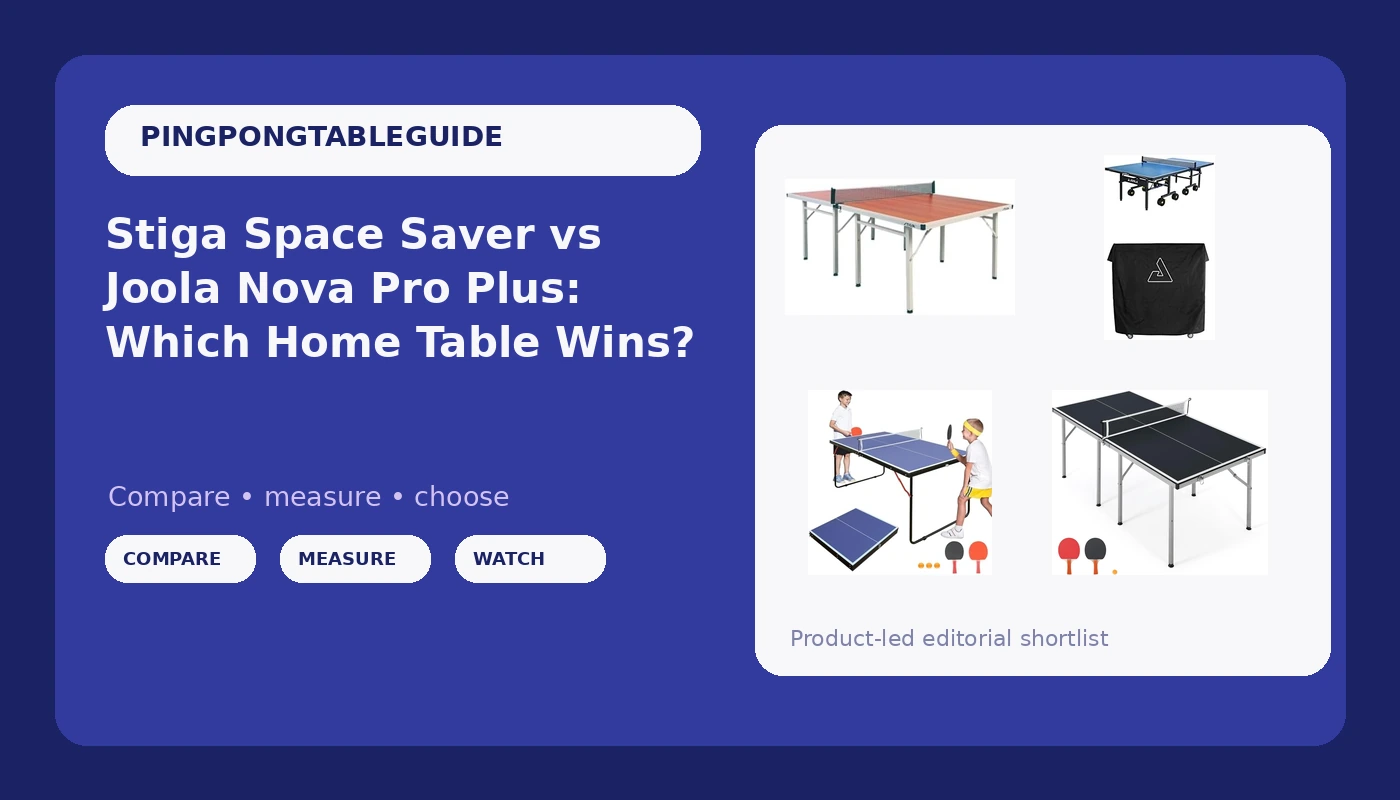
I run a community club out of a converted warehouse in Milwaukee. Six tables on the floor, four of them bought used, all of them leveled by me with a carpenter's square and a stack of shims. I played competitively in the Czech Republic as a teenager, and I have spent the years since fixing other people's table mistakes. The email I get most often is not about paddles or rubbers. It is from a parent standing in a basement with a tape measure, asking which table to buy.
So this is a home ping pong table comparison, written for that parent. Four tables that show up in those emails, what each one is actually for, and the spec lines that decide whether you get a table or a headache. The table is 10% of your game and 90% of your headaches. A warped surface ruins practice more than any paddle ever will.
For most basements, the JOOLA Nova Pro Plus bundle is the safest buy, because it is the only table here that arrives with its own protection and can live on a screened porch. If floor space is the constraint, the STIGA Space Saver is the fastest path from box to first ball. If your kids are small and the table has to double as a craft table, the foldable multi-use model earns its place. The Garvee is worth a look if you want to pick a style, but only after you read the exact variant you are buying.
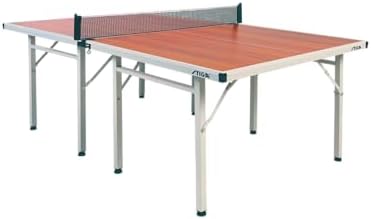
STIGA Space Saver Compact Ping Pong Table
Regulation height with no assembly at all, and the two halves store flat against a wall
Compact format, and two separate halves you have to set, align, and level every time
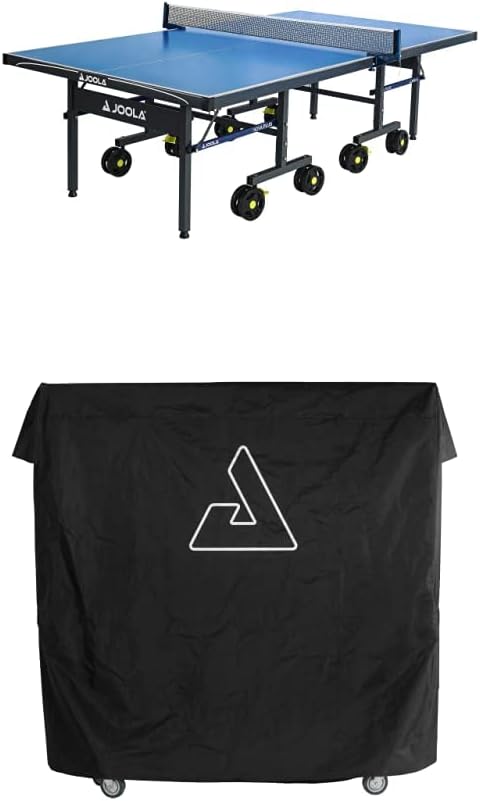
JOOLA Nova Pro Plus Indoor/Outdoor Table Tennis Table with Waterproof Cover
Indoor/outdoor construction plus the cover included, which is the part most buyers forget to budget
You pay for the tournament name and the cover whether or not you ever put it outside
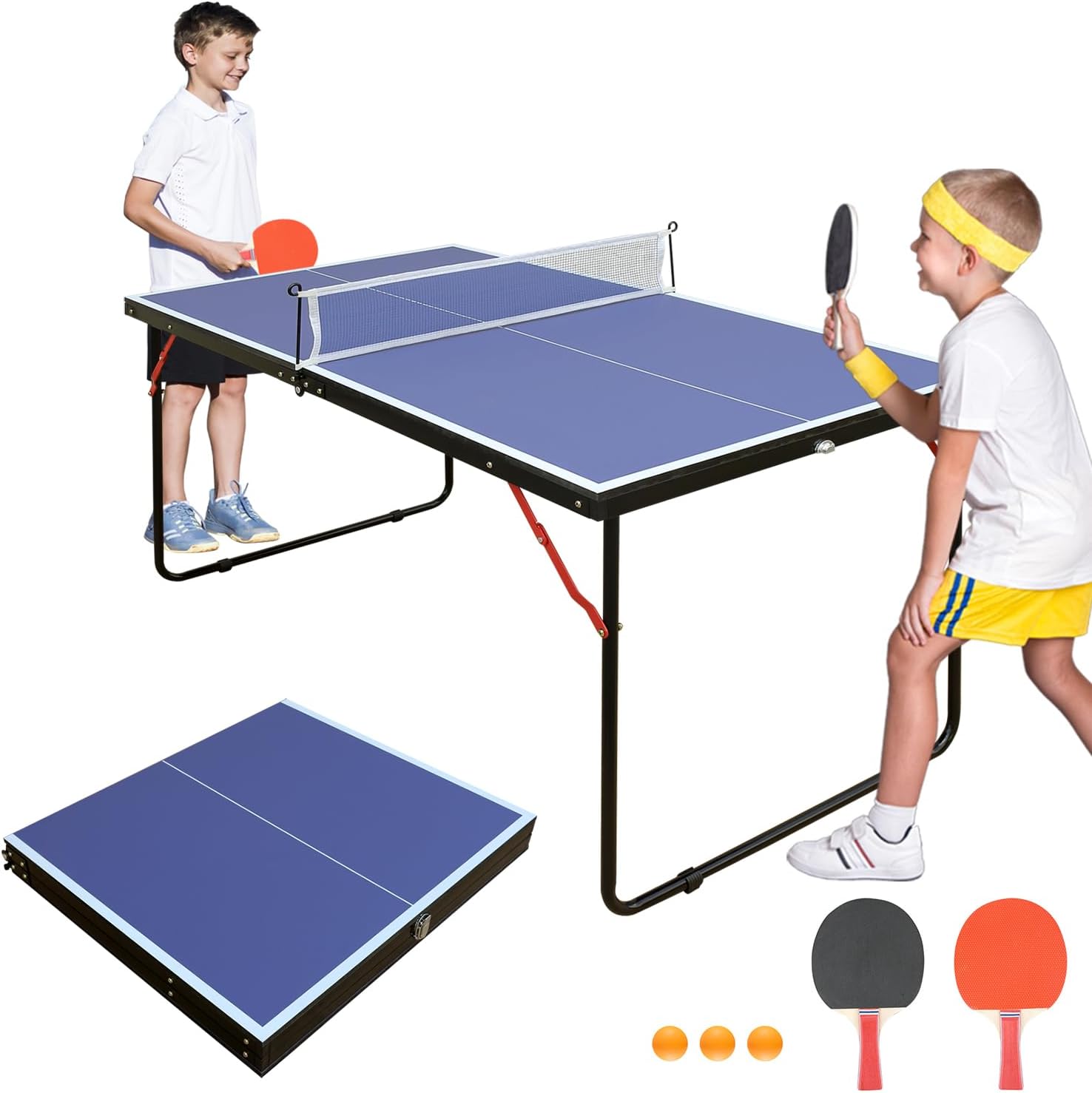
Foldable Multi-Use Table Tennis Table with Net, Paddles and Balls
Net, paddles, and balls in the box, sizes from 4.5FT to 9FT, and it folds away when the room is needed
MDF top and multi-use sizing mean the small variants are not regulation playing surfaces
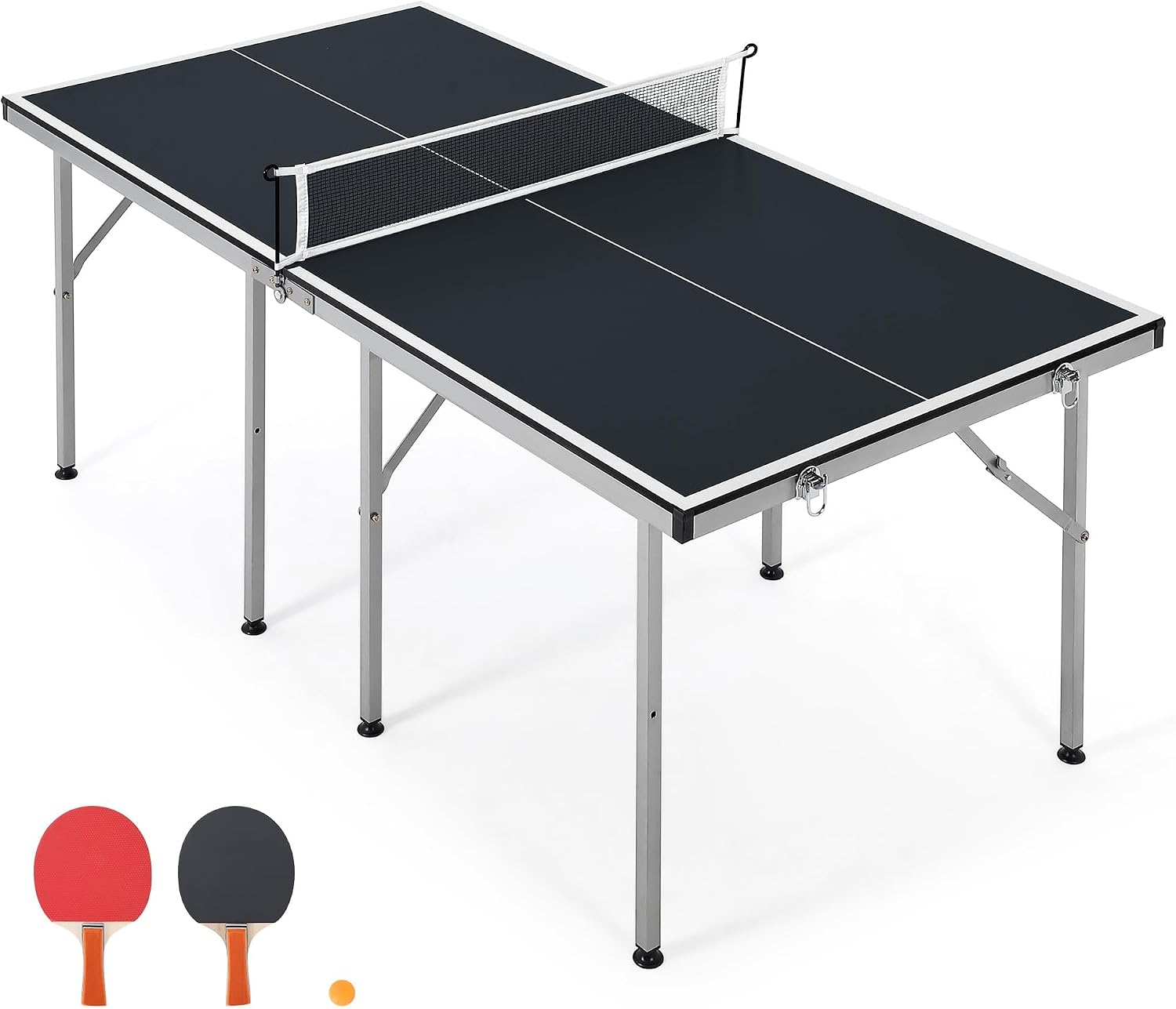
Garvee Indoor/Outdoor Table Tennis Tables, Multiple Styles
One listing covering several styles and indoor/outdoor construction, which suits a patio or an open garage
"Multiple styles" means the page reviews may not be about the variant you clicked, so read the exact listing
Prices and availability were captured from Amazon Creators API and may change.
What I check before anything else
I test bounce consistency with a ball dropped from 30cm at nine points across the surface. If the rebound height differs noticeably between the middle and the corners, the top has a hollow core or the frame is not square, and no amount of leveling will fix it. Then I put a carpenter's square on the frame corners, because a table that is out of square plays short on one diagonal and long on the other, and a junior who learns on that table learns the wrong distances.
After that it is hardware. The apron, which is the frame that supports the top. The folding locks. The casters, which have to lock. And the legs, because garage floors slope and a table with no adjustment rocks no matter how good the top is.
One thing I will not do here is pretend I have had these four on my club floor. I have not. What I can tell you is what each listing promises, what it carefully does not promise, and who each table is for.
STIGA Space Saver: for the room that is already full
This is the table for the apartment, the spare bedroom, the narrow side of a finished basement. The listing claims regulation height and no assembly required, and the halves come apart so they store flat.
No assembly is a bigger deal than it sounds. The single most common failure I see in home tables is a frame put together by someone in a living room who did not square it. A table that arrives already assembled removes an entire class of error before you open the box. If you do not own a carpenter's square and have no interest in buying one, that matters more than any other spec line on this page.
Two things to check before you buy. First, regulation height is not regulation length. Height gets you a playable surface at the right altitude. It does not make the table a tournament footprint, and it does not make it a club table. Second, two separate halves have to line up. When it arrives, join the halves and run your hand across the seam. If you can feel a lip, the ball will feel it too, and that seam is where your kid learns a bounce that does not exist anywhere else.
The trade-off is honest: this is not a table you roll out of the way, so measure the storage wall before you order.
JOOLA Nova Pro Plus: the one that comes with protection
The Nova Pro Plus listing is indoor/outdoor construction plus a waterproof JOOLA cover. The cover is the interesting part, because the thing that kills an outdoor table is not the surface, it is what a Wisconsin winter does to it when nobody is looking.
Here is my boundary, and I hold it: outdoor tables are a different material science, and I do not review them as outdoor furniture. Aluminum, composite, and resin tops behave nothing like a wood-core indoor top. So I judge this one on what I know, which is the frame, the folding hardware, and whether the surface bounces the same at all nine points.
JOOLA is a tournament brand, and for home use the tournament brands are usually overpriced. You are paying partly for a name that matters at sanctioned events and not at all in your basement. What you get in exchange here is at least physical: indoor/outdoor construction and a cover in the box. If you are buying for a covered patio or a garage that sees humidity, that is real value. If this table is going in a climate-controlled basement and staying there, you are paying for capability you will never use.
What to verify when it arrives: that the halves lock positively in the playing position, because a table that sags at the middle joint plays differently at every point, and that the surface is a solid core rather than a hollow panel.
The foldable multi-use table: the family compromise
This one is a different product wearing the same name. It ships as 4.5FT, 6FT, or 9FT, in MDF, with a net, paddles, and balls included, and it folds.
The 4.5 and 6 foot versions are not ping pong tables in the sense a club means. They are multi-use game tables that happen to take a net, and there is nothing wrong with that as long as you know it when you click. For kids under ten, a craft table that becomes a ping pong table on Saturday is a better use of a room than a full-size table nobody can walk around.
The material is the part I would think about. MDF is flat and stable until it gets wet, and MDF plus a garage floor plus a humid Milwaukee summer is exactly how warp starts. A warped top does not bounce consistently, and there is no repair for it, only replacement. If this table lives in a climate-controlled room, that risk drops. If it lives in a garage that sweats, it does not.
What to check: whether the top is painted or laminated, whether the seam between halves sits flush, and how much play the hinges have out of the box. The included paddles and balls are a starter kit. If your kid gets serious, you will replace them, and I do not review paddles, so I will leave that to the specialists.
The 9FT variant is the one to look at if you want a full-length surface with everything in the box on day one.
Garvee: read the variant before you click
This listing covers multiple styles of indoor/outdoor table in one place. That is both the appeal and the trap.
The trap is that on a multi-style listing, the reviews you read may belong to a different table than the one you buy. A five-star rating on a nine-foot outdoor model tells you nothing about the four-foot style you just added to your cart. So read the exact variant title, and if the spec block for that style does not give you the top thickness, the frame material, and the assembled footprint, that silence is your answer.
The appeal is choice and indoor/outdoor construction. For a patio, a deck, or a garage where the table lives in the open, that construction is the point. Same caveat as before: outdoor material science is not my lane, and I judge these on frame, hardware, and bounce.
What to check: whether the surface on your chosen style is one piece or two, whether the frame has locking casters, and whether the listing shows the assembled dimensions rather than the box dimensions. If you cannot find those three things, keep looking.
The folding mechanism is where tables die
I have repaired around 40 folding mechanisms. They fail in three ways. The lock wears and the table drops on someone mid-rally. The hinge screws pull out because they were driven into the end grain of particleboard. Or the safety catch pinches a finger, and that is the one that ends up with the table in the trash.
Locking casters are non-negotiable on any table with wheels. I have watched a table roll into a car door. On the tables above, the hardware is the part you cannot evaluate from a photo, so it becomes the part you evaluate in your own hallway during the return window.
Here is my routine. Before a child goes near a new folding table, fold and unfold it ten times and watch the lock engage each time. It should click positively and hold. If it does not, send it back while you still can.
"Tournament-grade" at 12mm is marketing
ITTF spec calls for an 18 to 19mm top with a consistent core, and that is the club standard for a reason. But thickness is not quality. A thick table with a hollow core bounces worse than a thin one with a solid core. I have hit on 22mm tables that felt dead and 15mm tables that played honest, because the core was solid and the frame was stiff.
So when a listing claims tournament-grade and never gives you a thickness, treat the phrase as decoration. The honest tables live in the $300 to $500 range, and below that you are mostly buying a game table with a ping pong skin. None of the four above should be judged on the word tournament. Judge them on bounce, and the nine-point drop test is free.
What a family should actually buy
If you have a spare wall and want a surface a junior can practice on without developing bad habits, the JOOLA Nova Pro Plus bundle is the pick, mostly because it is the only one here that comes with protection and can survive a porch.
If space is the constraint, buy the STIGA Space Saver. No assembly, regulation height, halves that store flat. Accept that it is compact and that you align the halves each time.
If the kids are young and the room has to do two jobs, buy the foldable multi-use table, and buy the 9FT variant if you want anything resembling a real surface.
If the table is going outside or in an open garage, look at the Garvee styles or the JOOLA, and read the exact variant you are buying.
Whatever you choose, keep the box for thirty days and run the drop test in your own basement. That tells you more than any review, including this one. And spend your money on the table before the paddles. The table is the thing you cannot fix.
What I am watching
Two patterns. Mid-tier brands keep closing the gap on the tournament names with solid-core 19mm tables, and the price gap will keep shrinking. And the next round of failures will come from folding-mechanism patents, because that is where the cheap hardware keeps hiding. I score these predictions every January.
My actual focus is narrower. I want home tables good enough that my juniors do not spend six days a week practicing on a surface that teaches them the wrong bounce. That is the whole test. Everything else is marketing.