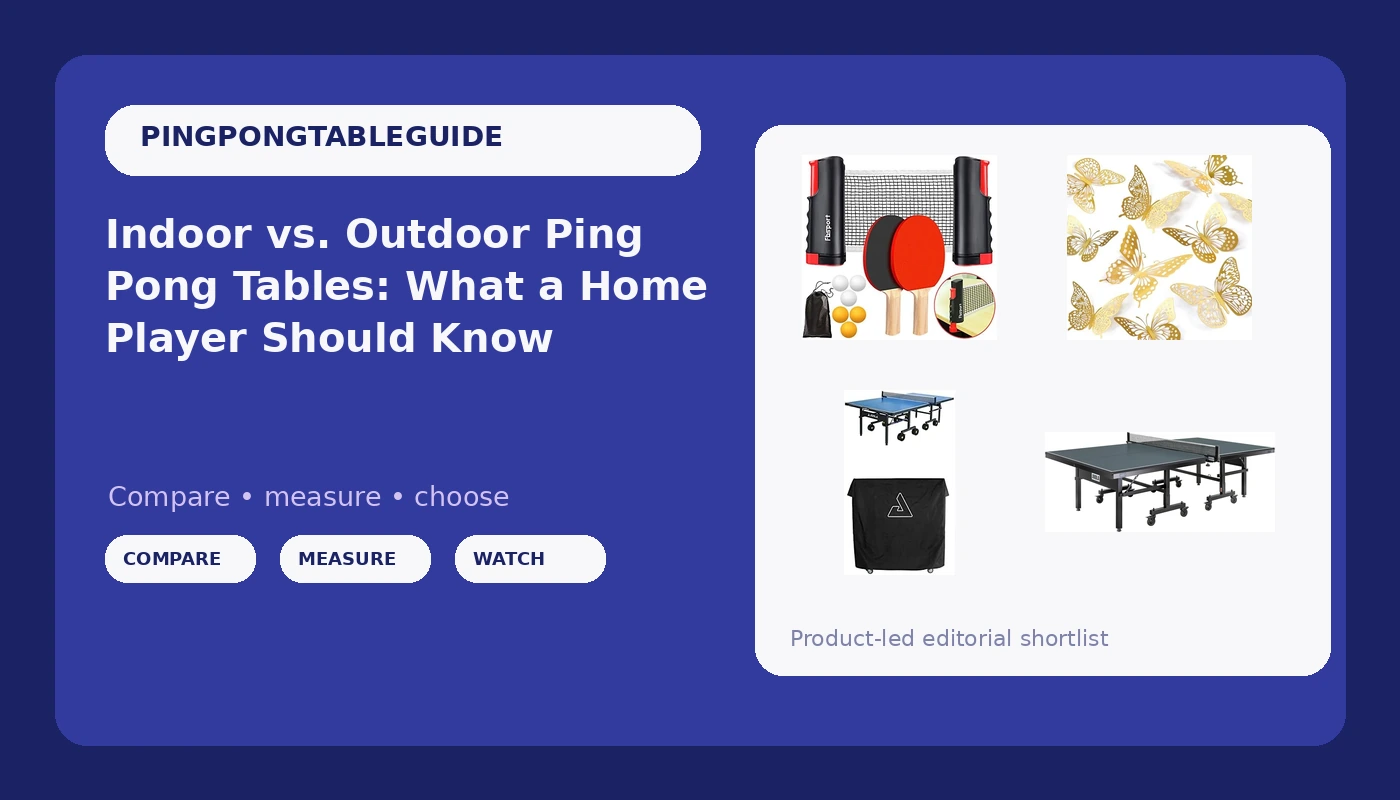
A home table tennis table is a piece of furniture that has to survive being folded, wheeled, and ignored for two months, then used four nights in a row. I run a community club in a converted warehouse in Milwaukee with six tables, and I have set up, leveled, and repaired more home tables than I want to count, including the cheap foldables that arrive warped and the used club tables that outlive their first owner. What I have learned is that indoor and outdoor ping pong tables are not two versions of the same product. They are different machines with different failure points, and the listing photos never show you any of them. This page explains how the two categories actually differ, what the specs tell you and what they hide, and how four specific options fit four different homes.
Related: Ping Pong Table Thickness and the Bounce Test That Actually Matters →
Quick answer
Start with the room, not the table. If the table lives indoors on a level floor and gets used several times a week, buy an indoor MDF table with a folding mechanism you can inspect and casters that lock; the JOOLA Inside is the one in this group built for that job. If the table has to tolerate weather, shade, and being folded away between sessions, a dual-purpose indoor/outdoor model like the JOOLA Nova Pro Plus, which ships with a waterproof cover, is the realistic compromise. If you do not own a table at all and want to play tonight, a portable paddle set with a retractable net turns any dining table into a court. If the purchase is for a party rather than practice, the SAOROPEB butterfly decor belongs in a different budget line entirely.
Four useful options
| Model | Best fit | What stands out |
|---|---|---|
| JOOLA Inside Professional MDF Indoor Ping Pong Table | Basements and garages where the table stays put | Indoor MDF build, quick-clamp net and post set, foldable with single player playback mode |
| JOOLA Nova Pro Plus Indoor/Outdoor Table Tennis Table + Cover | Patios, decks, and rooms that open to the outside | Dual indoor and outdoor use, bundled JOOLA waterproof cover described for outdoor protection |
| FBSPORT Ping Pong Paddle Set with Retractable Net | No table yet, or play away from home | Retractable net, rackets, balls, and a carry bag in one portable set |
| SAOROPEB 3D Butterfly Wall Decor, 48 Pieces | Dressing the room around the table | 48 gold three-dimensional butterfly pieces sold as party and birthday decoration |
The indoor practice table: JOOLA Inside Professional MDF Indoor Ping Pong Table
The phrase to slow down on is "tournament quality." That is a marketing phrase, not a specification, and I have seen it printed on tops I would not let a junior practice on. What the listing does tell you is useful: it is an indoor MDF table, it includes a quick-clamp net and post set, assembly is quoted at ten minutes, and it folds into a single player playback position. Those are the four things I would want in a basement table, because they map onto the four things that go wrong: a top that is not meant for humidity, a net that sags and cannot be tensioned, an assembly that takes an afternoon, and a table that cannot be used alone. If your floor is level and your room is dry, this is the category I would point a family toward. If the room is a damp garage that swings forty degrees between seasons, no indoor MDF table is the right answer, including this one.
The indoor/outdoor all-rounder: JOOLA Nova Pro Plus Indoor/Outdoor Table Tennis Table with Cover
I will be straight with you about my own boundary here. I do not review dedicated outdoor tables, because the material science is a different conversation from the indoor game I know: UV, freeze-thaw cycles, and aluminum versus treated wood frames all behave in ways that a warehouse club never tests. This model is the exception I will discuss, because it is explicitly sold as indoor and outdoor, and because the cover is part of the package rather than an afterthought. The honest framing is this: an indoor/outdoor table is a compromise that trades some of the indoor bounce feel for the ability to live outside, and the cover is what keeps that compromise from becoming a rusty folding mechanism by year two. If your table will sit under a covered porch and come inside for winter, the math works. If it will sit in full sun and standing rain all year, no cover makes a table immortal, and you should decide that before you spend.
The portable paddle kit: FBSPORT Ping Pong Paddle Set with Retractable Net
I do not review paddles, and I will not pretend otherwise: blade and rubber selection is a specialty, and the coaches I send players to know it far better than I do. What I can evaluate is the format. A retractable net set is the correct first purchase for two situations. The first is a household that has not decided whether table tennis will stick, because it costs a fraction of a table and answers the question in a week. The second is a family that travels, where a dining table at a rental or a picnic table at a campground is the only surface available. What it is not is a practice tool. A net stretched across a dining table sits at the wrong height and the wrong tension, the surface has no consistent bounce, and a junior who practices on it for a year will build habits that a real table exposes immediately. Use it for fun and for triage, not for training.
The room-dressing extra: SAOROPEB 3D Butterfly Wall Decor, 48 Pieces
This one is in the group because people who buy a table for a basement often buy it alongside a room refresh, and a club night or a birthday tournament is a real reason to decorate. Be clear about what it is: wall decor, not equipment. It does not affect play, it will not survive being hit by a ball at close range, and it belongs on a wall well behind the end line rather than beside the table. If you are setting up a junior tournament or a birthday party and want the room to look like an event, 48 pieces covers a decent stretch of wall. If you are shopping for a table, this is a separate line in the budget.
Prices and availability may change. Product images, names, and retailer links are matched to verified listings. No current price, rating, stock status, or measured result is stated here without current evidence.
Thickness, core, and the bounce test that actually tells you something
Every listing leads with thickness, and thickness is the number I trust least on its own. A thick top built around a hollow core can bounce worse than a thinner top with a solid core, because what the ball is responding to is the mass and density directly beneath the contact point, not the depth of the edge you can see. This is why two tables with the same millimeter figure can feel completely different, and why the phrase "tournament grade" attached to a thin top is one of my least favorite things in this market. As a general rule, the 18 to 19mm range is what club play is built around, and 12 to 15mm can be perfectly acceptable in a garage if the core is solid and the top is flat.
The test that settles it takes a ball and two minutes. Drop a ball from about 30cm onto nine points across the surface: four corners, four mid-edges, and the center. Watch the height and listen to the sound. A table that is flat and consistently built will return the ball to roughly the same height at all nine points, and the sound will be dull and even. A warped top, an uneven frame, or a hollow spot announces itself as a higher or deader bounce in one corner and a hollow, ringing tone. That inconsistency is what ruins practice, because your hand calibrates to a surface that is lying to you. Do this test before you buy if the seller will let you, and immediately after assembly if they will not, while the return window is still open.
Where folding tables fail
The folding mechanism is where home tables die, and I have repaired enough of them to know the failure order. First the hinge plates loosen, so the two halves no longer meet flush and a ridge appears at the center line. Then the locking latch wears, and the table starts to drop when someone leans on the far half. Then the casters, which are almost always the cheapest component on the table, stop rolling straight and start dragging, which twists the frame every time it moves. Every one of those failures is inspectable before you buy.
What to check: the hinge plates should be steel and through-bolted rather than screwed into particle board; the latch should require a deliberate two-part motion so a child cannot collapse it; and the casters should lock, all four of them, with a pedal or lever you can reach with a foot. Storage wheels that do not lock are how a folded table rolls into a car door, and I have seen exactly that. Ask also where the folded table will stand, because a folded table leaned against a damp garage wall is how a straight top becomes a warped one.
The five-step check before you pay
- Measure the room and the doorway, then measure the folded footprint, because a table that fits the room but not the stairwell is a table you own and cannot use.
- Decide honestly whether the table stays indoors or has to survive weather, and buy for the harder condition rather than the one you hope for.
- Put your hand on the folding hardware in the store or watch the assembly video closely, checking hinge plates, latches, and caster locks.
- Confirm what is actually in the box: net and posts, cover, paddles, and balls are frequently sold separately, and the bundle is usually cheaper than the pieces.
- Plan the storage spot and the floor level first, because garage floors slope toward the door and a table that rocks will be leveled with folded cardboard by month two unless you buy proper shims.
Setting up a home table without wrecking it
- Level the table before you play a single point, and re-check it a week later after the frame settles.
- Keep roughly five feet of clear space behind each end line, and more on the sides where players chase wide balls.
- Never store a folded table leaning against a wall in a damp or unheated space; store it flat or upright on its own casters.
- Put the waterproof cover on a dry table only, since trapping moisture under a cover is worse than leaving the table exposed to air.
- Budget for consumables: balls, a spare net, and a cover cost far less than replacing a table that was stored badly.
- If juniors practice at home, bounce consistency matters more than table size, and a flat 15mm top beats a warped 19mm one every time.
Which option should you choose?
Choose the JOOLA Inside Professional MDF Indoor Ping Pong Table when the table lives in a dry basement or spare room on a level floor and will be used often enough that a real playing surface is the point. Choose the JOOLA Nova Pro Plus Indoor/Outdoor Table Tennis Table + JOOLA Waterproof Ping Pong Table Cover when the table has to spend part of the year outside, or when you want the cover bundled instead of remembering to buy it. Choose the FBSPORT Ping Pong Paddle Set with Retractable Net when you have no table yet, want to test whether the household will stick with the game, or need something that travels. Choose the SAOROPEB 3D Butterfly Wall Decor when the room is hosting a party or a junior event and the walls need to look the part.
One caveat, stated plainly: I am describing what these listings claim and how the categories behave, not results from a lab bench. I have not measured these four products, and I am not going to invent a number. The indoor table's "tournament quality" line is a marketing phrase until you verify thickness and core construction yourself, and my own rule about outdoor tables still stands, which is why I kept the discussion of the dual-purpose model to its stated materials and bundled cover rather than claiming a season of weather testing.
The bottom line
The table is a small part of your game and a large part of your headaches, and the headaches come from buying the wrong category rather than the wrong brand. Indoor MDF for a dry room, an indoor/outdoor model with a cover for anything that sees weather, a portable net set for households that have not committed yet, and wall decor when the occasion is a party rather than practice. Match the product to the room, run the nine-point bounce test as soon as it is assembled, and check the folding hardware while the return window is still open. Do those three things and the table you buy will still be straight in five years, which is more than I can say for most of the ones I get called about.