Related: Best Ping Pong Table for a Garage: Bounce, Warp, and Locking Casters
I run a table tennis club in a converted warehouse in Milwaukee. Six tables, junior coaching on Tuesdays, league night on Thursdays, and a repair bench in the corner that sees more traffic than either. I have set up, leveled, shimmed, and buried more tables than I can count, and I have fixed around forty folding mechanisms in the process.
So when someone asks me which indoor ping pong tables are worth buying for a basement, I don't start with the brand. I start with the floor. A table that rocks on an uneven garage slab teaches worse habits than a cheap paddle ever will, and a fold that doesn't lock will eventually land on somebody's foot.
The table is 10% of your game and 90% of your headaches. That's the whole review philosophy, and it's why I judge every table the same way: bounce consistency first, frame squareness second, and the folding mechanism third, because that's where tables die.
What follows is three indoor tables and one paddle set, arranged by the room they actually belong in. I'm not printing prices here because they move constantly, so check the current Amazon price on each one. What I can hand you is the inspection list I use on my own floor.
The Room Decides: Foldable Multi Size Indoor Table
This one solves a problem the others can't. It's sold as a foldable indoor table in 6, 8, 8.5, and 9 foot playing lengths, which means you choose the size that fits the room instead of clearing out the room to fit the table.
That's a real feature, and it comes with a real warning. A 6 foot surface is a training aid. The ball arrives sooner, rallies shorten, and you learn to play in a space that doesn't exist in a real match. If your kids are going to play games that count, buy the 9 foot and move the exercise bike.
The fold is what I'd inspect first. Set it up, fold it once, unfold it, and put a carpenter's square on the frame corners. If the two halves don't meet flush, the ball will lie to you on every bounce down the middle. Then check the locks. Most of the mechanisms I've repaired failed because the lock was plastic and the owner was in a hurry.
If this table has wheels, they need to lock. Locking casters are non-negotiable in my book. I've watched a table roll into a car door, and I've watched a kid try to stop it.
For what this class of table asks, you get a functional indoor surface and a frame that holds if you level it properly. For a basement, that's a fair trade.
The Space Saver: Butterfly Junior 3/4 Size
The Butterfly Junior is the table I recommend to parents first, and not because of the badge. It's a 3/4 size table at regulation height, and it ships assembled with the net already on. That last part is worth more than it sounds, because I have spent entire evenings on assembly instructions that were translated badly.
Regulation height is the detail that matters most to me. A junior practicing at home on a coffee-table-height toy learns to swing up at the ball. Fix that habit at twelve and you'll still be fixing it at twenty. A 3/4 surface at the correct height lets a kid practice a real stroke in a room where a full table would never fit.
What you give up is the long game. The shorter surface changes the rhythm, and a strong junior will outgrow it. If your game room is 12 by 14 feet, that's the trade you make, and it's the right one. If you have the space, a full 9 foot table serves longer.
Check the frame before you commit. Sturdy is a word on a listing, but square is something you can measure. Fold it, unfold it, square the corners, and drop a ball at the four corners and the center. It should come back to your hand at the same height everywhere.
The Middle That Most Families Buy: JOOLA Inside
The JOOLA Inside is a full size MDF indoor table with a quick clamp net and post set, a 10 minute assembly claim, and single player playback mode. It folds. It's the table most people end up with, and for a family that wants to play actual games in a basement, it's a sensible place to land.
Two things I like. The quick clamp net means you're not threading a tension cord through a sleeve every time you set up. The playback mode, where one half stands vertically, is the feature I use most when I'm coaching alone and feeding balls to a junior.
One thing I'd push back on. JOOLA is a tournament brand and you pay for the name. The mid-tier brands build a comparable indoor table for less. The honest reasons to buy this one are convenience and resale value, not magic.
Tournament quality is the phrase I'd ignore. A tournament table is defined by bounce consistency, a frame that stays square, and an apron that doesn't flex when you lean on it. None of that is decided by the word on the box. Set it up, level it, run the drop test, and let the table tell you what it is.
Assembly: ten minutes is the claim. Give yourself an hour, a second person, and a level. Do it once, do it right.
Something to Hit With: STIGA Paddles
Paddles are not my department. I send paddle questions to people who obsess over rubber the way I obsess over aprons, and I won't pretend otherwise. But a table arrives with nothing to hit with, and this STIGA set is the one that shows up in the same breath as these tables.
The listing describes 2mm tournament approved sponge, which is the thickness most club players use, and a flared handle, which widens toward the bottom and suits most adult hands. It's sold in multiple styles and performance levels, and that's the part to read carefully. The recreational version and the competitive version are different paddles under one listing. Match the level to the player, and don't hand a beginner the fastest rubber in the set.
If you're buying a table for a family, buy four paddles, not two. Half the reason a table sits folded in the corner is that two people have to take turns while everyone else watches. Four paddles and a tube of balls is the difference between owning a table and owning a game.
How I test a table before I trust it
Every table that comes through my club gets the same treatment, and you can run these checks on a table you just unboxed.
The bounce test: drop a ball from 30cm at nine points, the four corners, the four mid-edges, and the center. It should come back to roughly the same height everywhere. A dead spot near a corner usually means a hollow core or a frame that isn't sitting flat. Do this before you throw the box away.
Frame squareness: a carpenter's square on the corners, and a level along the apron, the skirt that runs under the playing surface. If the apron flexes when you press on it, the table will sag in the middle within a year.
The level check: garage floors slope toward the door. That's drainage, not a defect. Use the leg levelers, shim if you have to, and re-check after a month, because a table settles.
The fold check: fold and unfold it ten times in a row. If the lock sticks, pinches, or forces you to lift the table to separate the halves, that's the failure you'll be living with.
The wheel check: push it. If it moves, it needs a brake. Locking casters, every time.
The indoor tables at a glance
| Table | Playing size | Where it belongs | First thing to check | Price |
|---|---|---|---|---|
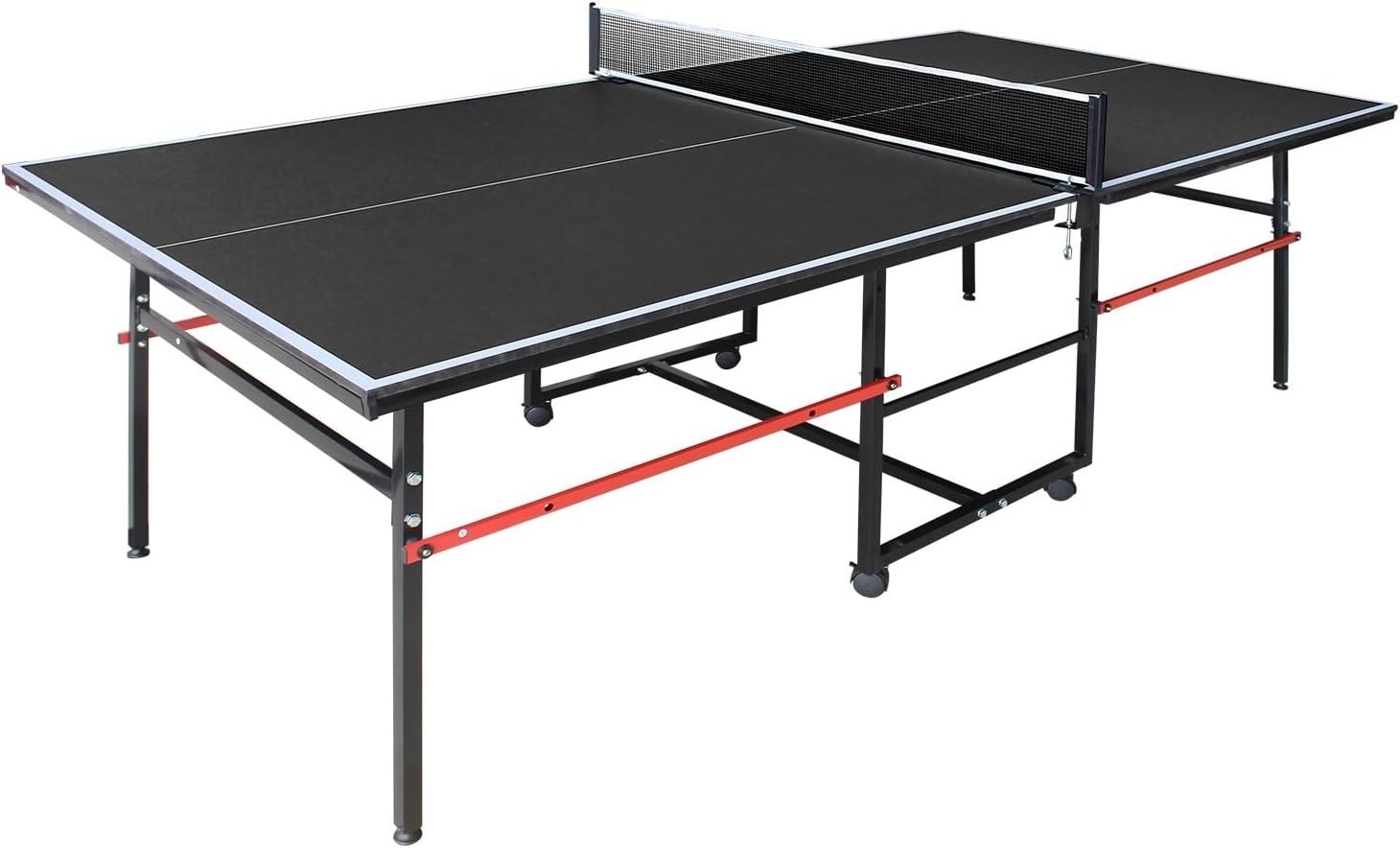 Visit on Amazon → Foldable multi size indoor table |
6, 8, 8.5, or 9 ft | Basements and garages where space changes | Whether the halves meet flush and whether the wheels lock | $199.49 |
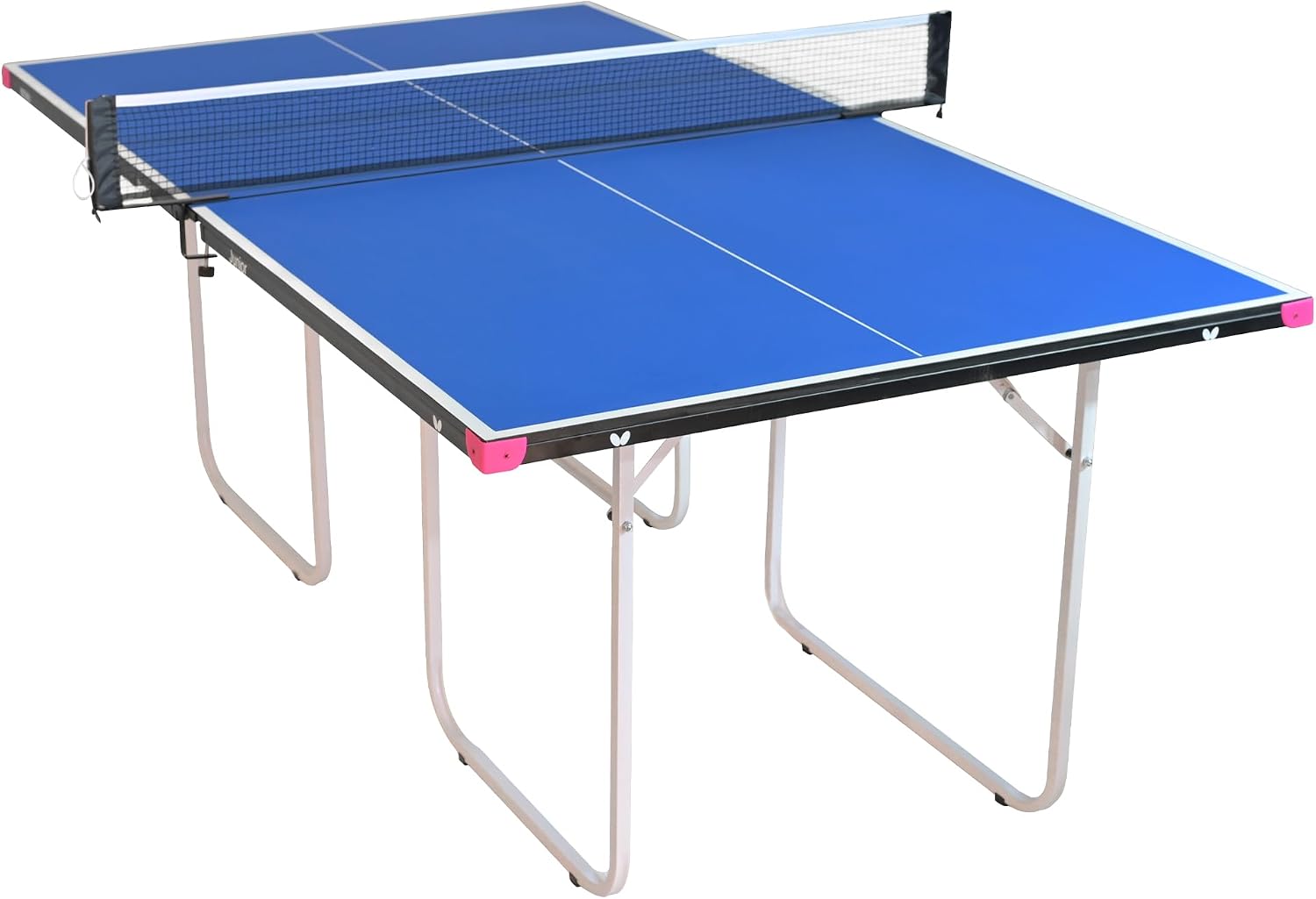 Visit on Amazon → Butterfly Junior |
3/4 size at regulation height | Small game rooms and junior practice | Whether the frame stays square after folding it twice | $549.49 |
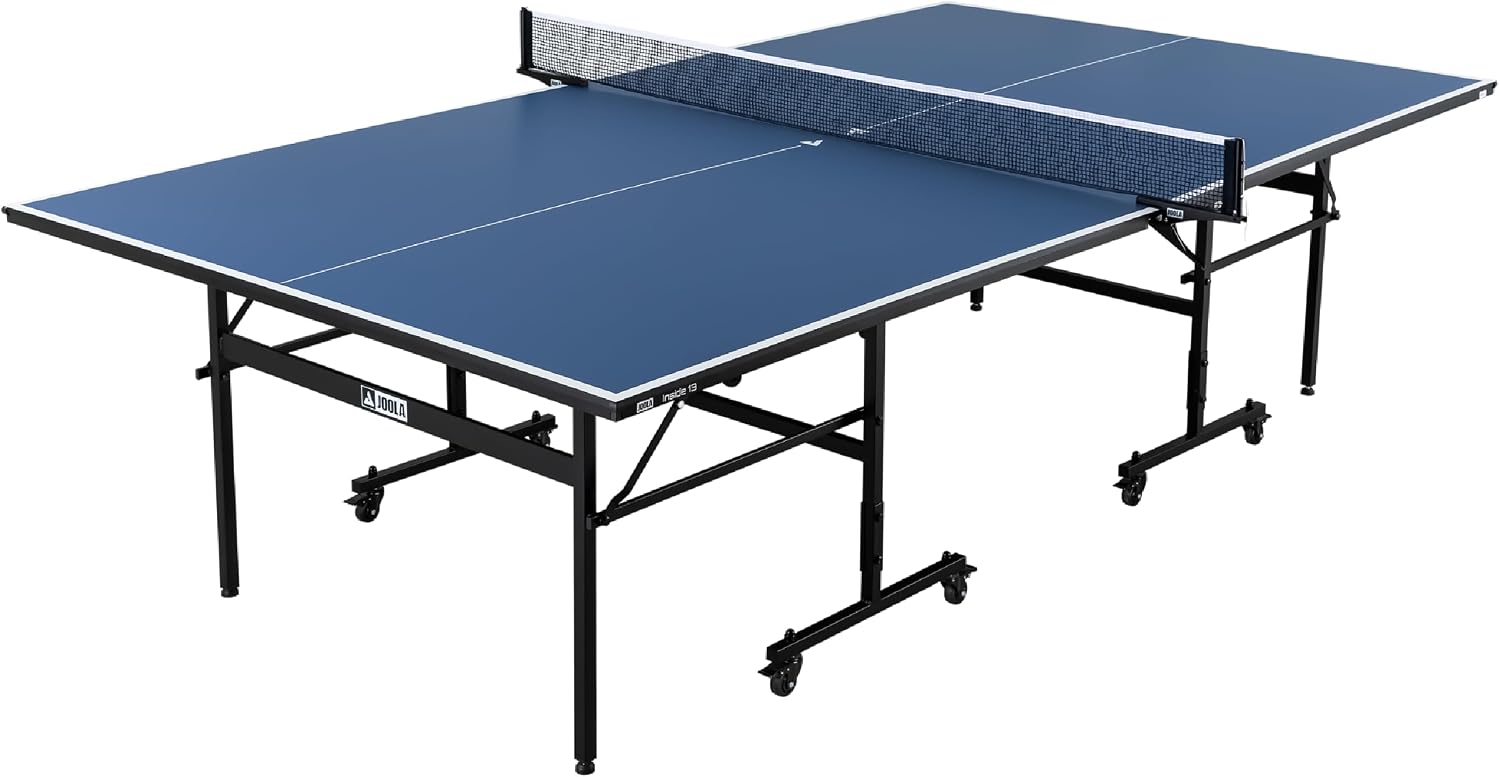 Visit on Amazon → JOOLA Inside |
Full size MDF, folds with playback | Home clubs and families playing real games | Apron rigidity and leg levelers | $329.95 |
 Visit on Amazon → STIGA paddles |
2mm sponge, flared handle | Any of the tables above | Which style and performance level you are actually ordering | $59.99 |
The table only tells the truth when it's level and square. Everything else on this page is a starting point, and the drop test is the referee.
Analysis and test results
Thickness is not quality. A thick table with a hollow core bounces worse than a thin one with a solid core, and I've proven that on my own bench more than once. 18 to 19mm is the club standard for a reason: it holds a consistent bounce under six hours of daily play. 12 to 15mm is fine for a garage if the core is solid and the frame is braced, and most home players will never notice the difference in a casual game.
What kills a home table is not thickness. It's warp. A table that lives against a damp basement wall, gets folded away wet, or sits under a leaking garage roof will twist, and once the surface twists, no amount of leveling saves it. Store it dry, and store it flat if you have the floor space.
Paint peeling where balls land is the other tell. If the finish lifts along the bounce line after a few months, the surface wasn't sealed properly, and you'll feel it in the bounce long before you see it.
And the word professional on a listing is not a spec. It's a category label. The specs are surface material, frame squareness, apron rigidity, fold locks, and wheel brakes. Everything else is packaging.
The middle of the market is where honest tables live. Below it, you're buying a pool table with a ping-pong skin. Above it, you're paying for a badge your basement will never notice.
Should you buy the foldable multi size table?
If your room is tight and unpredictable, yes. Buy the 9 foot if you want real games, and treat the 6 foot as a training surface. Level it on arrival, check the fold locks monthly, and keep it dry. It won't be the table your grandkids fight over, but it will be the one you actually use, and that counts for more than the spec sheet.
Should you buy the Butterfly Junior?
For a parent with a small game room and a kid who is learning, yes. Regulation height, ships assembled, 3/4 surface that fits where a full table won't. The quick clamp net and playback mode on the full size tables are nice, but a junior doesn't need them yet. Buy this one knowing the kid will outgrow it, then hand it down to the next beginner in the family.
Should you buy the JOOLA Inside?
Yes, with an eye on the price. The quick clamp net and the playback mode are the two features you'll use weekly, and the brand holds its value if you sell later. Just don't pay extra for the word tournament on the box, and don't skip the drop test because the packaging sounded confident.
Whatever you buy, budget for four paddles and a tube of balls, and measure your room twice before you order. The table you can set up and level in an afternoon gets played. The one that lives folded in the corner does not.